Dehumidifier Size Calculator
Estimate the pint-per-day capacity you need from room area, ceiling height, current humidity, leakage, and extra moisture sources like laundry, seepage, and crawlspace exposure.
📌Quick presets
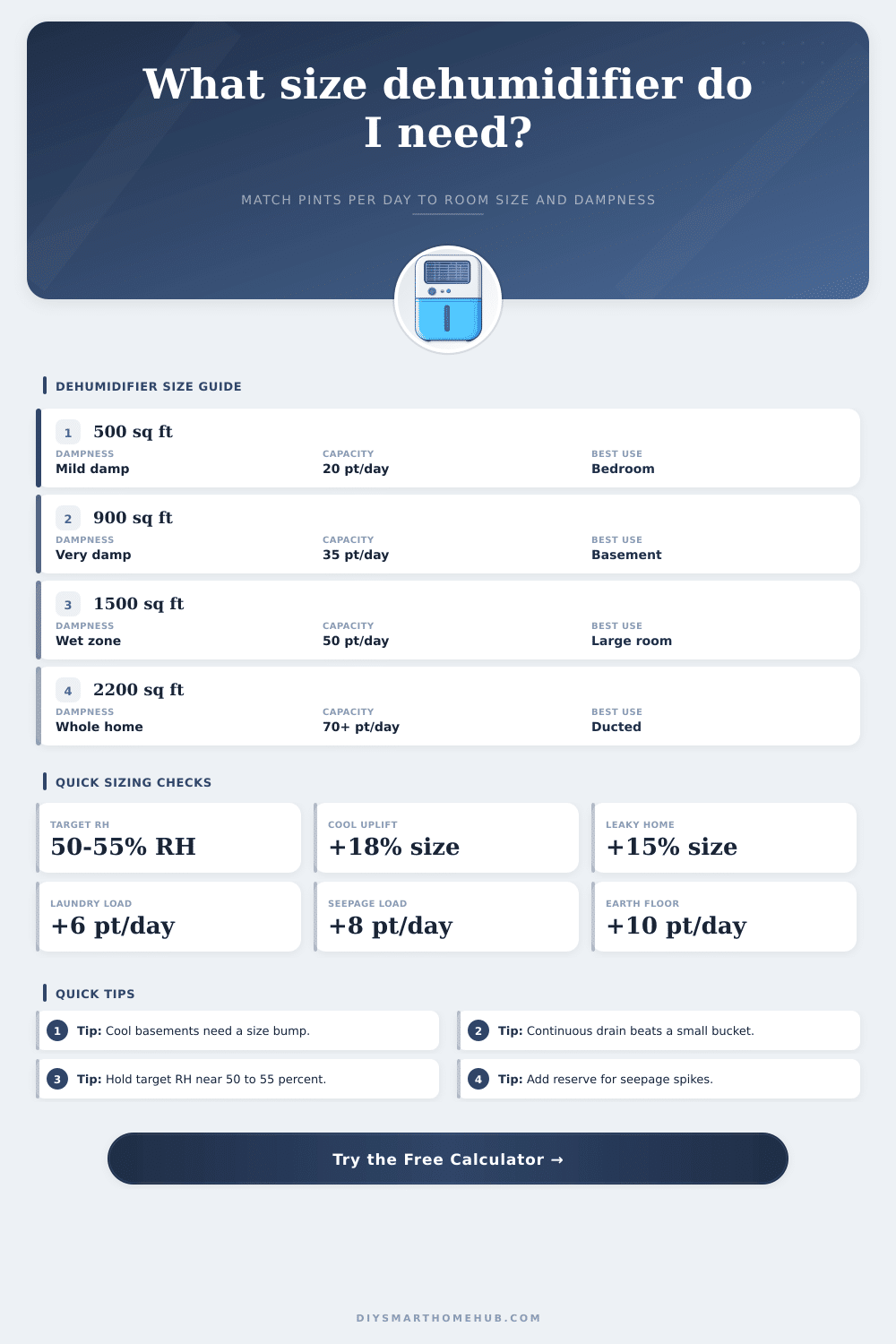
Sizing starts from ENERGY STAR room-capacity bands, then adjusts for humidity gap, cool-room performance, leakage, moisture sources, and reserve margin.
📏Calculator inputs
💡Sizing logic
Portable dehumidifier capacities are compared on DOE test ratings in pints per 24 hours. Cool spaces, seepage, and leaky envelopes all push the installed size higher.
📊Capacity class reference
📋Coverage and efficiency table
| Class | Liters/day | Min IEF | Est watts | Best fit | Drain note |
|---|
📘Dampness comparison
| Condition | Typical RH | Base band | Added sizing | Common spaces |
|---|
🏠Common project sizes
| Scenario | Area | RH gap | Recommended | Equipment match |
|---|
🛠Practical sizing tips
If your result lands above 35 to 50 pt/day, the water bucket fills quickly. A hose to a floor drain or condensate pump turns the recommendation into something practical.
A larger dehumidifier can hold RH near target, but seepage, open sumps, vented crawlspaces, and unsealed earth floors still deserve envelope fixes so runtime and energy stay reasonable.
A dehumidifier are a machine that remove moisture from the air. Many person use a dehumidifier to prevent dampness in there basement or crawlspace. A dehumidifier works by pulling air over cold coils, causing the moisture in the air to condense on the coils so that the machine can collect the moisture.
Because a dehumidifier removes moisture from the air, it prevents mold from growing in that room. When you purchase a dehumidifier, you must consider the capacity of the machine. The capacity are measured in pints of water per day that the machine can remove from the air.
How to Choose a Dehumidifier
However, tests performed in a laboratory at 80 degrees Fahrenheit with 60% humidity determine the capacity of the machine. If you live in a basement that is cooler than 65 degrees Fahrenheit, the dehumidifier will not be able to perform at the same rate as when it was measured. Warm air hold more water vapor than cool air.
For instance, a dehumidifier that has a capacity of 30 pints per day will not remove 30 pints of water per day in a basement that is cooler than 65 degrees Fahrenheit. Therefore, if you live in a cool basement, you will need to purchase a dehumidifier that has a higher capacity. The type of room where you will use the dehumidifier will impact the capacity that you need to purchase for the dehumidifier.
For instance, a bedroom will typically be drier than a basement. This is because the basement are surrounded by concrete and soil that retain moisture. Additionally, a laundry room may have more moisture in it than other room in the house because of the amount of steam that the dryers in the laundry room release.
Bathrooms may also have more moisture in them than other areas of the house due to the steam that is released from the showers. Another factor to consider is the height of the ceiling in the room. A room with a higher ceiling will have more air in the room.
Because air can hold more moisture, the room with higher ceilings will require a dehumidifier with a larger capacity. Additionally, you should consider any air leaks in the room. For instance, if the windows in a room are leaky or there are doors that are not seal in the room, humid air from outside may enter the room.
If there is an influx of humid air into the room, the dehumidifier will have to work harder to remove the moisture. In these cases, you may need to purchase a dehumidifier that is 15% larger than what you would normaly need. Finally, you should consider any extra sources of moisture in the room.
For instance, if there will be laundry in the room, the laundry will add moisture to the air. The same is true for water that seep into a wall through cracks. If these factors are ignored when purchasing a dehumidifier for a room, the machine may become too small for the needs of the room.
Common mistake when purchasing a dehumidifier is to either purchase a dehumidifier that is too large or to purchase one that is too small. If the dehumidifier that is purchased is too large for the area to be used, the machine will frequently cycle between running and idling. This can cause the coils of the dehumidifier to frost over and cause the machine to use more electricity than it should of.
Conversely, if the dehumidifier is too small for the area to be used, the machine will run continuously but will not reach the humidity level that are desired in the area. Aim to keep the humidity levels between 50 and 55%. This level is low enough to prevent mold from growing, but not too low to make the air uncomfortable to breathe.
To ensure that your dehumidifier works correctly in your specified area, you should place the machine in the correct location in the room. First, place the dehumidifier away from the walls. This will allow the machine to pull in the air that it needs to extract the moisture from the air.
Secondly, address any sources of moisture in the area. For example, if the room has cracks in the walls, seal them. Dehumidifiers only remove moisture from the air.
They do not prevent moisture from entering the room. Finally, if you are using a dehumidifier that removes more than 35 pints of water per day, you should purchase a hose that will allow that water to drain out of the machine and into a floor drain. Otherwise, you would be required to empty a bucket of water each day that the dehumidifier is running.