18650 Battery Capacity Calculator
Estimate 18650 pack watt-hours, amp-hours, series and parallel groups, runtime, BMS current, cell count, and bare cell weight from practical smart home loads.
📌Real 18650 Pack Presets
⚙18650 Pack Inputs
Calculation Breakdown With Formulas
🔋Selected 18650 Spec Grid
🧭18650 Design Notes
Energy cells
High-capacity cells near 3.4 to 3.5 Ah give longer runtime for routers, hubs, sensors, and low-current standby packs.
Power cells
Lower capacity cells with higher amp ratings fit tool packs, lock actuators, motor loads, and packs with larger peak currents.
Parallel groups
Parallel count is driven by both watt-hours and current. The calculator uses whichever requirement needs more cells.
📊18650 Reference Tables
| 18650 cell class | Typical capacity | Nominal voltage | Full voltage | Typical continuous amps | Best calculator use |
|---|---|---|---|---|---|
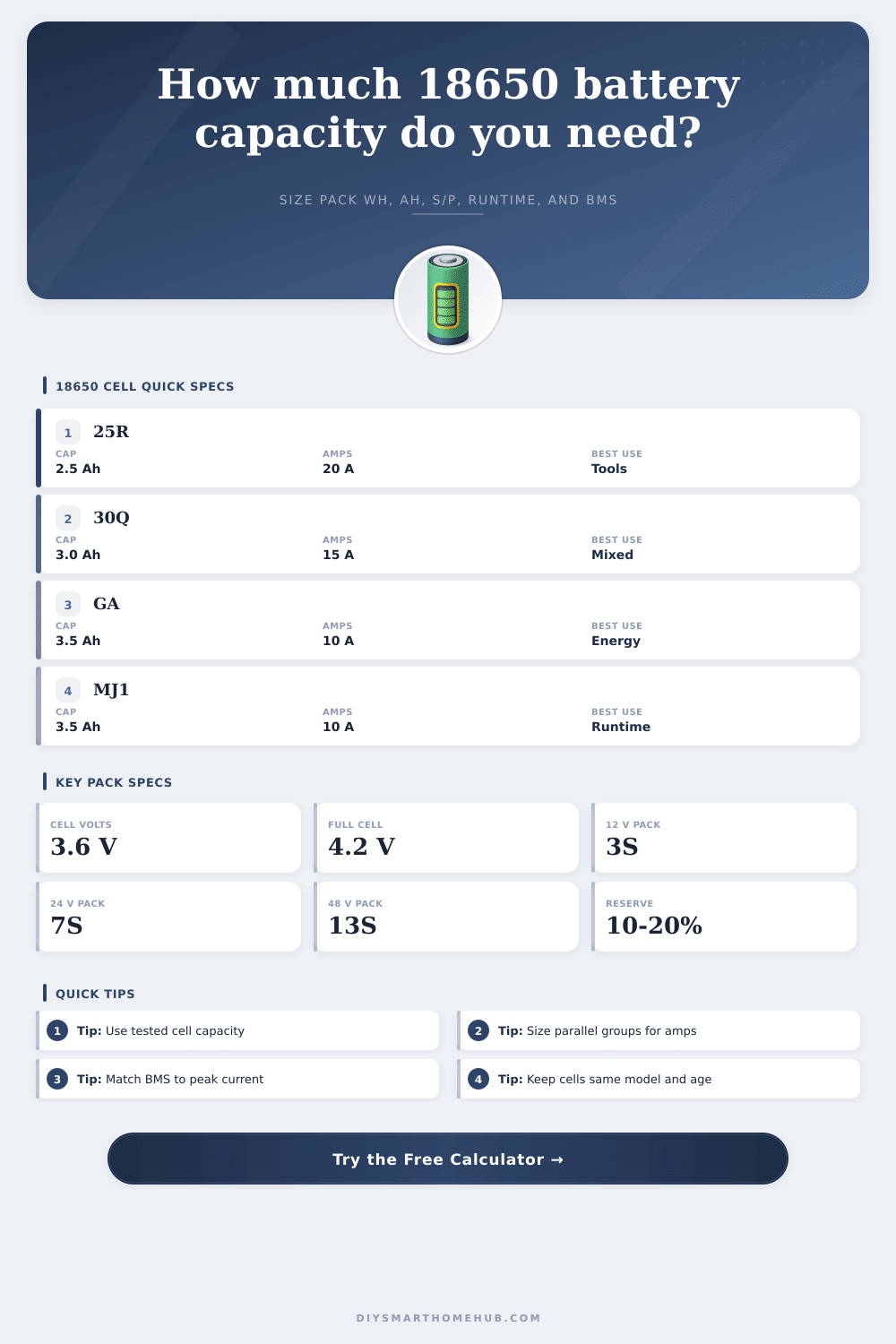
| Samsung 25R style power cell | 2.5 Ah | 3.6 V | 4.20 V | 20 A | High-current compact packs |
| Samsung 30Q style mixed cell | 3.0 Ah | 3.6 V | 4.20 V | 15 A | Balanced runtime and current |
| Sony VTC6 style mixed cell | 3.0 Ah | 3.6 V | 4.20 V | 15 A | Compact high-output devices |
| Sanyo NCR18650GA style energy cell | 3.5 Ah | 3.6 V | 4.20 V | 10 A | Long-runtime electronics |
| LG MJ1 style energy cell | 3.5 Ah | 3.6 V | 4.20 V | 10 A | Backup packs and low loads |
| Panasonic NCR18650B style cell | 3.35 Ah | 3.6 V | 4.20 V | 6.7 A | Low-current energy storage |
| Molicel P28A style power cell | 2.8 Ah | 3.6 V | 4.20 V | 35 A | Very high current packs |
| Tested reclaimed 18650 cell | 2.2 Ah | 3.6 V | 4.20 V | 5 A | Only after capacity testing |
| Pack class | Series count | Nominal voltage | Full charge voltage | Common smart home role |
|---|---|---|---|---|
| 1S boost pack | 1S | 3.6 V | 4.2 V | USB sensor bridge or microcontroller pack |
| 2S DC pack | 2S | 7.2 V | 8.4 V | Small locks, relays, and field nodes |
| 12 V-class lithium | 3S | 10.8 V | 12.6 V | Router, ONT, modem, and alarm backup |
| Camera field pack | 4S | 14.4 V | 16.8 V | PoE bridge, camera, and NVR accessories |
| 24 V-class lithium | 7S | 25.2 V | 29.4 V | Lighting zone and small inverter bus |
| 36 V-class lithium | 10S | 36.0 V | 42.0 V | Portable station and higher-power DC loads |
| 48 V-class lithium | 13S | 46.8 V | 54.6 V | Network rack and rack-mount DC systems |
| Smart home load | Typical watts | 12 hour energy | 24 hour energy | Common 18650 direction |
|---|---|---|---|---|
| WiFi router plus modem | 15 to 30 W | 180 to 360 Wh | 360 to 720 Wh | 3S4P to 3S8P with energy cells |
| Alarm panel and LTE module | 5 to 15 W | 60 to 180 Wh | 120 to 360 Wh | 3S2P to 3S6P with low-current cells |
| Home Assistant mini PC | 20 to 45 W | 240 to 540 Wh | 480 to 1080 Wh | 3S8P or 4S8P depending on converter |
| PoE camera bridge | 25 to 70 W | 300 to 840 Wh | 600 to 1680 Wh | 4S to 7S with current headroom |
| Smart lighting zone | 60 to 180 W | 720 to 2160 Wh | 1440 to 4320 Wh | 7S or higher to reduce pack current |
| Network rack with NVR | 150 to 350 W | 1800 to 4200 Wh | 3600 to 8400 Wh | 13S high parallel count or larger cells |
| Example pack | Layout | Cell capacity | Nominal pack Ah | Nominal energy | Planning note |
|---|---|---|---|---|---|
| Small alarm cabinet | 3S2P | 3.0 Ah | 6 Ah | 65 Wh | Good for low standby loads only |
| Router shelf backup | 3S4P | 3.0 Ah | 12 Ah | 130 Wh | Works for short outages and efficient routers |
| Camera bridge pack | 4S6P | 3.0 Ah | 18 Ah | 259 Wh | Higher voltage helps DC conversion |
| Mini PC backup | 3S10P | 3.5 Ah | 35 Ah | 378 Wh | Energy cells suit moderate steady loads |
| 24 V lighting zone | 7S8P | 3.0 Ah | 24 Ah | 605 Wh | Check LED driver voltage range |
| 48 V network rack | 13S12P | 3.0 Ah | 36 Ah | 1685 Wh | Requires 13S charger and BMS |
✅18650 Capacity Tips
When you build a battery pack using 18650 cells, you have to consider that the total capacity of that battery is not going to be the same than the total capacity of the individual cells. Many people use calculations to calculate the total capacity of a battery pack by simply multiplying the capacity of each individual 18650 cell by the total number of cells. However, this calculation is often incorrect because the cells dont deliver all of the energy that they are capable of delivering.
Instead, the total capacity of the battery will be less than calculated due to efficiency losses, decay of the cells over time, and the limit of the cells discharge rates. Battery packs has to be built to meet three needs of the battery pack: the runtime of the device that uses the battery, the peak current that the load of the device draws, and the space in which the battery pack will fit. Cells that contain high amount of energy often cannot provide the high amount of current that a motor requires, for example.
What to check when building an 18650 battery pack
Conversely, cells that can provide high peaks of current can often contain less total energy then the cells that provide energy at more steady rates. Thus, individuals has to decide which of these three feature are the most important to the battery pack that they are building. The nominal voltage of the battery pack will determine the number of cells that are used in series to create that battery pack.
For example, if a 12 volt router is to be powered, a 3S battery pack can be used. However, the voltage of the battery will range from 12.6 volts when the battery is fully charged to 9 volts when the battery is depleted. If the router is sensitive to these voltage drop, a 4S battery pack and an voltage regulator would be utilized to ensure proper operation of the device.
The voltage requirements of the device will help to determine the number of cells that is required for the battery pack. Beyond the voltage of the battery pack, it is also important to understand the difference between the theoretical and the usable capacity of those cells. The theoretical capacity of a lithium cell is energy that can be used, but the device that utilizes the battery pack should not use 100% of that energy.
Over time, using 100% of the energy of the cells can degrade the cells and limit their life span. Thus, if an individual desires to use 80% of the cells capacity, the battery pack must be built to 20% larger than calculated to allow for these cells to be depleted to only 80% of their calculated capacity. If the pack is built to the calculated amount of required wattage, the battery will fail before the calculations indicates that it should.
The energy that passes through buck and inverter converters into the devices that are to be powered is often lost as heat. Thus, a portion of the energy that was stored within the battery has dissipated into the surrounding environment. You can account for these losses when building the battery pack; however, other issues, like the aging of the cells or the use of the batteries in cold weather, can also reduce the capacity of the batteries to deliver the amount of energy that is required of the batteries.
Therefore, the gross capacity of the battery must be larger than the calculations made for the devices energy requirement. The batteries that are commonly used in these types of battery packs are either energy cells or power cells. Energy cells are used in applications that require low and steady rates of energy, such as network bridges.
Power cells are used in applications that require high rates of current, such as power tools. To calculate the number of cells that will be used in the battery pack, the individual must ensure that there is enough cells in parallel to meet the energy requirements of the device and enough in parallel to meet the current requirements of the device. A Battery Management System (BMS) is required for battery packs that contain more than two cells.
The BMS is responsible for the protection of the cells and the safety of the battery pack. You must size the BMS according to the peak current of the load that the battery pack is to supply. For instance, if the load, such as an NVR, requires the BMS to supply a peak amount of current to the hard drives when they are spinning up, if the BMS is sized according to the average load current, the BMS may shut off the system.
Thus, the BMS must be sized appropriately to allow for headroom in case of these high currents, or the system may shut off. Finally, the weight of the battery pack has to be considered. Battery packs that contain a high number of cells, such as 13S12P batteries, have a high mass.
You have to know the mass of each of the cells prior to building the battery pack; otherwise, the battery pack may fail due to insufficient strength of the case that contains the battery pack. If the battery pack is too heavy for the case, the case may flex or crack due to the weight. Thus, it is important to consider these factors prior to building the battery pack.
By considering each of these factors, an individual can build a battery pack that will function as a reliabel infrastructure.