12V Battery Capacity Calculator
Estimate the 12V battery capacity, battery count, protected runtime, and DC current needed for routers, cameras, alarm panels, CPAP machines, pumps, and small backup loads.
①Choose a real 12V backup scenario
②Enter the load and battery assumptions
③12V capacity results
④12V battery type spec grid
⑤Battery chemistry planning assumptions
| 12V battery type | Nominal voltage | Planning DoD | Typical use in this calculator |
|---|---|---|---|
| LiFePO4 4S pack | 12.8V | 80-85% | High cycle smart home backup, DC loads, inverter loads with BMS limits checked |
| AGM lead acid | 12.0V | 50% | Standby loads, UPS-style backup, alarm cabinets, moderate discharge rates |
| Flooded lead acid | 12.0V | 50% | Ventilated utility spaces where regular inspection is already part of the system |
| Gel lead acid | 12.0V | 45% | Low-current standby systems that avoid aggressive charge and discharge rates |
| Small sealed SLA | 12.0V | 35% | Compact electronics backup where high-rate discharge reduces available Ah |
| Lead carbon | 12.0V | 60% | Partial-state backup systems with more usable depth than conventional lead acid |
| NiMH 10-cell pack | 12.0V | 70% | Specialized low-voltage packs where the battery maker gives a usable Ah rating |
⑥Common 12V smart home loads
| Load group | Typical watts | Example runtime | Useful capacity note |
|---|---|---|---|
| Fiber ONT plus WiFi router | 18-35W | 8-24 hours | A 12V DC path often avoids inverter losses for network gear. |
| Alarm panel with LTE communicator | 6-18W | 24-48 hours | Small SLA batteries lose usable capacity quickly under age and cold derating. |
| NVR with four PoE cameras | 45-90W | 6-12 hours | Camera infrared mode can raise the overnight average load. |
| Smart hub cabinet and modem shelf | 35-80W | 8-16 hours | Measure the whole power strip when several adapters share one backup bank. |
| CPAP without humidifier heat | 30-60W | 7-10 hours | Humidifier heat can more than double the watt-hour requirement. |
| Small compressor refrigerator | 60-140W avg | 8-18 hours | Use average watts over a full cooling cycle, not only compressor running watts. |
| Sump pump backup window | 250-700W avg | 1-4 hours | Inrush current and inverter surge rating matter as much as steady Ah. |
| Low-voltage LED outage lighting | 15-60W | 8-24 hours | Direct 12V lighting can keep current predictable and avoid idle inverter draw. |
⑦12V battery count examples
| Project size | Load and runtime | LiFePO4 85% DoD | AGM 50% DoD |
|---|---|---|---|
| Network shelf | 30W for 12h | About 39Ah before battery rounding | About 72Ah before battery rounding |
| Security cabinet | 60W for 8h | About 52Ah before battery rounding | About 96Ah before battery rounding |
| Camera rack | 90W for 10h | About 96Ah before battery rounding | About 180Ah before battery rounding |
| CPAP night | 45W for 8h | About 38Ah before battery rounding | About 72Ah before battery rounding |
| Small refrigerator | 100W for 12h | About 127Ah before battery rounding | About 240Ah before battery rounding |
| Pump backup | 500W for 2h | About 106Ah before battery rounding | About 200Ah before battery rounding |
⑧Efficiency, reserve, and derating reference
| Adjustment | Typical planning value | Formula position | Why it changes capacity |
|---|---|---|---|
| DC buck or boost converter | 90-98% | Load Wh ÷ efficiency | Electronics consume part of the battery energy as heat. |
| Small inverter | 85-92% | Load Wh ÷ efficiency | AC loads also include inverter conversion loss and sometimes idle draw. |
| Reserve margin | 10-25% | Multiply after DoD | Gives headroom for load changes, battery spread, and measurement error. |
| Cold capacity derate | Depends on chemistry | Divide by temp factor | Lower battery temperature reduces deliverable Ah at the same discharge rate. |
| Battery age derate | 80-100% | Divide by age factor | Aged batteries may no longer deliver their original rated capacity. |
| 12V current | Watts ÷ volts | Load W ÷ efficiency ÷ voltage | High current can trigger BMS, fuse, connector, or inverter limits. |
⑨Capacity formula reference
| Step | Formula | Output | Calculator use |
|---|---|---|---|
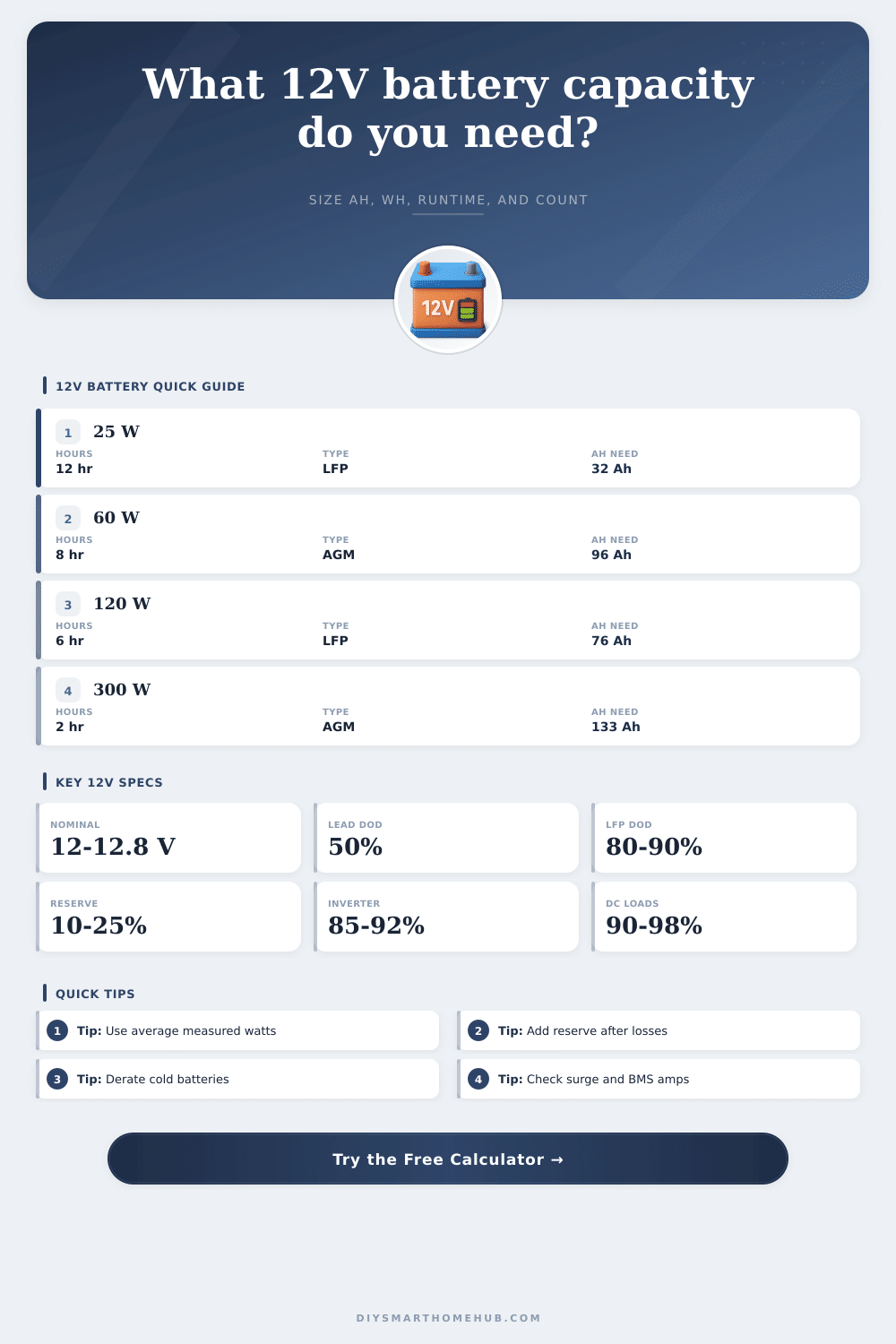
| Load energy | Average watts × runtime hours | Watt-hours | Energy the device must receive during the outage. |
| Battery usable energy | Load Wh ÷ efficiency | Usable Wh | Energy that must leave the 12V battery before DoD limits. |
| Nameplate energy | Usable Wh ÷ DoD × reserve ÷ derates | Required Wh | Total rated energy needed from the selected battery type. |
| 12V amp-hours | Required Wh ÷ nominal battery voltage | Required Ah | Capacity to compare with 12V battery labels. |
| Battery count | Required Ah ÷ one battery Ah | Parallel count | Number of same-voltage 12V batteries required after rounding up. |
| Current estimate | Load W ÷ efficiency ÷ nominal voltage | Battery amps | Steady current to compare with BMS, inverter, fuse, and connector ratings. |
A 12V battery bank are used to provide backup power for various devices in the case that there is a power outage. A power outage occur when the electrical grid in a home stop providing power to the devices in that home. Many people purchases a 12V battery bank to provide power to essential devices during a power outage.
The correct size of a 12V battery bank is a difficult decision to make due to teh misleading information that is often printed on the labels of batteries. A battery bank label might read that the battery bank can provide 100Ah of energy. However, the battery bank does not have to provide 100Ah of energy to the devices.
How to Choose the Right 12V Battery Bank
If a person purchases a 12V battery bank of too small of a size, the battery bank will not provide enough energy to support the devices during the power outage. Additionally, if a person who purchase the battery bank purchases a 12V battery bank of too larger of a size for the devices that are to be powered, the person who purchase the battery bank will end up spending more money than is necessary. The first factor to consider when purchasing a 12V battery bank is the depth of discharge, or DoD.
The depth of discharge is the amount of energy that is drawn from a battery compared to the total amount of energy that the battery can contain. If you are to use lead acid batteries, it is important to ensure that all of the energy is not drawn from the batteries as this will damage the batteries. For AGM batteries, however, only about 50% of the batteries capacity should be use.
LiFePO4 batteries are different than lead acid batteries in that with these batteries, a much larger percentage of the energy can be drawn from the battery without damaging the battery. Thus, the equation for calculating the size of the battery bank will change depending upon whether lead acid or LiFePO4 batteries is to be used in the battery bank. The second factor to consider when purchasing a 12V battery bank is the loss of energy that occur during power conversion.
Power conversion is the process of changing DC power to AC power or changing the voltage levels of the electricity that is to be delivered to the devices. If an inverter is used to power an AC device, the inverter will use some of the energy that the battery bank provides. Additionally, energy is lost during the process of changing DC to AC power.
If a DC to DC converter is used, energy is also lost due to the release of energy as heat from the DC to DC converter. Thus, the wattage of the devices that the battery bank must power must be measured. The wattage that is measured should be the average wattage, not the maximum wattage that is listed on the devices label.
The third factor to consider when purchasing a 12V battery bank is the temperature of the environment in which the batteries are to be stored. Batteries are chemical engine. Chemical engines run less efficiently at lower temperatures.
Thus, if the batteries are to be stored in a location that is often cold, such as a garage, the 12V battery bank will have a smaller amount of energy that it can provide to the devices compared to a 12V battery bank that is stored in a warmly location. Thus, the temperature of the storage area for the battery bank should be considered in the calculations of the size of the battery bank. The fourth factor to consider when purchasing a 12V battery bank is the age of the batteries.
As batteries age, they hold less energy than when they were new. For instance, a battery that is three years old might only hold 80% of the energy of a new battery. Thus, a reserve margin must be provided for the 12V battery bank when purchasing the batteries to ensure that there is enough energy to power the devices.
The fifth factor to consider when purchasing a 12V battery bank is the electrical current that the batteries will provide and the thickness of the wires that will be used to provide power to the devices. To provide a large amount of wattage with the 12V battery bank, a person must purchase thick wires with heavy-duty fuses. If the wires are too thin for the amount of current that the system is to provide, the wires will heat up and the devices will often reboot.
Additionally, if a very large number of batteries are to be used in the battery bank, the voltage of the system might have to be higher than 12V to increase the efficiency of the battery bank. Finally, the cost of the batteries and the amount of space in which the 12V battery bank can be stored must be considered. Using a calculator, a person can determine the nameplate capacity of the 12V battery bank based off the length of time that the devices will need to run and the chemistry of the batteries that will be used in the battery bank.
Additionally, using the calculator, a person can determine the number of batteries that will have to be placed in parallel with one another to provide power to the devices. By considering the chemistry of the batteries, the temperature at which they will be stored, the losses of energy during power conversion, the age of the batteries, and the amount of electrical current that will have to be provided to the devices, an individual can accurately calculate the size of the 12V battery bank that will be needed for such a situation.