Wind Turbine Size Calculator
Estimate the rotor diameter, swept area, nominal turbine rating, and daily energy needed for a smart home, cabin, sensor, or backup charging load.
⚙Real turbine size presets
📏Wind and load inputs
📊Current sizing spec grid
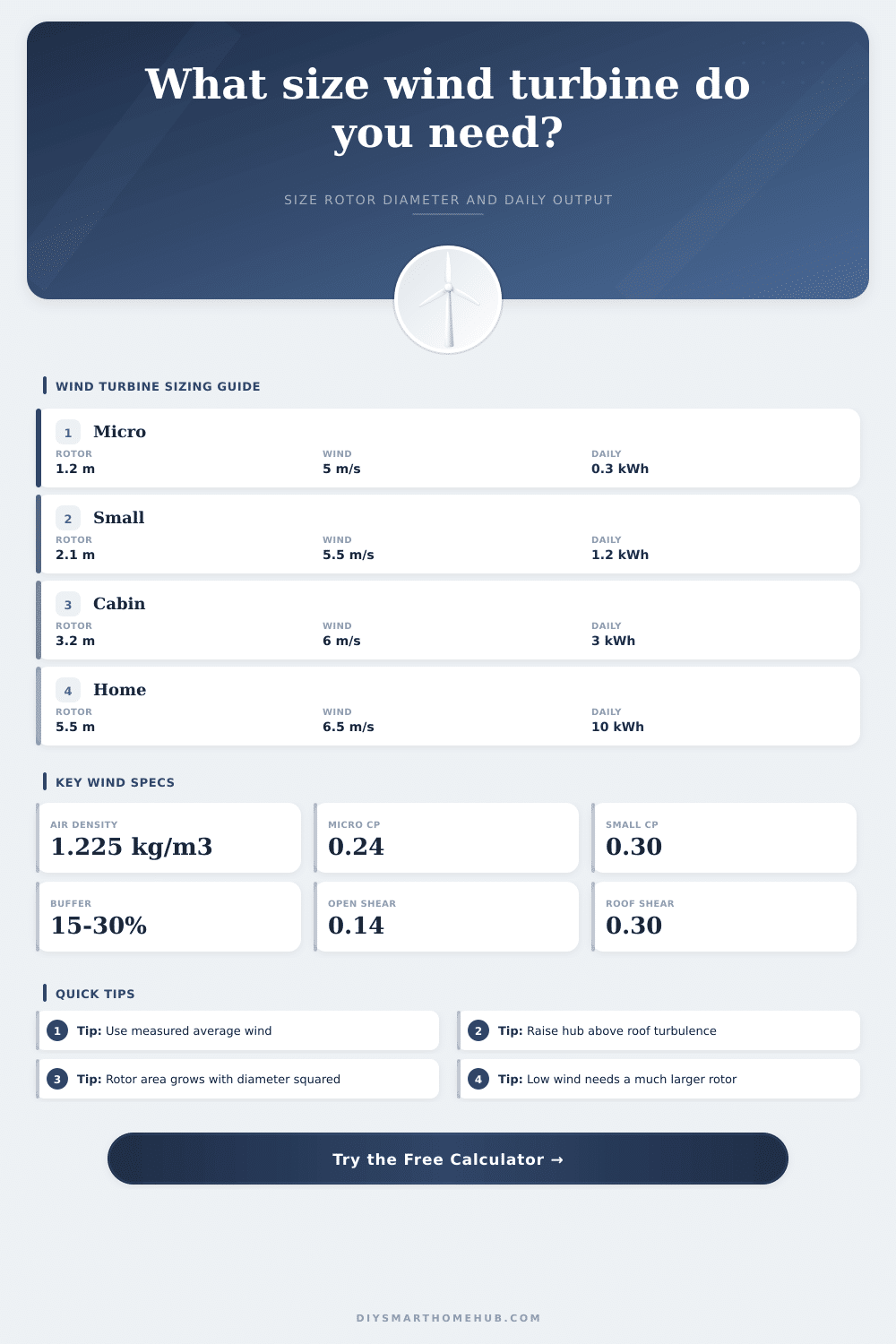
📐Turbine size classes
| Size class | Typical rotor diameter | Nameplate range | Best planning use |
|---|---|---|---|
| Micro battery charger | 1.0 to 1.5 m / 3.3 to 4.9 ft | 100 to 500 W | Sensors, gates, radios, marine batteries |
| Small cabin turbine | 1.8 to 2.7 m / 5.9 to 8.9 ft | 0.7 to 1.5 kW | Cabin lights, routers, small DC loads |
| Off-grid support | 3.0 to 4.5 m / 9.8 to 14.8 ft | 2 to 4 kW | Hybrid solar battery systems |
| Home-scale tower | 5.0 to 7.0 m / 16.4 to 23.0 ft | 5 to 10 kW | Strong-wind residential energy contribution |
🌬Wind speed sensitivity
| Average wind at hub | Power vs 5 m/s | Design meaning | Calculator impact |
|---|---|---|---|
| 4 m/s / 8.9 mph | 0.51x | Low-wind site | Needs about 2x rotor area |
| 5 m/s / 11.2 mph | 1.00x | Usable small-wind baseline | Good for modest backup loads |
| 6 m/s / 13.4 mph | 1.73x | Strong small-wind site | Rotor size drops meaningfully |
| 7 m/s / 15.7 mph | 2.74x | Excellent exposed site | Higher output from same rotor |
📝Common project sizes
| Project profile | Daily wind target | Typical rotor | Smart home load example |
|---|---|---|---|
| Remote monitoring pole | 0.15 to 0.4 kWh | 1.0 to 1.4 m | LTE router, sensors, camera wake events |
| Smart shed or gate | 0.5 to 1.5 kWh | 1.8 to 2.8 m | Lighting, access control, charger, WiFi bridge |
| Cabin backup circuit | 2 to 5 kWh | 3.0 to 4.8 m | Fridge controls, network rack, DC pump |
| Hybrid home contribution | 6 to 12 kWh | 5.0 to 7.5 m | Battery charging beside solar array |
🏔Height and exposure reference
| Exposure | Shear alpha | 30 ft to 60 ft wind gain | Planning note |
|---|---|---|---|
| Open field / shoreline | 0.14 | About 10% | Smoother air, preferred for small wind |
| Suburban lots and trees | 0.22 | About 16% | Higher tower usually matters |
| Wooded or uneven terrain | 0.28 | About 21% | Clearance above obstacles is critical |
| Roof or urban turbulence | 0.30 | About 23% | Average speed can hide poor turbulence quality |
💡Sizing notes
Choosing the correct size for a wind turbine require understanding the rotor of that turbine. The rotor perform most of the work of the wind turbine. The energy that the turbine will produce are directly related to the area that the rotor moves through the wind.
While many look at the nameplate ratings of the wind turbine to determine the energy output of that turbine, the actual energy that is harvested is actualy related to the diameter of the rotor, the hub height of the turbine, and the quality of the wind resource that are available. The target energy requirements for you location must be matched with the energy available from the wind at your site in order to meet your energy need. Wind speed is one of the main factor to consider in the sizing of your wind turbine installation.
How to Choose the Right Wind Turbine Size
The power produced by your wind turbine relate to the cubed velocity of the moving air. Thus, wind speeds of five meters per second will produce half the energy of a site with average wind speeds of six meters per second. Because of this relationship, increasing the height of the wind turbine may produce more energy than increasing the hardware of the wind turbine.
Wind data can be calculated using a calculator to provide an estimate of turbine sizing without having to calculate the correction factor to the wind speed manual. The height of the hub of a wind turbine is a crucial element of the determination of the size of the turbine. The higher the hub is raised, the less impact that the turbulence of the surrounding area will have upon the performance of the wind turbine.
By raising the hub by ten or fifteen feet, the wind turbine will move above many of the areas of turbulence caused by the surrounding buildings, trees, and the elevation of the roof. By using taller towers, the wind turbine will experience smooth air movement through the rotor, which will not detrimentally impact the operation of the turbine. While many wind turbine owners will choose a shorter tower to lower the cost of the installation, the cost of the additional section of the tower may pay for themselves due to the ability of the taller tower to capture more wind.
The diameter of the rotor of a wind turbine is another of the main variables that the site developer can control. The area that the turbine moves through the wind are related to the square of the rotor diameter. Therefore, changing the diameter from two meters to three meters will more than double the area through which the turbine moves.
In areas with lower wind speeds, it is essential for the wind turbine to have a larger rotor to capture the necessary amount of energy to power the load requirements of the site. In areas with high wind speeds, such as hilltop areas or coastal areas, the rotor diameter may be smaller to meet the same energy target while lowering the cost of the wind turbine system. A buffer has to be provided for the estimated energy production of a wind turbine.
The average wind speed for a location does not account for the variation of the wind speeds throughout the day. It is possible for a location to have calm weather for a week, or experience storm that deliver strong gusts of wind for that same period. Thus, twenty or thirty percent has to be added to the energy target in order to account for these variable.
This buffer accounts for energy losses in the wiring and controllers for the wind turbine, as well as ensures that the energy target include the fact that the turbine does not operate at its peak efficiency all of the time. The classes of the turbines differ in their features and the amount of energy that they produce. The main reason for this is due to the purpose of the wind turbine.
For instance, a micro-wind turbine is often made with a lower coefficient of performance, yet can better handle the starts and stops that occur with the charging of battery. In contrast, a larger wind turbine that is to be used as part of a home and hybrid energy system will have a higher coefficient of performance. These different classes of turbine can be selected in the sizing calculator to ensure that the energy estimates are accurate to the specifications of the hardware to be purchased.
Many site will be different from what is calculated in the sizing calculator. For instance, trees will continue to grow at the site, and new buildings may be constructed. Each of these feature will impact the wind pattern at the site.
The shear exponent that is used in the calculation of the wind speeds at various heights is only an average of the stability of the atmosphere at the site. Thus, data that is calculated at the actual site will provide the best estimate of the energy that can be produced at that location. Such data may be collected with a temporary anemometer that is constructed at the site in question.
An anemometer will reveal data regarding the actual wind speed at the site, rather than the averaged wind speed from a distant airport. The relationship between the diameter of the rotor of the turbine and the height of the tower will have an impact upon the permitting required for the installation of the turbine, as well as the acceptance of the neighbor where the turbine is to be constructed. A wind turbine with a large rotor and small tower will likely be within the height limit for construction permits, yet the size of the rotor may create issue for the neighbors.
Should the same sized rotor be constructed on a taller tower, the turbine will sit at a height that utilize the wind that passes through the turbine without creating any air pollution, yet will be further from the line of sight of the neighbors. The goal with sizing the wind turbine is to develop a system that will produce the amount of energy that is required for the site, yet at an acceptable cost. Each of the main variable in the sizing calculator should be based off an estimate of the loads on the site each day, the wind speed at the hub height of the turbine, and the energy availability at the site.
With these estimate established, the sizing calculator can determine the diameter of the rotor. With the rotor size determined, the rest of the component of the system can be sized to match the requirement of the wind turbine of that size.