Wind Turbine Blade Length Calculator
Estimate blade radius, rotor diameter, swept area, loaded RPM, and chord targets from desired watts, wind speed, air density, efficiency, blade count, and tip speed ratio.
Blade Length Results
| Loaded wind | Metric speed | Raw wind power density | What it means for blades |
|---|---|---|---|
| 8 mph | 3.58 m/s | 28 W/m² | Very long rotor for useful charging |
| 10 mph | 4.47 m/s | 55 W/m² | Small loads need generous radius |
| 12 mph | 5.36 m/s | 94 W/m² | Practical for sensors and cameras |
| 15 mph | 6.71 m/s | 185 W/m² | Common small-turbine sizing point |
| 18 mph | 8.05 m/s | 319 W/m² | Much smaller rotor for same watts |
| 22 mph | 9.83 m/s | 582 W/m² | Check tip speed and overspeed control |
| Rotor type | Typical Cp | Blade length impact | Best calculator use |
|---|---|---|---|
| Flat plate experimental blades | 0.12 to 0.18 | Longest required radius | First prototypes and teaching rigs |
| Basic carved wood blades | 0.18 to 0.24 | Conservative DIY sizing | Most home shop rotors |
| Refined wood airfoil | 0.24 to 0.30 | Moderate blade length | Carefully shaped small turbines |
| Molded small rotor | 0.28 to 0.36 | Shorter radius for same output | Repeatable blade profiles |
| Excellent small rotor | 0.36 to 0.42 | Aggressive compact estimate | Validated designs with test data |
| Betz theoretical limit | 0.593 max | Not achievable in real builds | Upper physics reference only |
| Blade count | Common TSR | Chord tendency | Rotor behavior |
|---|---|---|---|
| 2 blades | 6 to 8 | Narrower blade set | Fast rotor, lower solidity, more balance sensitive |
| 3 blades | 5 to 7 | Moderate chord | Best all-around small turbine starting point |
| 5 blades | 3 to 5 | Wider total chord | Better starting torque, slower loaded RPM |
| 6 blades | 2.5 to 4 | High solidity | Slow torque rotor for low-speed alternators |
| Project scenario | Target watts | Sizing wind | Typical blade length range |
|---|---|---|---|
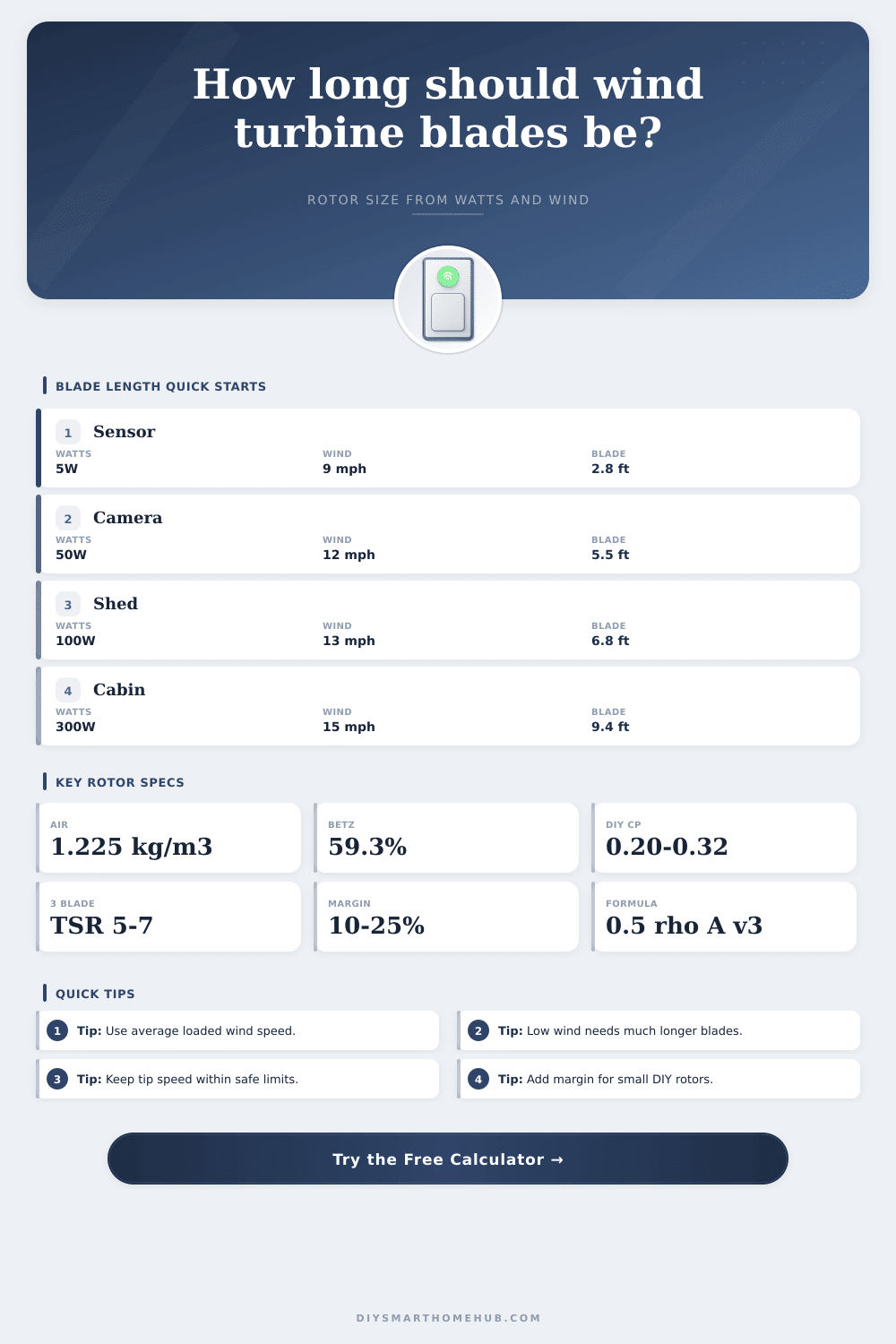
| Remote sensor trickle charger | 5 to 10 W | 8 to 10 mph | 2 to 4 ft per blade |
| Weather station battery support | 10 to 20 W | 9 to 11 mph | 3 to 5 ft per blade |
| Garden lights battery top-off | 25 to 40 W | 10 to 12 mph | 4 to 6 ft per blade |
| Remote camera or radio node | 40 to 75 W | 11 to 13 mph | 5 to 7 ft per blade |
| Shed battery charger | 100 to 200 W | 12 to 15 mph | 6 to 9 ft per blade |
| Small cabin charge rotor | 300 to 500 W | 14 to 18 mph | 8 to 12 ft per blade |
Wind power is an attractive choice for small off-grid projects. Wind power use free fuel and hardware that can be build using ordinary tools. The first decision to make is what the blade length of the wind turbine will be.
The length of the blade greatly impact the wind turbine. If the blade length is too short, the wind turbine will never be able to charge the battery. However, if the length of the blade are too long, the wind turbine will be too heavy and expensive to construct.
How to Choose the Right Blade Size for Small Wind Turbines
The second variable to determine is the wind speed at the desired location for the construction of the wind turbine. A location that has an average wind speed of 12 mph will have almost twice as much energy compared to a location with an average wind speed of 10 mph. Thus, small change in the wind speed will require large changes in the length of the blade of the wind turbine.
Many use the loaded wind speed for these calculation. The loaded wind speed is the determined wind speed that the blades will experience while the wind turbine is generate electricity. Using a wind speed that is too high for the area will result in the wind turbine sitting idle on days without high winds.
Conversely, a wind speed that is too low will result in the construction of blades that are impractically long for such a wind speed. The third variable is the density of the air at the site of the installation of the wind turbine. The air density will vary with the altitude of the area or the weather at the location.
Thin air will require longer blades than thick air to produce the same amount of energy. Therefore, installing a wind turbine on a mountain will require longer blades than a coastal location even if the wind speed is the same at each location. The fourth variable that must be determined for the construction of a wind turbine is the power coefficient (Cp).
The power coefficient is the amount of the kinetic energy of the wind that the rotor will extract. The theoretical maximum for any real-world wind turbine is 59% of the kinetic energy of the wind. Small built models have much lower percentage.
Thus, a rotor having a power coefficient of 0.20 will require a larger radius of blade than one having a power coefficient of 0.30. A higher coefficient allow for a smaller rotor. Thus, builders who invest time in formulating the airfoil shape of the blades can use a smaller rotor.
The fifth and final variable is the efficiency of the generator and the controller. The generator will transform the mechanical power of the rotor into electrical energy. The efficiency of a permanent magnet generator is 65% but a generator and controller can reach 85% efficiency.
Thus, a low efficiency will require longer blades to compensate for the energy that will be lost in transforming mechanical to electrical energy. The number of blades on the rotor can have a major impact on the design of the rotor. Three is the most common number of blades on a small wind turbine.
Two blades will make for a lighter rotor that will spin at a faster rate. However, high tip speed can be created that are noisy and can erode the edge of the blades. Five and six blades allow for heavy alternators to start and turn at low speed.
However, wider chord of the blades will make them heavier. Once the radius of the blades is determined, the chord of the blades must be determined. The chord of the blade is the distance from the outer edge of the blade to the center of the blade.
The blades at the root of the blade need to be thicker than the remainder of the blade. However, the tips of the blades can be narrower than the root of the blade. Many add a margin to the area of the blade calculated for the wind and the other variable.
Adding a margin to the area of the blade will ensure that the wind turbine will produce the amount of power that is required on days that are not perfect for the production of energy by the blades. Finally, small wind turbines will rarely have the same wind speeds calculated in the formulas. Trees, buildings, and hills can create turbulence in the wind.
Thus, the blades may not reach the wind speed calculated. Observing the site or measuring the wind over a period of time will tell the person what the actual wind speed will be at the installation of the blades. Safety margin must also be built into the blade when the blades are turning.
As the radius of the blade increases, the tip speed of the blade increases. High tip speeds will make the blades noisy and lead to blade failure. Thus, overspeed protection must be built into the blade as the radius increases.
Overspeed protection can include furling, electronic braking, and dump loads. If the overspeed protection is ignored, the blades may self destruct during high winds. The relationship between the variables of the wind, the area of the blade, and the power that is captured by the blade is consistent.
Small changes in one of the variables will have a large change in the other three. For the best results, the length of the blade should be determined according to the wind resource, the blades, and the electrical load. If all three of these variable match, the best results will be obtained with the wind turbine running quiet and charging the battery.