Commercial Water Softener Sizing Calculator
Estimate compensated hardness, daily grain loading, per-tank working capacity, and service-flow margin for restaurants, lodging, healthcare, laundry, and multi-building facilities.
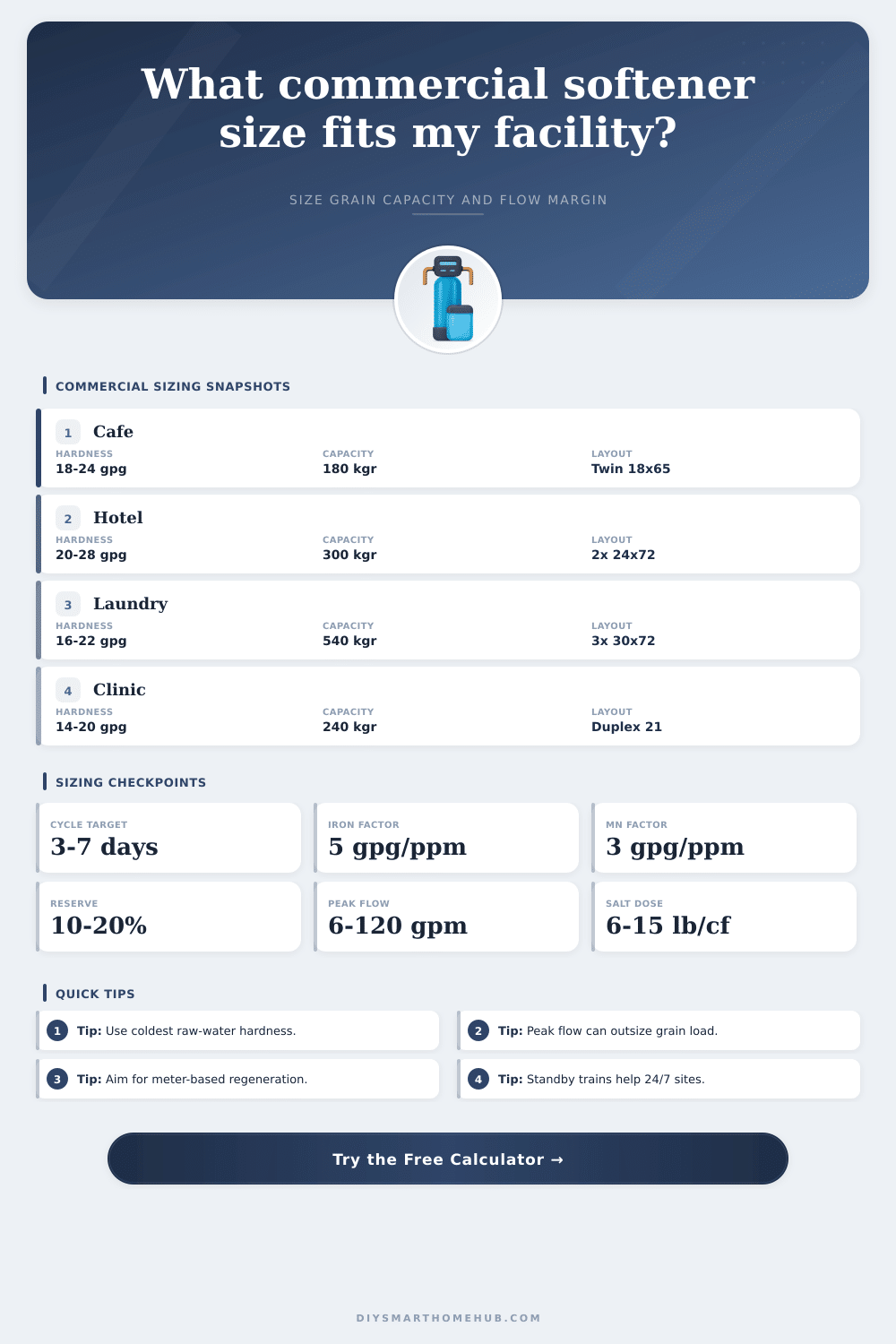
Use one of these commercial profiles to preload realistic water volume, hardness, and redundancy targets before fine-tuning your design basis.
Sizing checks both grain capacity and service flow. A tank that has enough resin can still fail if its valve and bed area cannot carry the busiest hour.
Recommended Softener Train
Adjust the inputs, then calculate to view a flow-limited and capacity-limited sizing recommendation.
These spec cards summarize the design relationships used by the calculator so you can explain the recommendation to operations or engineering teams.
Use this quick table to compare common commercial resin volumes against working capacity at the balanced 8 lb/ft3 salt setting.
| Tank | Resin | Working Cap | Normal Flow | Typical Use |
|---|---|---|---|---|
| 12 x 52 | 1.5 cu ft | 36 kgr | 5 gpm | Coffee bars and combi-oven makeup |
| 13 x 54 | 2.0 cu ft | 48 kgr | 6 gpm | Small kitchens and bakery feed |
| 16 x 65 | 4.0 cu ft | 96 kgr | 9 gpm | Clinics and light locker rooms |
| 18 x 65 | 5.0 cu ft | 120 kgr | 12 gpm | Restaurants and small hotels |
| 21 x 62 | 7.0 cu ft | 168 kgr | 16 gpm | Health clubs and apartment risers |
| 24 x 72 | 10.0 cu ft | 240 kgr | 22 gpm | Boutique hotels and central plants |
| 30 x 72 | 14.0 cu ft | 336 kgr | 35 gpm | Linen and process rinse trains |
| 36 x 72 | 18.0 cu ft | 432 kgr | 50 gpm | Large hotels and campus loops |
Commercial softeners often live or fail on redundancy strategy. This table helps match the train style to operational downtime tolerance.
| Arrangement | Online Tanks | Best Fit | Main Benefit |
|---|---|---|---|
| Simplex | 1 | Light-duty seasonal loads | Lowest footprint and controls cost |
| Duty/Standby Duplex | 1 | Critical buildings with spare capacity | Backup vessel stays available for failures |
| Alternating Twin | 1 | 24/7 demand with no hard-water bypass | Immediate switchover during regeneration |
| Duplex Parallel | 2 | Higher peak flow with shared load | Flow is split across two duty vessels |
| Triplex N+1 | 2 | Hospitals, hotels, campus plants | One spare tank while two carry flow |
These examples combine daily usage, compensated hardness, and layout style to show why commercial softeners usually need both capacity and redundancy checks.
| Project | Daily Water | Comp Hardness | Typical Recommendation |
|---|---|---|---|
| 80-seat cafe | 900 gal/day | 21 gpg | Alternating 2 x 16 x 65 |
| 60-room hotel | 3,200 gal/day | 23 gpg | Duplex 2 x 24 x 72 |
| 30-washer laundromat | 8,500 gal/day | 18 gpg | Triplex 3 x 30 x 72 |
| Fitness club | 2,100 gal/day | 16 gpg | Duty/Standby 2 x 21 x 62 |
| Student housing | 5,600 gal/day | 24 gpg | Triplex 3 x 24 x 72 |
If you have a BAS trend or water meter log, enter that measured peak flow. Real short spikes in kitchens, locker rooms, or laundry tunnels often force the vessel diameter higher than grain math alone.
A large simplex unit can still create hard-water bleed-through during regeneration. For occupied buildings, alternating or N+1 trains protect uptime even when the grain requirement looks manageable.
Commercial water softeners are made up of high systems for treat water. They remove minerals, like calcium and magnesium, from the water. Like this they protect gear, extend its use and improve the water quality in many ways.
Ideal for businesses like medical facilities, laboratories, canteens, car washes and laundromats, those devices answer also for hostels, hospitals, plants and nursing homes. In these places you require big easy amounts and strong skill.
Commercial Water Softeners: What They Do and How to Care for Them
The softening happen by means of ion change. Water flows through tank filled by means of special bead resin. This resin fits to attract and seize minerals from the water.
Hard water creates many troubles, it stuffs tubes, leave white traces on dishes and cloths. It destroys washing machines, water heaters and fixtures, even injure the skin and makes hairs unhealthy. Conditioner gives cleaner plates and soft linens to guests.
You finds many makers and models for sale. For instance Fleck have the 9100, 9500, 2850 and 2900. Between others are the SoftPro Pro Series or Hi-Flo 3e. The Hi-Flo 3e well served processes with 280 gallons for minute and remove until 1.2 million grains of hardness each tank.
Little businesses choose one-tank unit with 2 until 3 cubic feet, when overnight water use little. Big resin bed softens more effectively.
Necessarily are first test the water. You does not know, what you requires, until you knows the content of your water and its hardness. For good result you must match the devices with the use.
The system requires right size according to its task. For instance, wrong size can create problems. Some models answer specially for minute water.
Attention matters also. In the brine tank you can lay commercial cleaners before regeneration. Add salt and leave to dissolve some hours mean manual work.
Some use Iron Out powder in the brine tank monthyly for minute water, so that the unit operate well. For protect the resin you advises to lay sediment filter in front the conditioner.