Water Softener Regeneration Calculator
Estimate your metered gallon setting, corrected hardness load, day override, salt dose, and drain-water burden so the softener regenerates often enough to protect the resin without wasting salt and water.
📋Preset scenarios
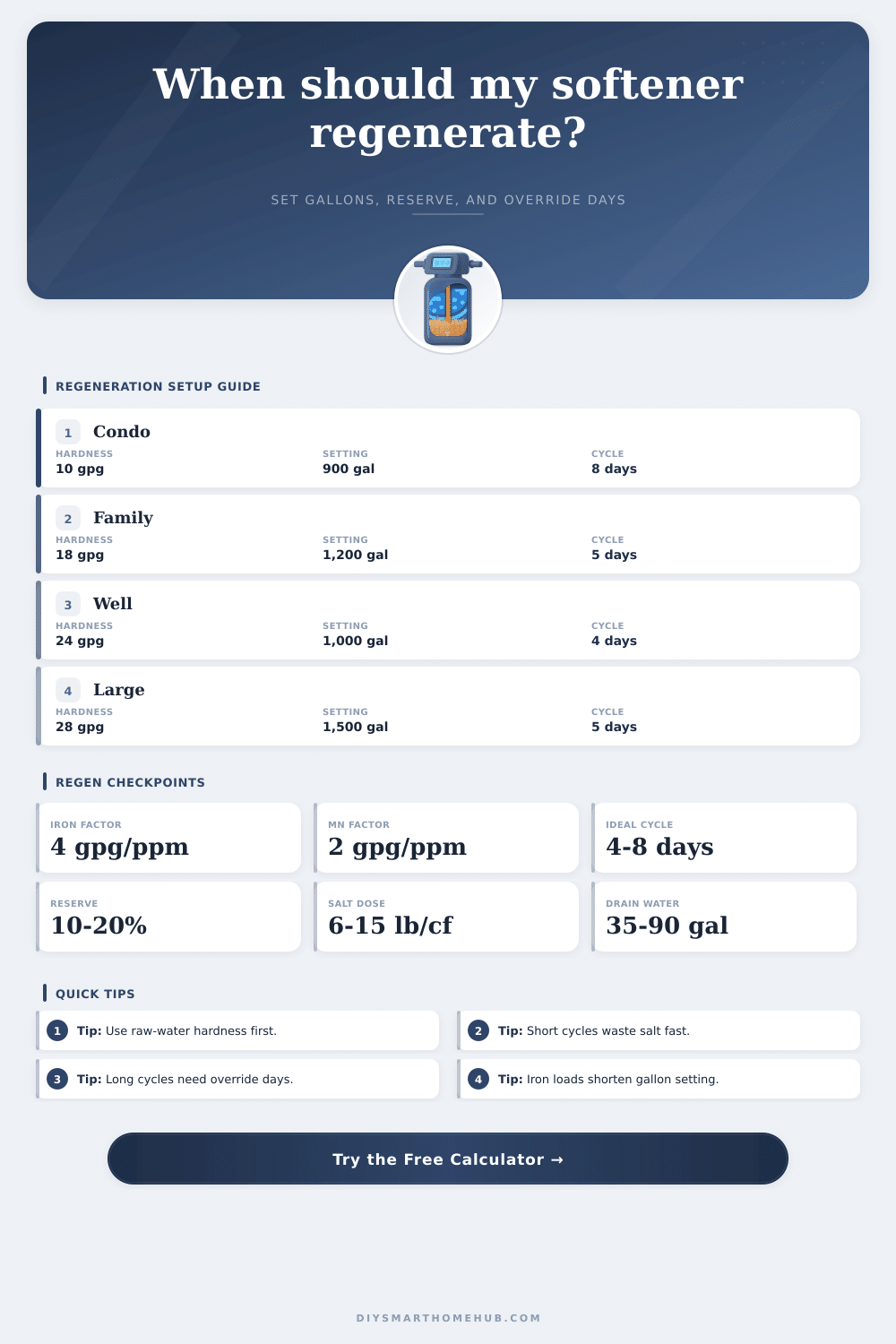
These presets model real residential regeneration patterns, from efficient city-water condos to high-iron well systems where reserve and override settings need a tighter safety margin.
⚙Regeneration inputs
The model starts with corrected hardness and daily gallons, then checks resin volume, salt efficiency, reserve, and rinse water so you get a usable meter setting instead of only a headline grain number.
Recommended regeneration program
Run the calculator to see the gallon setting, expected cycle length, salt dose, and drain-water use for the current softener configuration.
Breakdown
📘Programming reference grid
These cards summarize the fixed assumptions behind the regeneration model so you can compare a high-efficiency setup against higher-salt, higher-capacity programming styles.
📊Reference tables
Salt profile guide
| Profile | Grains/cf | Salt/cf | Use case |
|---|---|---|---|
| High efficiency | 20,000 | 6 lb | Stable city water |
| Balanced | 24,000 | 8 lb | Most homes |
| Standard | 27,000 | 10 lb | Harder municipal |
| Max capacity | 30,000 | 15 lb | Short-cycle loads |
Cycle band interpretation
| Cycle | Days | Read | Action |
|---|---|---|---|
| Very short | Under 3 | High wear | More resin |
| Short | 3-4 | Heavy load | Watch salt |
| Ideal | 4-8 | Balanced | Keep setting |
| Long | Over 8 | Use override | Tighten days |
Common override bands
| Water profile | Hardness | Override | Reason |
|---|---|---|---|
| Stable city | 6-12 gpg | 10 days | Low fouling |
| Hard city | 13-20 gpg | 8 days | More scale load |
| Well w/ iron | 18-26 gpg | 6-7 days | Cleaner resin |
| Mn well | 20+ gpg | 5-6 days | Avoid fouling |
Drain-water planning
| Drain gpm | Cycle mins | Drain gal | Read |
|---|---|---|---|
| 1.5 | 45 | 68 gal | Light flow |
| 2.0 | 45 | 90 gal | Common range |
| 2.2 | 40 | 88 gal | Typical 10x54 |
| 3.0 | 35 | 105 gal | Larger tanks |
Household regeneration snapshots
| Household | Typical load | Meter setting | Controller note |
|---|---|---|---|
| Two-person condo | 100 to 130 gpd, 10 to 12 gpg | 700 to 1,100 gal | High-efficiency salt settings usually keep cycle days above a week without overshooting the override. |
| Four-person suburban home | 220 to 270 gpd, 15 to 20 gpg | 1,000 to 1,400 gal | A 1.5 cu ft bed often lands in the balanced salt band with a seven- to eight-day override. |
| Iron-bearing well home | 220 gpd, 22 gpg plus iron | 700 to 1,050 gal | Compensated hardness tightens both the gallon count and the maximum days between regenerations. |
| Main home plus ADU | 320 to 380 gpd, 15 to 18 gpg | 1,300 to 1,800 gal | Higher daily draw often justifies a metered delayed valve with a six-day override for consistency. |
| Large family well system | 350 to 420 gpd, 20+ gpg | 1,100 to 1,600 gal | Peak occupancy makes reserve more important because short surges can spend the last part of the usable capacity quickly. |
💡Practical notes
Meter setting and override work together
The gallon setting should carry the day-to-day load, but the override is still important when occupancy drops or a vacation week keeps the meter from calling for regeneration. Long idle periods can foul resin even when plenty of grains remain unused.
Salt efficiency changes the whole program
Higher salt doses restore more working grains per cubic foot, but they also increase salt per regeneration and can hide an undersized softener. If the cycle remains very short even at a heavy salt setting, more resin volume is usually the cleaner fix.
Water softeners are strong tools for settle difficult problems with water. They inhibit the collection of minerals in tubes, devices and fixtures. During everyday usage, the resin in the device saturates by means of calcium and magnesium.
The time passes, the resin beads cover by means of those minerals from difficult water and become packed. When the beads reach their maximum capacity, the system no any more can soften water. Then comes the regeneration.
How a Water Softener Regenerates
It is the necessary sanitary process, that flushes the minerals, that seized the difficult water. That cycle restores to the softener the skill remove minerals and ensure, that it operates effectively.
Regeneration you also call recharge. The sanitary process has five steps: fill, brine, brine spivado, backwash, and fast spivado. In this phase, the resin washes by means of salty solution.
The saltwater flies vice versa through the system, removing the calcium and magnesium ions, that the resin absorbed. That removes the minerals of hardness from the resin, so the device can maintain produce soft water. Consequently, you receive pureer plates, softer hairs and fewer collection in each water flow.
As far as commonly the system requires to regenerate, depend of the hardness of the water and of the usage. More difficult water requires more common regenerations, because it stores more minerals each gallon. Because softeners can remove only undoubted amount of calcium and magnesium simultaneously, the usage matters a lot.
For some, regenerate every two weeks or a bit more long can suffice. Rule of thumb is once monthly as minimum. Modern softeners commonly have program with 28-day override.
That does, that the system automatically regenerates, even if the resin bed no fully packed. Like this it stays always well functional.
Some water softeners preserve a bit of water in the bottom of the tank, for inhibit, that the salt hardens in big block, you calls that bridging. Some units keep the brine-tank full always, others only fill it just before regeneration. Basic model has separate brine-tank and complex valvigon for regenerate the zeolite.
Better models use servan valve for do the connections. Are utile control water usage and salt level regular. Often regenerations inhibit scale collection and help the water system operate optimally.