💧 Water Softener Hardness Setting Calculator
Find the correct hardness setting for your water softener based on your water hardness, iron content, and household size.
| Iron Content (ppm) | GPG Adjustment | Iron Type | Notes |
|---|---|---|---|
| 0 ppm | +0 GPG | None | No iron adjustment needed |
| 0.3 ppm | +1.2 GPG | Ferrous | Near detection limit |
| 0.5 ppm | +2 GPG | Ferrous | Common in light well water |
| 1.0 ppm | +4 GPG | Ferrous | Noticeable staining risk |
| 2.0 ppm | +8 GPG | Ferrous | Standard iron filter recommended |
| 3.0 ppm | +12 GPG | Ferrous | Iron filter strongly advised |
| 5.0 ppm | +20 GPG | Ferrous | Dedicated iron removal required |
| Any level | +8 GPG per ppm | Ferric / Bacterial | Pre-filter mandatory |
| Water Hardness (GPG) | Water Hardness (mg/L) | Base Setting (GPG) | Classification |
|---|---|---|---|
| 1–3 | 17–51 | 1–3 | Soft |
| 4–6 | 68–103 | 4–6 | Slightly Hard |
| 7–10 | 120–171 | 7–10 | Moderately Hard |
| 11–15 | 188–257 | 11–15 | Hard |
| 16–20 | 274–342 | 16–20 | Hard |
| 21–25 | 359–428 | 21–25 | Very Hard |
| 26–30 | 445–514 | 26–30 | Very Hard |
| 31–40 | 530–685 | 31–40 | Extremely Hard |
| 40+ | 685+ | 40+ | Exceptionally Hard |
| Household (People) | Daily Use (gal) | Grains/Day (at 15 GPG) | Regen Interval (Typical) |
|---|---|---|---|
| 1 Person | 75 gal | 1,125 grains | Every 6–8 days |
| 2 People | 150 gal | 2,250 grains | Every 4–6 days |
| 3 People | 225 gal | 3,375 grains | Every 3–5 days |
| 4 People | 300 gal | 4,500 grains | Every 2–4 days |
| 5 People | 375 gal | 5,625 grains | Every 2–3 days |
| 6+ People | 450+ gal | 6,750+ grains | Every 1–2 days |
The hardness of water depends on the amount of lime, magnesium and calcium in city or well water. To reach the best result from a water softener, it matters to understand that hardness. You estimate it according to the total of settled solids, or TDS, in certain amount of water.
Usually you measure that by means of milligrams in liter (mg/L) or grains in gallon (gpg). Before choose the right level, it is important to test the water. Testing it is possible by means of quality gear, home test strips or help of local water authority.
How to Measure and Set Hardness on Your Water Softener
Sometimes the city itself issues annual report about water that shows those values.
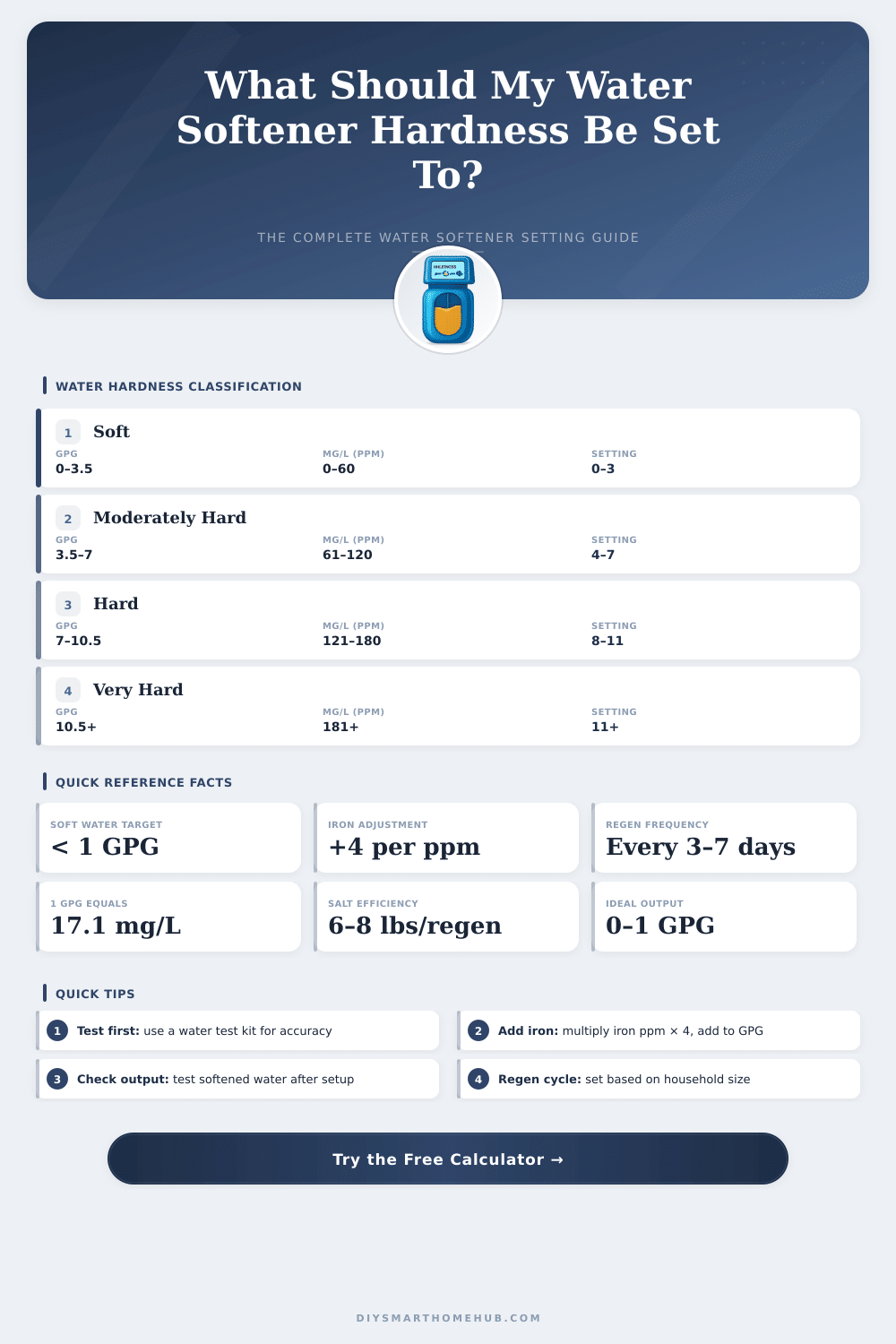
If the value is in mg/L, share it by means of 17.1 to convert to grains in gallon. For instance, soft water has less than 1 grain in gallon, so under 17.1 mg/L. Water softeners reduce those minerals of hardness.
They do that substituting magnesium- and calcium ions by means of sodium- or potassium ions of same charge. Because you replace the ions instead of remove them, the TDS stays same or a bit increases. Use potassium chloride instead of sodium chloride helps to remove hardness from well water without add sodium.
Set the right hardness level on the panel is key for use a softener. That setting affects only the regeneration of the unit. The device follows the flow of water and estimates how much calcium it removed.
It is good to lay the setting according to the real hardness of the raw water, in grains in gallon. Some set it 4 grains higher for safety. For instance, for 18 grains you can choose 20 to compensate changes.
At measured softener you need to calculate a compensated number and add it to the setting.
The best setting for hardness of a water softener usually ranges between 25 and 35, but it depends on the water. Do not forget that that number is not a softness setting. Higher value does that the softener think the resin ends more quickly so it regenerates often.
Increasing the setting increases salt use because regeneration happens more often. After new salt dose you should do an extra cycle and measure the hardness for assure the desired level.