Water Heater Standby Loss Calculator
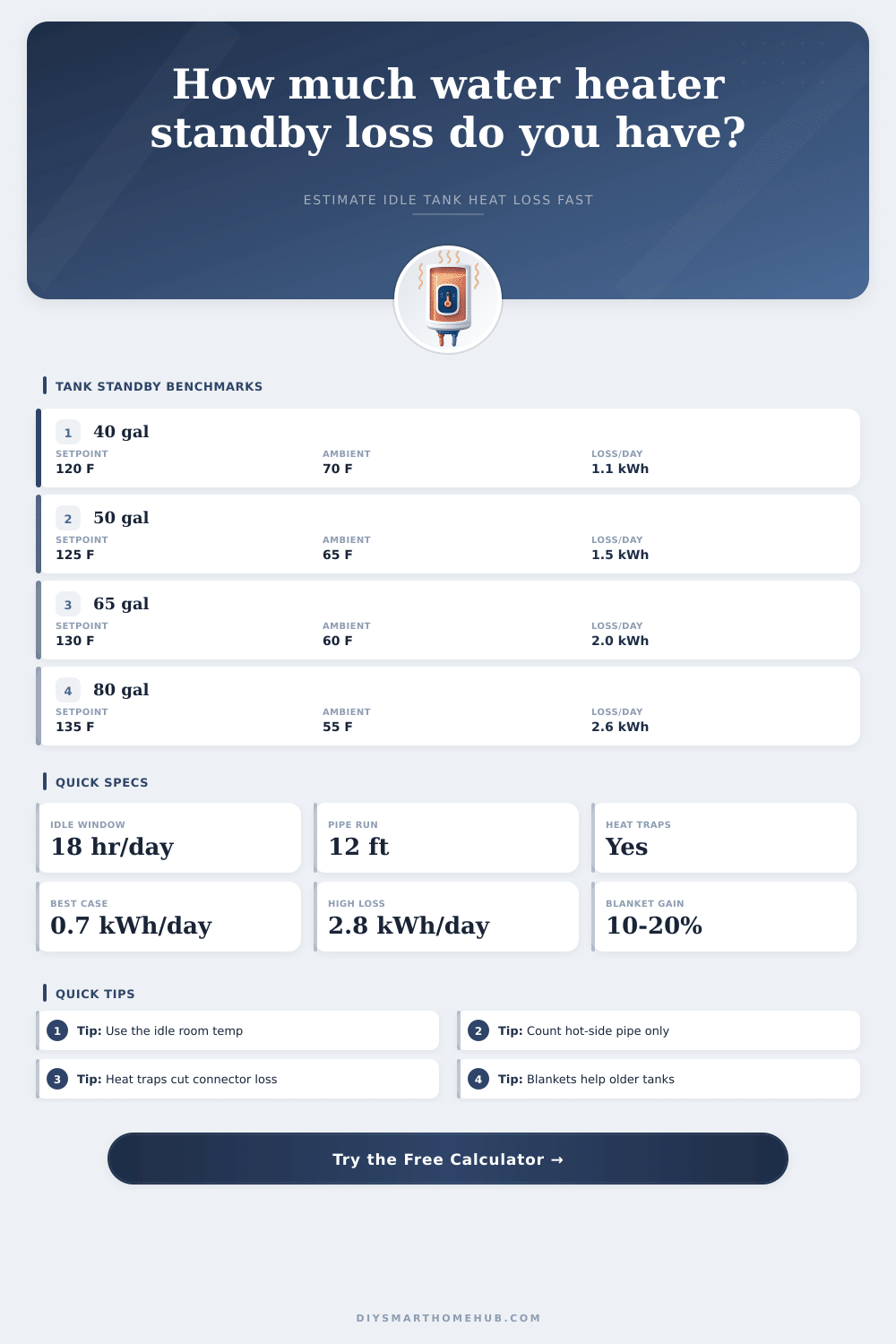
Estimate how much heat a storage water heater loses while sitting idle by modeling tank geometry, insulation, piping, and the room around it. This calculator isolates standby loss only, not draw energy.
📋Preset standby scenarios
Pick a real-world storage setup, then adjust the details below. Presets change tank type, temperatures, piping, and idle windows so the output stays specific to standby heat loss.
⚙Standby loss inputs
📈Standby loss results
Full breakdown
🔍Device and spec comparison grid
Each archetype uses a different shell resistance, parasitic UA adder, recovery rate, and thermostat deadband. The active heater type is highlighted below.
📚Standby reference tables
Tank geometry quick reference
| Tank | Surface | BTU/F stored | Typical use |
|---|---|---|---|
| 20 gal | 12.0 sq ft | 167 | Mini or office |
| 40 gal | 17.8 sq ft | 334 | 1-2 people |
| 50 gal | 20.3 sq ft | 417 | Typical family |
| 80 gal | 28.1 sq ft | 667 | High reserve |
Archetype standby band
| Heater type | Typical loss | Key driver | Idle note |
|---|---|---|---|
| Electric tank | 0.8-1.6 kWh/day | Jacket quality | Mostly shell loss |
| Gas atmospheric | 1.2-2.4 kWh/day | Center flue | Higher off-cycle loss |
| Hybrid tank | 0.6-1.3 kWh/day | Low shell UA | Good in mild rooms |
| Mini tank | 0.3-0.8 kWh/day | Small mass | High ratio to volume |
Pipe connection loss guide
| Condition | Length | Loss impact | Best use |
|---|---|---|---|
| Bare 3/4 in | 10 ft | High | Garage or basement |
| 3/8 foam | 10 ft | Medium | Fast retrofit |
| 1/2 foam | 15 ft | Low | Long connector runs |
| 3/4 fiberglass | 20 ft | Very low | Mechanical rooms |
Idle-day benchmark scenarios
| Scenario | Delta T | Idle hours | Expected band |
|---|---|---|---|
| Closet electric | 50 F | 16 hr | 0.9-1.2 kWh/day |
| Garage gas | 65 F | 18 hr | 1.5-2.1 kWh/day |
| Hybrid basement | 55 F | 18 hr | 0.8-1.1 kWh/day |
| Solar storage | 70 F | 20 hr | 1.0-1.6 kWh/day |
Reference values above are planning bands for standby behavior. Use the calculator for your actual tank size, room temperature, connector length, and insulation package.
💡Practical standby tips
Measure the room, not the thermostat
Standby loss depends on the air surrounding the tank. A garage, attic closet, or basement can sit much colder than the home thermostat, which widens delta T and raises shell loss.
Do not ignore the first hot connector run
Short exposed pipe near the tank can account for a meaningful share of idle loss, especially without heat traps. Insulating those first feet often lowers standby faster than expected.
Standby heat loss happens when heat from the water in a still warm system flees through the tank walls to the colder air around it. Like this the energy misses during the water stays warm in the tank or the device gets ready moment after moment. All standby losses are simply that heat that spills from the tank to the space when the water heater does not deliver water actively.
Modern tanks for water heaters insulate much better than before thanks to progress in building and making. They successfully hold the heat transfer more effectively than before. But any device with a tank must have standby energy loss.
How Water Heaters Lose Heat When Not Used
For instance, new electric water heaters can lose 1.4 kWh because of the storage tank. Similarly, well insulated gas model suffer 8.3 kWh of such losses. Keeping water at 60°C instead of 49°C you expand the temperature difference between water and space.
You can estimate the standby loss. It estimates the maximum Btu/h based on a 39°C difference between stored water and space. For electric heaters above 12 kW count the formula: 20 + (35 × square root of V) = SL.
If you know the loss in BTU/h and gas cost in therm it is possible to smartly estimate cost for warm water when not using it.
Heating methods differ. Electricity heats at 100% efficiency so without firing losses. Natural gas reaches around 80% efficiency in most water heaters.
Tankless models escape whole tank loss. Maybe seem good to turn the device off for several days to save money. Even so standby losses at new electric heaters are little so turning it off for some hours does not help much.
Occasionally the heat loss through the insulation stays almost same do the heater operate or no.
Standby heat loss hapens when heat from the water in a still warm system flees through the tank walls to the colder air around it. Like this the energy misses during the water stays warm in the tank or the device gets ready moment after moment. All standby losses are simply that heat that spills from the tank to the space when the water heater does not deliver water actively.
Modern tanks for water heaters insulate much better than before thanks to progress in building and making. They successfully hold the heat transfer more effectively than before. But any device with a tank must have standby energy loss.
For instance, new electric water heaters can lose 1.4 kWh because of the storage tank. Similarly, well insulated gas model suffer 8.3 kWh of such losses. Keeping water at 60°C instead of 49°C you expand the temperture difference between water and space.
You can estimate the standby loss. It estimates the maximum Btu/h based on a 39°C difference between stored water and space. For electric heaters above 12 kW count the formula: 20 + (35 × square root of V) = SL.
If you know the loss in BTU/h and gas cost in therm it is possible to smartly estimate cost for warm water when not using it.
Heating methods differ. Electricity heats at 100% efficiency so without firing losses. Natural gas reaches around 80% efficiency in most water heaters.
Tankless models escape whole tank loss. Maybe seem good to turn the device off for several days to save money. Even so standby losses at new electric heaters are little so turning it off for some hours does not help much.
Occasionally the heat loss through the insulation stays almost same do the heater operate or no.