🚿 Gas vs Electric Water Heater Calculator
Compare annual energy consumption between gas and electric water heaters based on your household usage
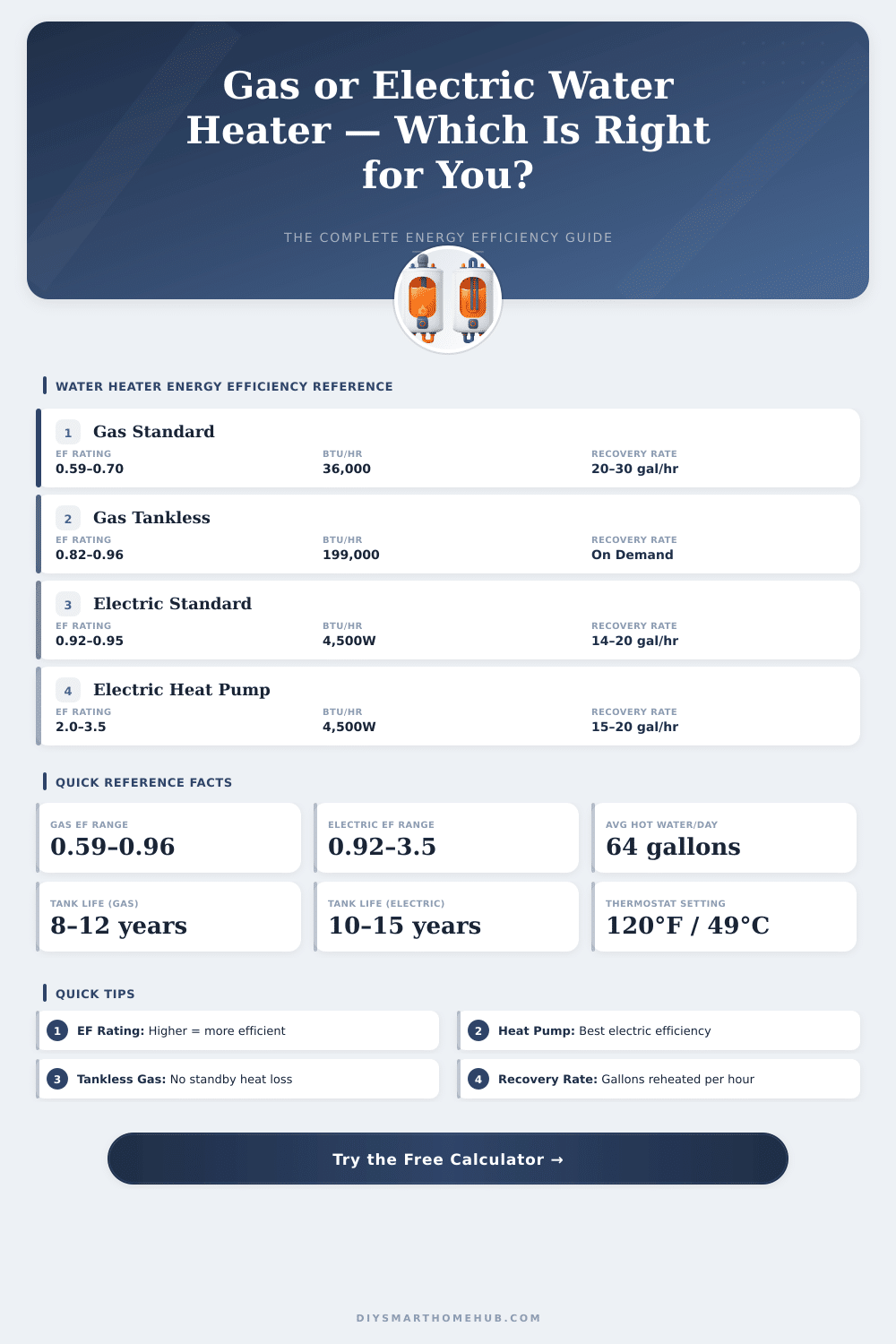
| Heater Type | Energy Factor | Fuel Source | Recovery Rate | Typical Tank Size | Lifespan |
|---|---|---|---|---|---|
| Gas Standard Tank | 0.59 – 0.70 | Natural Gas / Propane | 20 – 30 gal/hr | 30 – 80 gal | 8 – 12 years |
| Gas Power Vent | 0.62 – 0.72 | Natural Gas | 22 – 32 gal/hr | 40 – 75 gal | 8 – 12 years |
| Gas Condensing | 0.80 – 0.92 | Natural Gas | 30 – 45 gal/hr | 50 – 100 gal | 10 – 15 years |
| Gas Tankless | 0.82 – 0.96 | Natural Gas / Propane | On-demand | None | 20+ years |
| Electric Standard Tank | 0.89 – 0.95 | Electricity | 14 – 20 gal/hr | 30 – 80 gal | 10 – 15 years |
| Electric Tankless | 0.96 – 0.99 | Electricity | On-demand | None | 15 – 20 years |
| Heat Pump Standard | 2.0 – 2.8 | Electricity + Air | 15 – 21 gal/hr | 40 – 80 gal | 10 – 15 years |
| Heat Pump Hybrid | 2.4 – 3.5 | Electricity + Air | 20 – 30 gal/hr | 50 – 80 gal | 10 – 15 years |
| Occupants | Avg Daily Usage (gal) | Avg Daily Usage (L) | Recommended Tank (gal) | Recommended Tank (L) |
|---|---|---|---|---|
| 1 Person | 20 – 30 gal | 75 – 115 L | 30 gal | 115 L |
| 2 People | 30 – 50 gal | 115 – 190 L | 40 gal | 150 L |
| 3 – 4 People | 50 – 80 gal | 190 – 300 L | 50 – 60 gal | 190 – 225 L |
| 5 – 6 People | 80 – 100 gal | 300 – 380 L | 80 gal | 300 L |
| 7+ People | 100+ gal | 380+ L | 100+ gal | 380+ L |
| Inlet Temp | Setpoint 110°F | Setpoint 120°F | Setpoint 130°F | Setpoint 140°F |
|---|---|---|---|---|
| 40°F (4°C) | 70°F rise | 80°F rise | 90°F rise | 100°F rise |
| 50°F (10°C) | 60°F rise | 70°F rise | 80°F rise | 90°F rise |
| 55°F (13°C) | 55°F rise | 65°F rise | 75°F rise | 85°F rise |
| 60°F (16°C) | 50°F rise | 60°F rise | 70°F rise | 80°F rise |
| 70°F (21°C) | 40°F rise | 50°F rise | 60°F rise | 70°F rise |
| Energy Unit | Equivalent BTU | Equivalent kWh | Gallons Heated (65°F rise) |
|---|---|---|---|
| 1 Therm (gas) | 100,000 BTU | 29.3 kWh | ~128 gallons |
| 1 kWh (electric) | 3,412 BTU | 1.0 kWh | ~4.4 gallons |
| 1 CCF (gas) | ~102,700 BTU | 30.1 kWh | ~131 gallons |
| 1 Gallon Propane | 91,500 BTU | 26.8 kWh | ~117 gallons |
The choice between gas or electric water heater depend on several things. Electric models heat water by means of resist elements in electric circuit. Gas versions light natural gas or propane by means of burner.
Here the main difference between them because they operate entirely different. Electric heater convert almost all energy in warming so it is very energy-saving. They reach until 98 percent of efficiency.
Gas vs Electric Water Heaters
Gas water heaters are a bit less efficient in around 80 until 85 percent even so they heat water very quickly.
Gas water heaters heat more quickly than electric. Moreover they operate even while power failure. Usually cost less to run gas model.
In many areas gas is better price than electricity. If instead electricity is cheaper you will favour the electric option. Gas water heater help for faster times between showers.
For even faster recovery you can actuate gas and electric at the same time. Like this you speed up the warming. This is useful for fast heating.
A benefit of both simultaneously is that while propane ends the electric part continuously keeps water warm.
Many new units especially in RVs combine gas and electric mode. They operate on propane or 120-volt electricity. Usually you find switch at the control panel or self on the heater for choose mode.
Some has DSI-system that self lights the burner. Combine both modes give faster heating or warmer water. Some leave the electric always switched for have warm water when ever required without permanently use propane.
Electric heating happens relatively slowly. The gas part however ensures fast recovery. If the unit is connected to shore energy well use the electric option.
Some occasions both together give steady heat. Even so efficiency limits of the tank size and the unit self.