Water Heater Recovery Rate Calculator
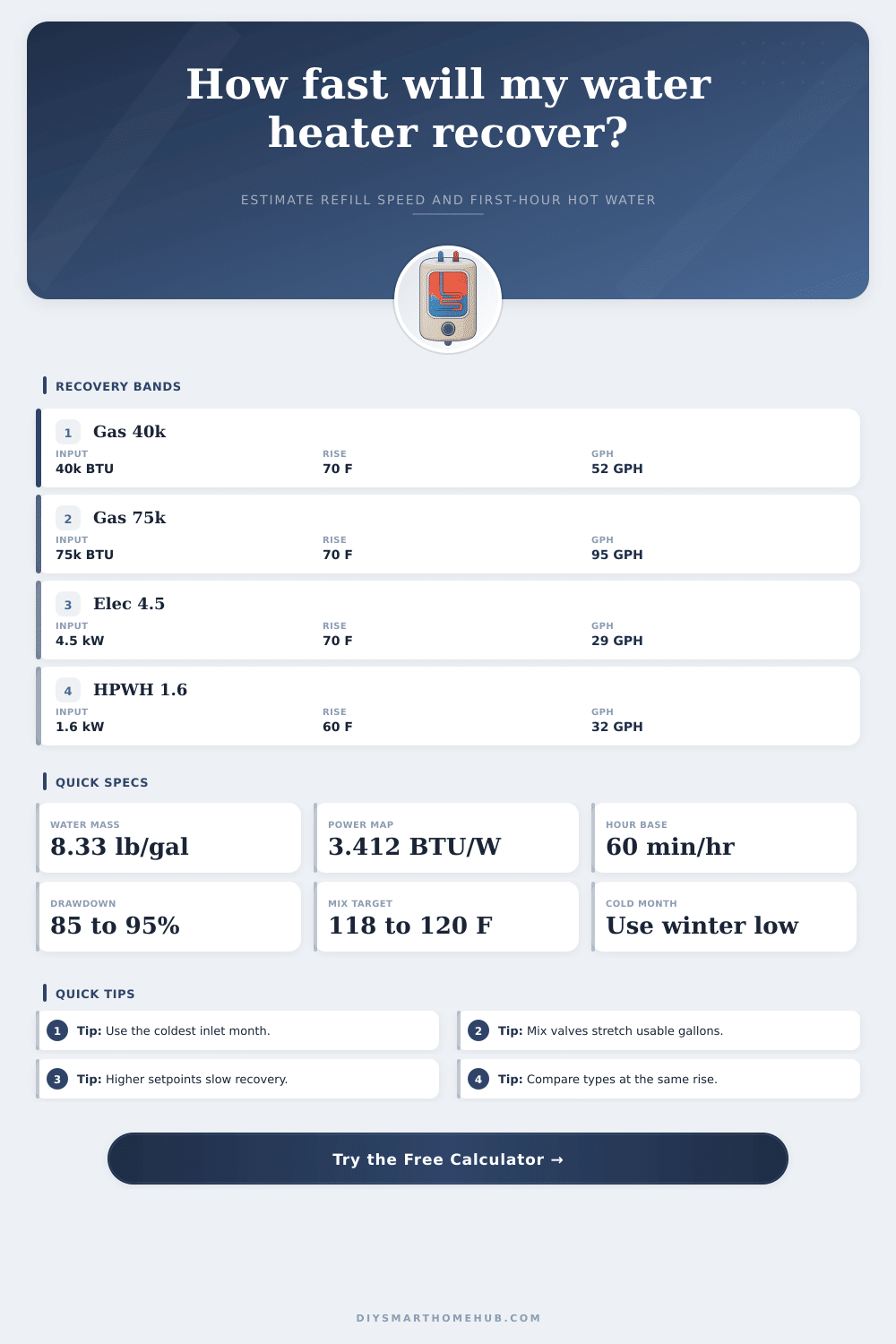
Compare gas, propane, electric, and hybrid water heaters by actual refill speed. This calculator estimates tank recovery rate, mixed delivery gallons, first-hour availability, and recovery time after a real hot water event.
Each preset loads a realistic heater type, storage size, temperature rise, drawdown, event size, and recovery window so you can compare recovery behavior before fine-tuning the details.
These built-in reference cards compare the heater families loaded into the calculator. They help you see how nominal input, efficiency, and typical recovery behavior shift from one technology to another.
Incoming Water Temperature Bands
Cold inlet temperature swings recovery rate more than most homeowners expect.
| Condition | Inlet | Metric | Recovery effect |
|---|---|---|---|
| Sunbelt summer main | 70 deg F | 21 deg C | Fastest rise and strongest GPH |
| Temperate shoulder season | 60 deg F | 16 deg C | Balanced everyday benchmark |
| Cold winter municipal | 45 deg F | 7 deg C | Slower refill after long draws |
| Deep well cold snap | 38 deg F | 3 deg C | Steep rise and sharp drop in GPH |
Typical Heater Recovery Benchmarks
Guide values assume common nameplate inputs and realistic efficiency factors.
| Heater type | Input | Eff or COP | 70F rise result |
|---|---|---|---|
| Atmospheric gas | 36k BTU/hr | 0.76 | 47 GPH |
| Power vent gas | 45k BTU/hr | 0.82 | 63 GPH |
| Condensing gas | 76k BTU/hr | 0.94 | 122 GPH |
| Electric dual-element | 4.5 kW | 0.99 | 29 GPH |
| Hybrid heat pump | 1.6 kW | 2.8 | 31 GPH |
Common Hot Water Event Sizes
Pair these draw sizes with the event field to see how fast your tank can catch up.
| Event | Delivered gallons | Typical flow | Recovery note |
|---|---|---|---|
| Quick shower | 15 to 20 gal | 2.0 gpm | Easy test for small tanks |
| Back-to-back showers | 30 to 40 gal | 2.0 to 2.5 gpm | Good first-hour stress case |
| Dishwasher plus shower | 22 to 28 gal | Mixed fixture load | Shows overlap more than storage |
| Whirlpool tub fill | 45 to 70 gal | 4.0 gpm | Often exceeds storage without mixing |
Tank Size and Mixed Gallon Guide
Guide assumes 135 deg F storage, 120 deg F delivery, 55 deg F inlet, and 90 percent drawdown.
| Tank size | Usable mixed gallons | Metric | Best fit |
|---|---|---|---|
| 40 gal | 44 gal | 167 L | One shower stack |
| 50 gal | 55 gal | 208 L | Small family routine |
| 65 gal | 72 gal | 273 L | Hybrid high-efficiency homes |
| 80 gal | 88 gal | 333 L | Tub-heavy or larger households |
Tip Box: Choose the coldest inlet month
Recovery rate falls whenever the cold water entering the tank gets colder. If you only test summertime inlet temperatures, winter refill time will look much better than real life.
Tip Box: Mixing valves change usable gallons, not burner speed
Raising tank setpoint and blending down to a safe delivery temperature can stretch stored hot water, but the heater still recovers based on the full tank temperature rise.
The recovery rate of a water heater shows how much warm water it can deliver during a given time. You measure it in gallons per hour (GPH). It depends direct on the energy that you use, and on the temperature rise.
The value ranges according to the model: it estimates the tank size, the heat source and the strength of the burner or heater. For all devices you determine this number according to standards of the Air Conditioning, Heating, and Refrigeration Institute.
What Is a Water Heater Recovery Rate
do not mix the recovery rate with the first hour amount. The first hour rating is made up of 70 percent of the tank capacity plus the recovery rate. To estimate it, you multiply the tank volume by means of 0.7 and add the recovery rating.
For instance, a water heater with 40 gallons and 36,000 BTU burner gives 40 × 0.7 = 28 gallons plus 49.9 GPH, so entirely 77.9 gallons for the first hour. Always count using winter water temperatures.
Different heat sources affect the pace of warming. A gas water heater with strong burner recovers more gallons per hour than little electric version with low kilowatt rating. Typical home tank models, gas or electric, have a recovery rate between 40 and 60 gallons per hour.
Average water heaters recovers around 40 gallons of warm water in hour. For a 50-gallon electric tank with 4500 W it requires 60 until 90 minutes for full recover. A gas model with 40, 50,000 BTU/h burner reaches full rocover in 20 until 40 minutes.
Using gas and electric energy at the same time you get fast recovery. For instance, only electric system reaches around 6 gallons per hour. Only gas version can reach around 10 gallons per hour.
Together they give around 16 gallons per hour. Models like the Suburban 6-gallon gas water heater have 10.2 gallons for hourly recovery. Combined gas electric devices with 1440-watt heater add 6.0 gallons per hour.
The recover time matters only if the warm water ends entirely and you require it immediately. At a heat pump water heater with overnight recovery the time does not care. Instead of little unit you install big model with high recovery, as 75-gallon, for have more water available.
High recovery device recovers also more quickly. You can add circulation warm water recovering system, that halvs the recovery time for showers. Natural gas water heater with high recovery produce warm water quickly.
40,000 BTU’s model can have ultra low NOx gas burners and good tank protection.