🛁 Water Heater Energy Calculator
Estimate your water heater’s annual energy consumption, efficiency, and daily usage in kWh or therms
| Household Size | Avg Daily Usage (gal) | Avg Daily Usage (L) | Recommended Tank Size |
|---|---|---|---|
| 1 Person | 20–30 gal | 76–114 L | 30–40 gal |
| 2 People | 40–55 gal | 151–208 L | 40–50 gal |
| 3–4 People | 60–90 gal | 227–341 L | 50–60 gal |
| 5–6 People | 90–120 gal | 341–454 L | 60–80 gal |
| 7+ People | 120+ gal | 454+ L | 80+ gal or tankless |
| Heater Type | Annual kWh | Annual Therms (gas) | EF / UEF Range |
|---|---|---|---|
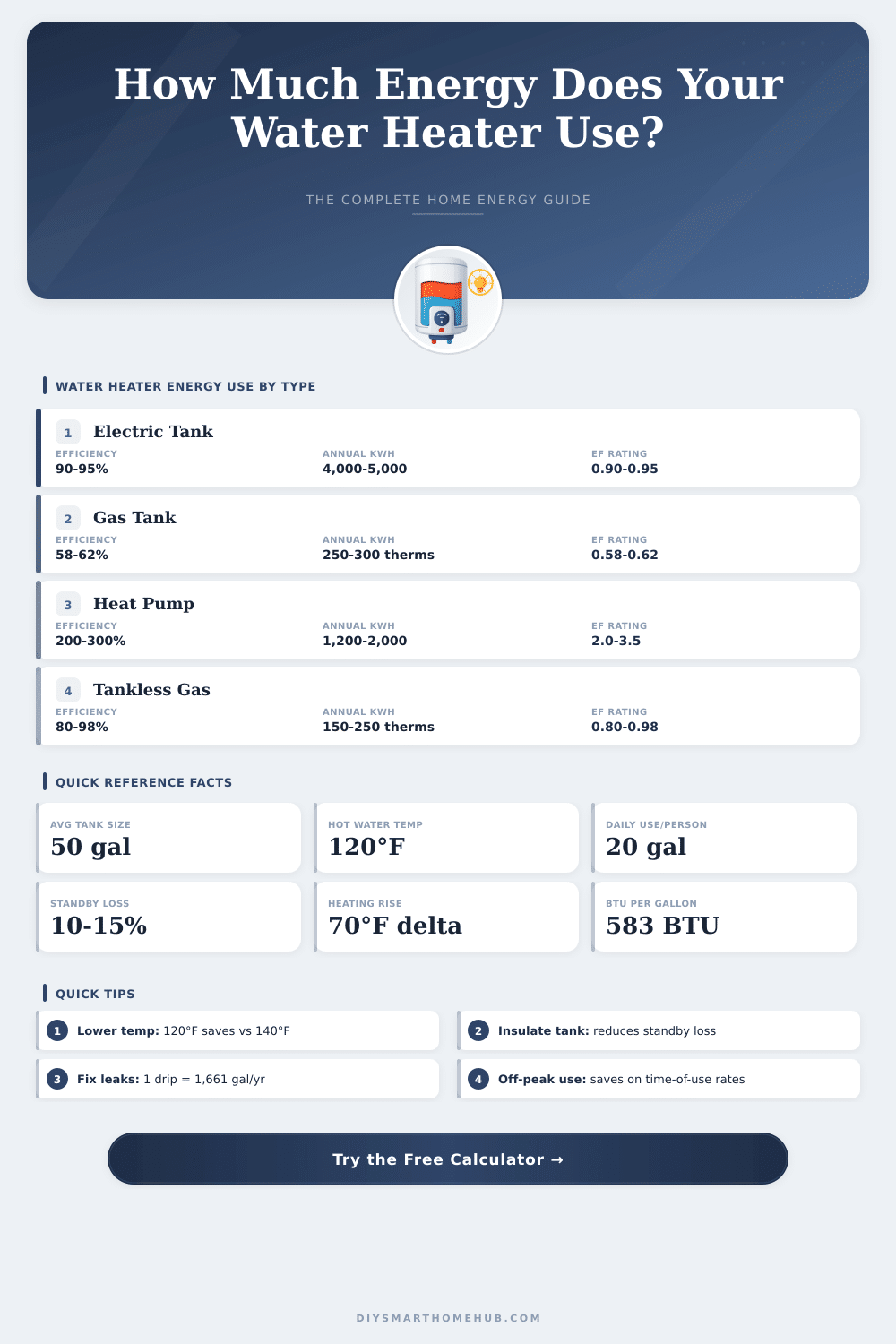
| Electric Tank (50 gal) | 4,000–5,500 | — | 0.90–0.95 |
| Gas Tank (50 gal) | — | 245–310 | 0.58–0.70 |
| Heat Pump (50 gal) | 1,200–2,200 | — | 2.0–3.5 |
| Tankless Gas | — | 150–250 | 0.82–0.98 |
| Tankless Electric | 3,200–4,200 | — | 0.96–0.99 |
| Solar Assisted | 800–1,800 | — | 0.80–2.20 |
| Propane Tank | — | 270–340 (gallons propane) | 0.58–0.65 |
| Oil-Fired Tank | — | 120–160 (gal oil) | 0.53–0.60 |
| Temp Rise (°F) | Temp Rise (°C) | BTU per Gallon | kWh per Gallon |
|---|---|---|---|
| 40°F rise | 22°C rise | 333 BTU | 0.098 kWh |
| 50°F rise | 28°C rise | 417 BTU | 0.122 kWh |
| 60°F rise | 33°C rise | 500 BTU | 0.147 kWh |
| 70°F rise | 39°C rise | 583 BTU | 0.171 kWh |
| 80°F rise | 44°C rise | 667 BTU | 0.195 kWh |
| 90°F rise | 50°C rise | 750 BTU | 0.220 kWh |
| 100°F rise | 56°C rise | 833 BTU | 0.244 kWh |
Domestic water heaters consume big part of the energy in house. It corresponds about around 18% of the whole domestic energy use. Usually it is the second biggest expense of energy in homes.
In United States, water heaters of various kinds take around 13 percentages from the household energy use. That surpasses the energy for cook and cool together. Houses commonly discharge between 400 and 600 dollars yearly for heat water used for laundry, showers and dishwashing.
Home Water Heaters: Types, Energy Use and Costs
Various water heaters consume energy according to dissimilar modes. Water heaters with heat pump move heat of one place to another by means of electrical energy, instead of generate it directly. Hence they can be two until three occasions more efficient than average electrical resistance heaters.
Heat pump model with ENERGY STAR-label uses only quarter of the energy comparatively to standard type. Split heat pump water heaters have internal water tank and exterior compressor. Those ENERGY STAR-models well heat water even during exterior temperature fall until -25°F.
Without armor or instant water heaters bid other variant. Because they do not heat water when it no used, they operate only around 2 hours day. In houses that requires 41 gallons or fewer warm water day, they are 24 until 34% more efficient than those with tank.
In houses with 86 gallons or more water day, they surpass in 8 until 14%. Without armor models also spare energy, because they must not keep big tank of warm water. Even so, heat water immediately require much energy.
One measures the efficiency by means of UEF ratings. Those ratings separate water heaters in four categories according to amount of used warm water, called bins. One assigns UEF-number to heater according to its first-hour skill inside his bin.
Higher UEF shows bigger energy efficiency and reduced functional cost comparatively with others in same bin. No-solar water heaters receive ENERGY STAR-attestation if they accomplish UEF-criteria. The efficiency depends also of kind of heater, amount of used warm water, loss during pause and local electrical prices.
In RV vehicles, water heaters have several energy sources. Many models operate by means of propane and electricity. If model has both gaseous and electrical option, it can use propane either 120V-electricity.
Using only electrical energy for heat water, you can nul the expense in long station where you pays electricity. Even so, electrical warming in dry camping quickly empties the batteries. Some RV water heaters have electrical element that works only when connected to shore energy.
You can use campfire for warm water by means of heat exchanger either vapor-generated electricity.