Washing Machine Energy Consumption Calculator
Estimate washer machine energy, electric-equivalent hot water energy, standby use, monthly kWh, and yearly kWh from real laundry cycle settings.
Washing Machine Energy Results
| Washer profile | Typical machine energy | Water per load | Best calculator check |
|---|---|---|---|
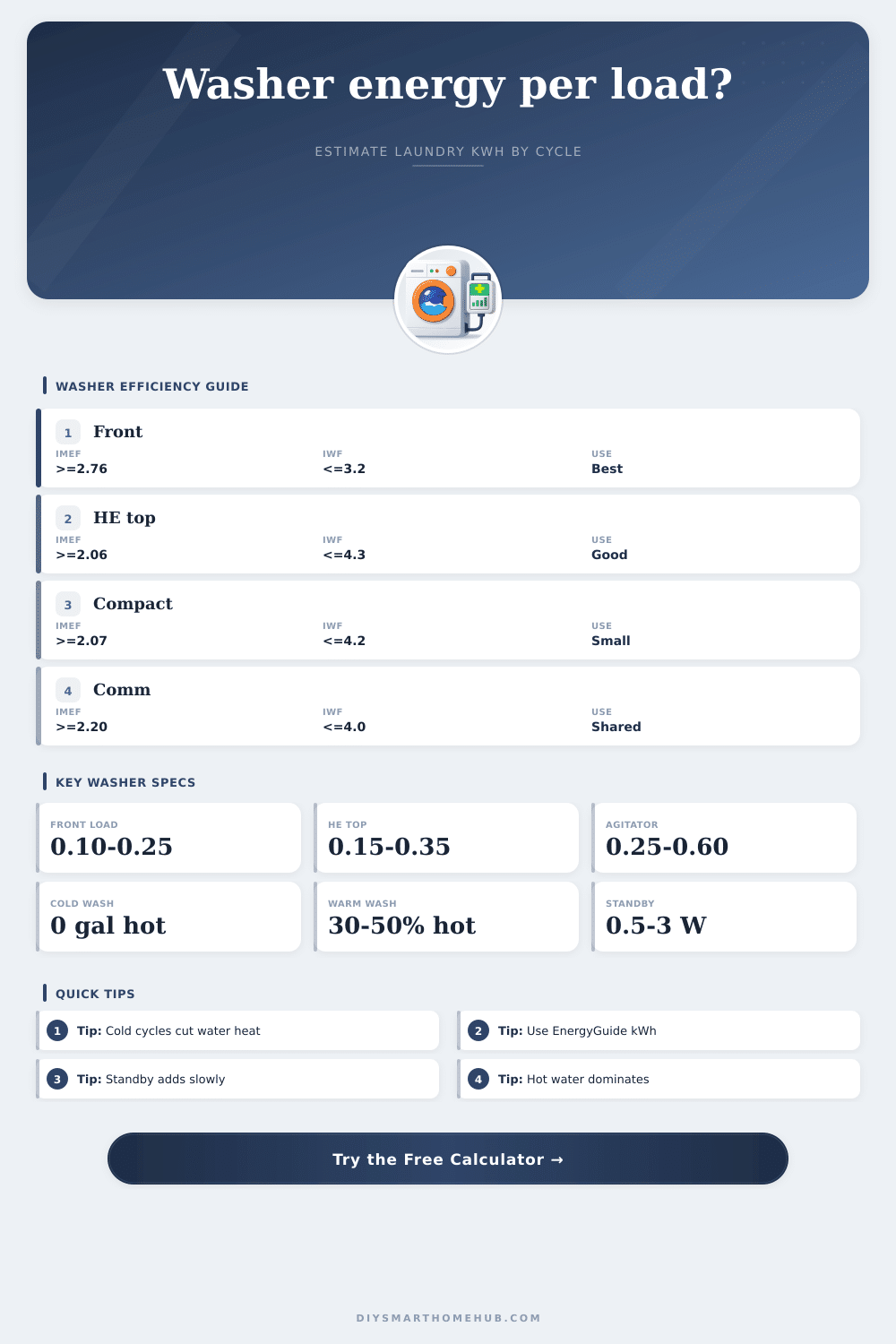
| ENERGY STAR front load | 0.10 to 0.25 kWh before hot water | 12 to 16 gal | Low IWF and strong spin |
| ENERGY STAR HE top load | 0.15 to 0.35 kWh before hot water | 16 to 24 gal | Moderate water and motor use |
| Conventional agitator top load | 0.25 to 0.60 kWh before hot water | 28 to 42 gal | Water volume drives heat energy |
| Compact washer | 0.08 to 0.22 kWh before hot water | 7 to 12 gal | Small capacity, lower gallons |
| All-in-one wash cycle | 0.18 to 0.45 kWh before hot water | 11 to 18 gal | Do not include drying mode here |
| Portable compact washer | 0.06 to 0.18 kWh before hot water | 5 to 9 gal | Short cycles, small loads |
| Commercial front load | 0.18 to 0.45 kWh before hot water | 14 to 22 gal | High loads per week matter most |
| ENERGY STAR class | Efficiency minimum | Water maximum | What it means in this calculator |
|---|---|---|---|
| Residential front load above 2.5 cu ft | IMEF at least 2.76 | IWF 3.2 or lower | Use 12 to 16 gallons for many full-size loads |
| Residential top load above 2.5 cu ft | IMEF at least 2.06 | IWF 4.3 or lower | Use 16 to 24 gallons for HE top loaders |
| Residential compact 2.5 cu ft or less | IMEF at least 2.07 | IWF 4.2 or lower | Use 7 to 12 gallons for compact cycles |
| Commercial clothes washer | MEF J2 at least 2.20 | IWF 4.0 or lower | Multiply carefully for shared laundry volume |
| Cycle setting | Temp rise used | Typical hot share | Energy effect |
|---|---|---|---|
| Normal cold | 0 F | 0% | Machine energy is the main kWh load |
| Normal cool | 10 F | 20% | Small hot-water contribution |
| Normal warm | 40 F | 35% to 50% | Hot water can exceed motor energy |
| Heavy hot | 70 F | 60% to 80% | Water heating often dominates |
| Quick cold | 0 F | 0% | Lower time and no hot-fill energy |
| Sanitize or allergen | 90 F | 50% to 80% | Higher washer watts or hot water energy |
| Common laundry scenario | Starting inputs | Expected result band | Most sensitive input |
|---|---|---|---|
| Efficient front-load cold washing | 7 loads/wk, 500 W, 55 min, 14 gal | About 0.46 kWh/load or 3.2 kWh/week | Cycle minutes |
| Warm family laundry | 7 loads/wk, 14 gal, 35% hot, 40 F rise | About 0.94 kWh/load or 6.6 kWh/week | Hot-fill share |
| Older top-load warm cycles | 8 loads/wk, 32 gal, 45% hot, 40 F rise | Can exceed 15 kWh/week | Water gallons per load |
| Compact apartment cold loads | 4 loads/wk, 350 W, 60 min, 10 gal | About 1.4 kWh/week | Machine watts |
| Shared laundry room | 20 loads/wk, 800 W, 40 min, 18 gal | Often 14 to 25 kWh/week | Loads per week |
Laundry machines uses two different type of energy to operate: mechanical energy and thermal energy. The mechanical energy are used to power the motor and the pump in the laundry machine. The thermal energy is used to heat the water in a laundry machine.
Many people believes that the laundry machine uses the motor as the source of the energy. However, the thermal energy used to heat the water is more larger source of energy usage. Whether the laundry machine use an element in the laundry machine to heat the water or if a water tank in the laundry room provides the water, energy are required to heat the water from an initial temperature to a higher temperature.
How Laundry Machines Use Energy and How to Save It
If you choose a laundry machine that use cold water, the machine will primarily use mechanical energy. However, if you choose a laundry machine that use warm or hot water settings, the laundry machine will use more thermal energy. The type of laundry machine can have an impact on the amount of thermal energy that is require of the laundry machine.
Top-loading laundry machines tend to use more water than front-loading machines. Therefore, these older type of laundry machines will require more thermal energy to heat the water used for the laundry load. High-efficiency front-loading laundry machines use less water and, therefore, require less thermal energy for heating the water.
Additionally, moddern type of laundry machines may have a “phantom load.” A phantom load is the energy the laundry machine uses even when the machine are not performing it’s main function. Modern laundry machines may contain computers that is connected to WiFi, or that have display screens that are continuously lit. The frequency with which you use your laundry machine can also have an impact upon the total energy cost of the laundry machine.
For instance, it is possible that a person use an energy-efficient laundry machine more frequently than an inefficient laundry machine. Consequently, the energy costs of the energy-efficient laundry machine can be higher. Therefore, it is necessary to track the number of times with which you run the laundry machine each week.
By calculating the number of times that you run the laundry machine, you can gain an understanding of how your laundry habit will impact your energy costs each month. Additionally, many laundry machines contain technical label with information regarding the amount of energy and water that the laundry machine uses. The energy efficiency rating on these laundry machines indicate the amount of energy that the machine uses with respect to the volume of laundry that are washed.
Information regarding the amount of water that the laundry machine uses with respect to the volume of laundry that is wash is also provided on these labels. The best way to reduce the energy that is used by the laundry machine is to change the water temperature for the laundry machine. Many of the detergents that are available today are manufactured to work with the water in clothes washing machines that use cold temperature.
Thus, if you change the water temperature for your laundry machine to cold water, you can eliminate the thermal energy that is used to heat the water. Instead, you will only use the mechanical energy in the machine to turn the motor and the pump. If you must use hot water to clean fabric like towels or bed sheets, it is best to await when you have a large load of laundry before you start the hot water cycle.
Using hot water for a load of laundry all the way from start to finish will use less energy per piece of clothing then using hot water for a few small loads of laundry. Thus, by monitoring your kilowatt hours and by using cold water for your laundry, you will be able to control the energy that is used for the laundry machine. It should of been noted that many peoples laundry habit can be changed.