Ventilation Rate Calculator
Estimate residential outdoor air, local exhaust, ACH, CFM, L/s, and runtime-adjusted fan capacity. The calculator separates whole-home standards, person/area logic, room air-change targets, and bath or kitchen exhaust so each result uses the right formula.
🎯Ventilation Presets
⚙Ventilation Inputs
📊Live Airflow Snapshot
🛠Ventilation Device/Spec Comparison Grid
📐Whole-Home Reference Examples
| Dwelling example | Formula path | CFM result | L/s result |
|---|---|---|---|
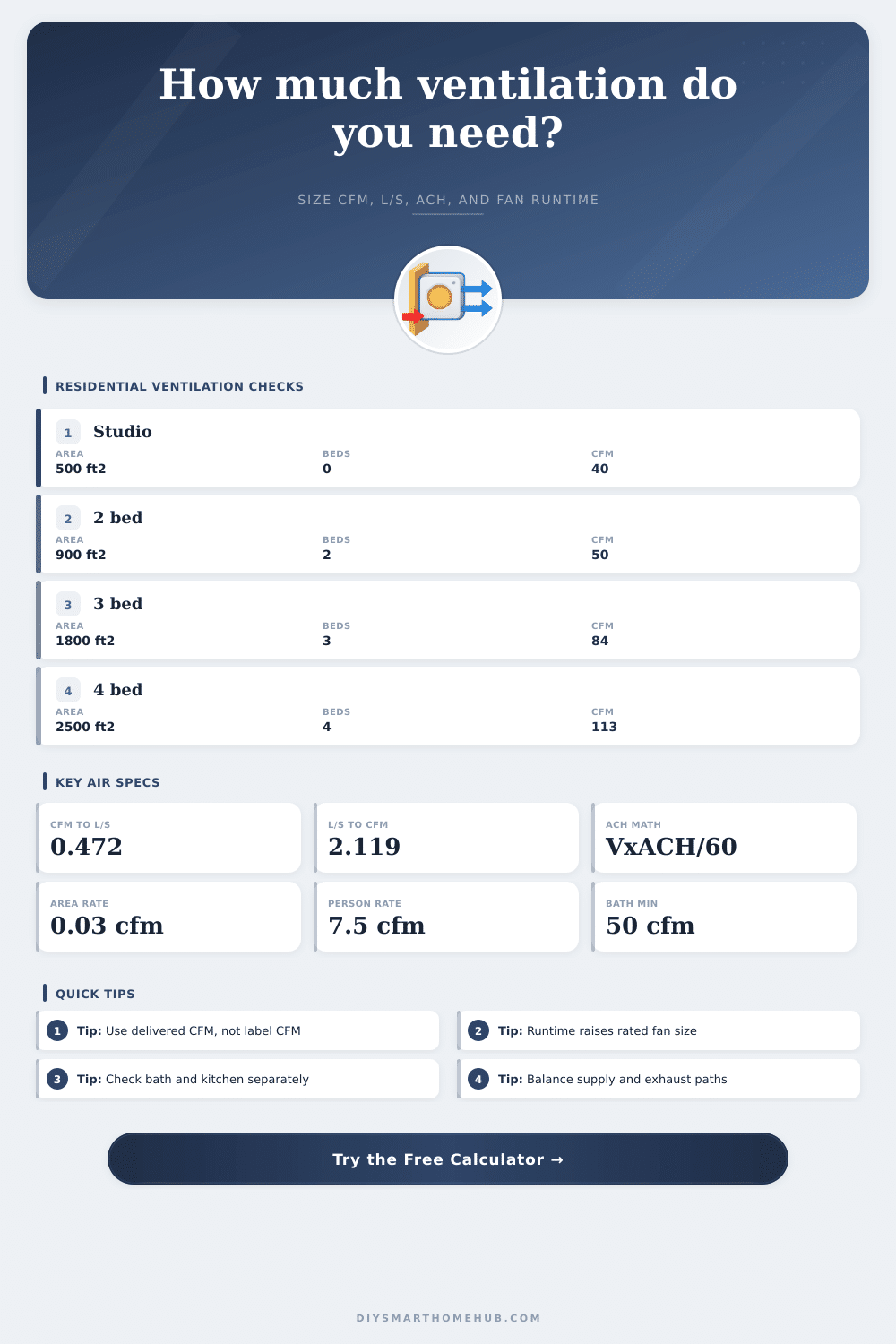
| 500 ft² studio, 0 bedrooms | 0.03 x 500 + 7.5 x 1 | 22.5 CFM | 10.6 L/s |
| 900 ft² apartment, 2 bedrooms | 0.03 x 900 + 7.5 x 3 | 49.5 CFM | 23.4 L/s |
| 1,800 ft² house, 3 bedrooms | 0.03 x 1800 + 7.5 x 4 | 84 CFM | 39.6 L/s |
| 2,500 ft² house, 4 bedrooms | 0.03 x 2500 + 7.5 x 5 | 112.5 CFM | 53.1 L/s |
🔁ACH and Room Target Reference
| Use case | Typical target | Formula used | Best result to watch |
|---|---|---|---|
| General residential room | 0.35 ACH | CFM = ACH x volume / 60 | Continuous CFM and ACH |
| Bedroom CO2 watch | 15 CFM/person and 0.5 ACH floor | Max(person CFM, ACH CFM) | Person load plus ACH floor |
| Basement fresh air | 0.5 ACH or person/area | Max(ACH CFM, people + area CFM) | Moisture and occupancy dilution |
| Garage workshop dilution | 6 ACH while occupied | 6 x volume / 60 | Intermittent fan rating |
| Hobby or VOC room | 8 ACH while active | 8 x volume / 60 | Delivered exhaust CFM |
🚿Local Exhaust Reference
| Local source | Intermittent reference | Continuous reference | Calculator treatment |
|---|---|---|---|
| Small bathroom | 50 CFM minimum | 20 CFM common minimum | Max of 50 CFM or 1 CFM/ft² |
| Large bathroom | Fixture sum or area | Continuous equivalent allowed | Uses area and ACH proxy when fixture count is unknown |
| Range hood over cooking | 100 CFM minimum | Continuous kitchen exhaust varies by code path | Max of 100 CFM or 5 ACH enclosed |
| Laundry or utility room | 50 CFM practical minimum | 20-25 CFM typical continuous check | Max of 50 CFM or 6 ACH |
🔢Conversion and Formula Reference
| Need | Formula | Imperial | Metric |
|---|---|---|---|
| CFM to L/s | CFM x 0.47194745 | 100 CFM | 47.2 L/s |
| L/s to CFM | L/s x 2.11888 | 106 CFM | 50 L/s |
| ACH to CFM | ACH x ft³ / 60 | 0.35 ACH | Same air-change math |
| Rated intermittent fan | Continuous CFM / duty fraction | 60 CFM at 30 min/hr needs 120 CFM | 28 L/s at 50% needs 56 L/s |
💡Ventilation Calculation Tips
A ventilation rate calculator help to determine the amounts of fresh air that a space require. Using a ventilation rate calculator allow people to determine the exact amount of air that a space require by taking into account the size of the space and the number of individual that live in that space. By using this calculator, individuals can choose the proper sized of a fan for the space that they are considering use it in.
To use the ventilation rate calculator, individuals will need to provide a few different piece of information regarding the space that is to be vented. For example, individuals will need to input the area of the space that is to be vented as well as the height of the space. These two measurement will help the calculator to calculate the total volume of air that will need to be moved in order to ensure that the air within the space is fresh and usable by those in the area.
How to Use a Ventilation Rate Calculator
Additionally, other inputs will include the number of bedroom within the space or the total number of individual that live in the area. Because humans excrete moisture and carbon dioxide into the atmosphere, the number of individual within an area is used to calculate how much moisture that will need to be removed from that area. Based off the type of ventilation that is to be provide for a space, there are different target for the amount of air that will be moved through that space.
For instance, if the ventilation is to be performed for the entire house, the targets for each house will be different than targets that are created for the removal of moisture from a specific location within the house, such as the bathroom. Each location create different ventilation targets due to the specific reasons for which the ventilation is to be performed within that area of the house. In addition to considering the type of ventilation that is to be provide for an area, it is also important to consider the amount of time that the fan will be running.
Fans cannot typically run at full capacity for every hour of the day, so the ventilation rate calculator can create an adjustment in the total capacity for the fan according to the amount of time that it will be running. Additionally, the calculation will also create an adjustment for the delivery of the air within the house. For instance, air can become lost through the ducts or the grilles for exhaust fans.
Thus, the ventilation rate calculator can provide individuals with an understanding of the amount of air that will need to be deliver to the area of concern, as well as the total amount of airflow that the fan will need to possess in order to provide that amount of air to the area when it is not running at full capacity for every hour of the day. In addition to these factor, it is also helpful for individuals to consider the balance of air within the house. For instance, if the house continuously exhausts air out of the house, the house may create a negative balance of air within the structure.
Conversely, if air is only being provide to the house, it may lead to the house having a positive balance of air, which can allow moisture to enter the wall. Thus, while the ventilation rate calculator can provide individuals with an understanding of the amount of air that should be provide to the house, it does not create a plan for how the air should be balance within the structure. Another consideration for individuals is the sound level that the fan will create.
Though the fan may meet the requirements for the amount of air that is to be provide by the fan, it is possible that the individuals in the house will not utilize that fan if it is too loud. Thus, it is important for individuals to consider the sound that the fan will create when purchasing it. Some fans produce less sound than other.
Additionally, individuals should also consider the relationship between ventilation and insulation for the house. For instance, if a person construct a house in a way that allows for less air exchange with the outside environment, less energy will be used to heat or cool that house. However, it will also be necessary to ensure that the house has ventilation system to remove the indoor pollutant that are created by the individuals within that house.
Finally, individuals should consider how to verify the airflow within the space after the installation of the fan. The airflow within the space can be measured at the grille, and the measurement will help to ensure that the necessary amount of air is being deliver to the space. Additionally, it will also allow individuals to ensure that the house is not losing too much of its air to the ducts.
Thus, the ability to verify the airflow will allow individuals to decide when it is necessary to perform maintenance on the house and its duct. While the ventilation rate calculator can help to provide individuals with the target for the amount of air that should exit the space, it is also important for individuals to utilize that rate calculator to ensure that the fans that are to be purchased have the correct amount of capacity for the size of the room and the number of individual that live in the space.