UPS Battery Sizing Calculator
Estimate the battery watt-hours, DC amp-hours, UPS VA rating, and 12 V module count needed to keep smart home gear online during an outage.
Calculation Breakdown
| Battery Type | Typical Usable DoD | Rate Allowance | Good Fit |
|---|---|---|---|
| Sealed lead acid UPS blocks | 50% | 82% | Short runtime desktop and small network UPS banks |
| AGM deep-cycle lead acid | 55% | 88% | Longer router, NVR, and smart panel backup |
| Gel lead acid | 50% | 86% | Moderate loads where sealed construction matters |
| Lithium iron phosphate | 80% | 95% | High cycle life and long smart home outages |
| Lithium ion pack | 75% | 94% | Compact energy storage with controlled BMS limits |
| Nickel cadmium industrial | 65% | 90% | Harsh cabinets and industrial control backup |
Usable depth and rate allowances are planning values. The battery manufacturer's discharge curves should override generic assumptions for final equipment selection.
| UPS Type | Typical PF | Transfer Behavior | Best Smart Home Use |
|---|---|---|---|
| Standby UPS | 0.6 to 0.8 | Short transfer gap | Router, ONT, bridge, and low-power hub loads |
| Line-interactive UPS | 0.8 to 0.9 | AVR with fast transfer | Network closets, switches, NAS, NVR, and access points |
| Online double-conversion | 0.9 to 1.0 | No transfer interruption | Control cabinets and sensitive automation servers |
| DC UPS module | DC output | Battery rides DC bus | 12 V or 24 V modem, camera, panel, and DIN-rail loads |
| Device Group | Typical Watts | VA at 0.9 PF | Notes for Sizing |
|---|---|---|---|
| Fiber ONT plus WiFi router | 15 to 30 W | 17 to 34 VA | Long runtime is usually practical with modest battery size |
| Router, hub, and modem stack | 25 to 50 W | 28 to 56 VA | Good candidate for compact DC UPS or small line-interactive UPS |
| PoE switch with four cameras | 55 to 100 W | 62 to 112 VA | Include switch overhead and camera night-mode draw |
| NVR plus storage and network gear | 110 to 220 W | 123 to 245 VA | Storage startup can push short surge higher than running load |
| Automation cabinet with controller | 250 to 650 W | 278 to 723 VA | Use 24 V or 48 V bus sizing for high current loads |
| Project | Input Example | Primary Result | Secondary Result |
|---|---|---|---|
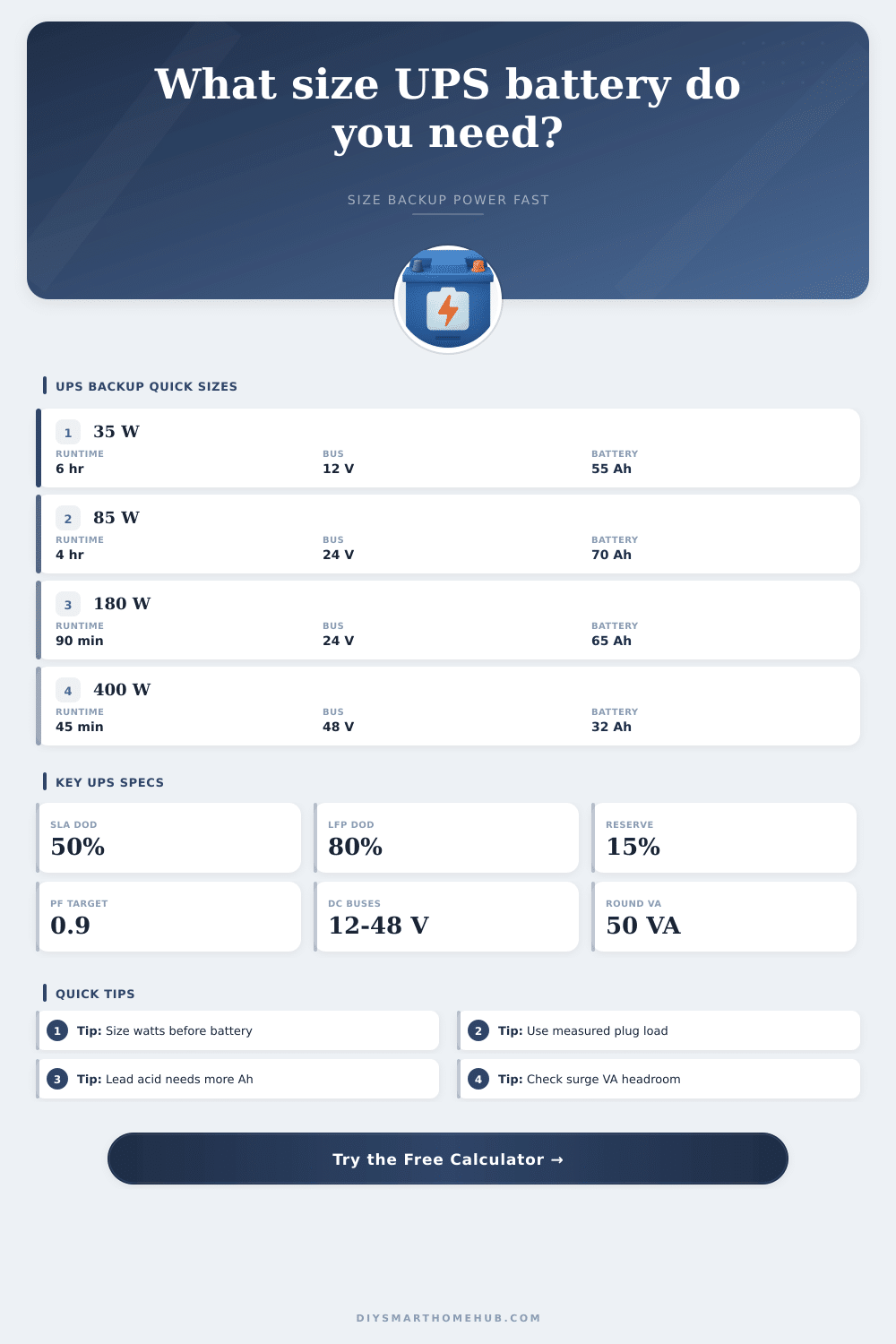
| Router and ONT continuity | 18 W for 8 hours | About 430 Wh SLA | 350 VA UPS class |
| PoE camera monitoring | 85 W for 4 hours | About 930 Wh AGM | 400 VA UPS class |
| NAS and network rack | 180 W for 90 minutes | About 740 Wh AGM | 600 VA UPS class |
| Apartment communications rack | 400 W for 45 minutes | About 850 Wh LFP | 850 VA UPS class |
| Whole-home controls | 900 W for 20 minutes | About 850 Wh LFP | 1550 VA UPS class |
When the power fails during a storm, many people may find that their internet router, security cameras, and other device in the smart home stop working. These devices require power to operate. People may think that the small battery that is included with each device is going to be sufficient to provide power to that device during a power outage.
However, such a battery may only be able to provide power for a short period of time. A person needs to understand the difference between a battery that can provide power for a short period of time as opposed to one that can provide enough power to keep those network devices operational for several hours. If a person guesses at how much power a network of devices require, then the battery may fail when the power outage occurs.
Pick the Right Battery for Your Home Network
When people look at the power adapters for network devices, the wattage ratings for those devices are often inaccuracy. For example, the router may indicate that it requires 30 watts of power to perform its function. However, the router may only require 12 watts of power when it is idling.
If you simply add up the wattage ratings for each device that the battery is to be powered by, then the battery will be larger than what is needed to power those devices. This will result in higher costs for the battery system. In order to determine how much power is actualy drawn by the devices, people should use a plug-in watt meter.
If the meter measures the power draw of each device, accurate data will be displayed on the meter. Using this data will help the person to not purchase a battery that costs too much money while also ensuring that there is enough power to maintain the network. Another factor that one must consider is that some of the power from the battery is lost during power conversion from direct current (DC) from the battery to alternating current (AC) that is required by the network devices.
In order for the DC power from the battery to be converted to the AC power that the devices require, an inverter is required. In the process of using the inverter to convert the DC power to the AC power, some of that power is converted to heat. That heat is waste power.
Because some of the power from the battery is wasted through the inverter, the capacity of the battery must be higher than what is required by the devices in order to account for the power that is lost in this conversion process. Another consideration is the chemistry of the batteries that are to be used in the battery system. Many battery systems that are relatively inexpensive contain lead acid batteries.
Lead acid batteries are relatively inexpensive but can be damaged if they are ever drained to less than 50% of their battery capacity. In contrast, lithium iron phosphate batteries can be intentional and deeply drained without damaging the batteries. Because the lithium iron phosphate batteries can be deeply drained, they can be much more small in physical size than lead acid batteries.
Although the cost of the lithium batteries is higher than the lead acid batteries, they will last longer and take up less space in the smart home network. The DC bus voltage to which the network devices are to be supplied with DC power is another factor. In most cases, a DC bus voltage of 12 volts is sufficient to power a single modem.
However, should one wish to add devices to the network, such as Power over Ethernet (PoE) switches or Network Video Recorder (NVR) systems, higher DC bus voltages would be required. Devices that are powered by DC bus voltages draw more current. The higher the current that the devices draw, the more heat that those devices create.
Furthermore, the higher the current that the devices draw, the more voltage drops that occur in the network. A 24 volt or 48 volt DC bus will reduce the current that is drawn by the devices. Furthermore, using a higher voltage that reduces the current allow for more batteries to be connected in series in the network without the use of excessively thick cables to distribute the DC power.
In addition to the factors mentioned above, one must also account for power surges in the network devices. A power surge can occur when a device within the network system starts up. For example, one of the devices that may draw significant power is a hard drive within a Network Attached Storage (NAS) system.
Another device that draws significant power are the infrared LEDs that is often in security cameras. When the system with these devices is powered by a battery system, the power surge that occurs when the devices start up may cause the overload protection for the system to trip. If the overload protection for the network devices trips, the entire network will crash.
To avoid this problem, the battery system should have some extra capacity provided for the system above the power draw of the network devices. This extra capacity is expressed as extra voltage and amperage for the system. As with any system that is used over time, batteries tend to age.
The battery that can provide four hours of power to the network devices today may not be able to provide that same amount of power in two years. Batteries degrade over time. To account for this, the battery system should include some reserve capacity for the battery system.
Fifteen percent of the power requirements for the network devices can be purchased as a reserve capacity for the battery system. This reserve capacity will act as a safety margin for the battery system. Furthermore, providing fifteen percent extra capacity to the battery system will ensure that the devices remains operational even as the battery ages.
One must ultimately decide what is more important to them: their budget or the risk of failure of their network system. If they are willing to sacrifice the reliability of their network system, they could purchase a small, stand-by UPS battery system. However, should they desire to maintain their home server or security system, they will have to consider the depth of discharge of the batteries as well as the DC bus voltage for the network.
Regardless of the system that is used, people want to ensure that there is a battery system that will provide power to their network when an outage of power occur.