Therms to Gallons of Propane Calculator
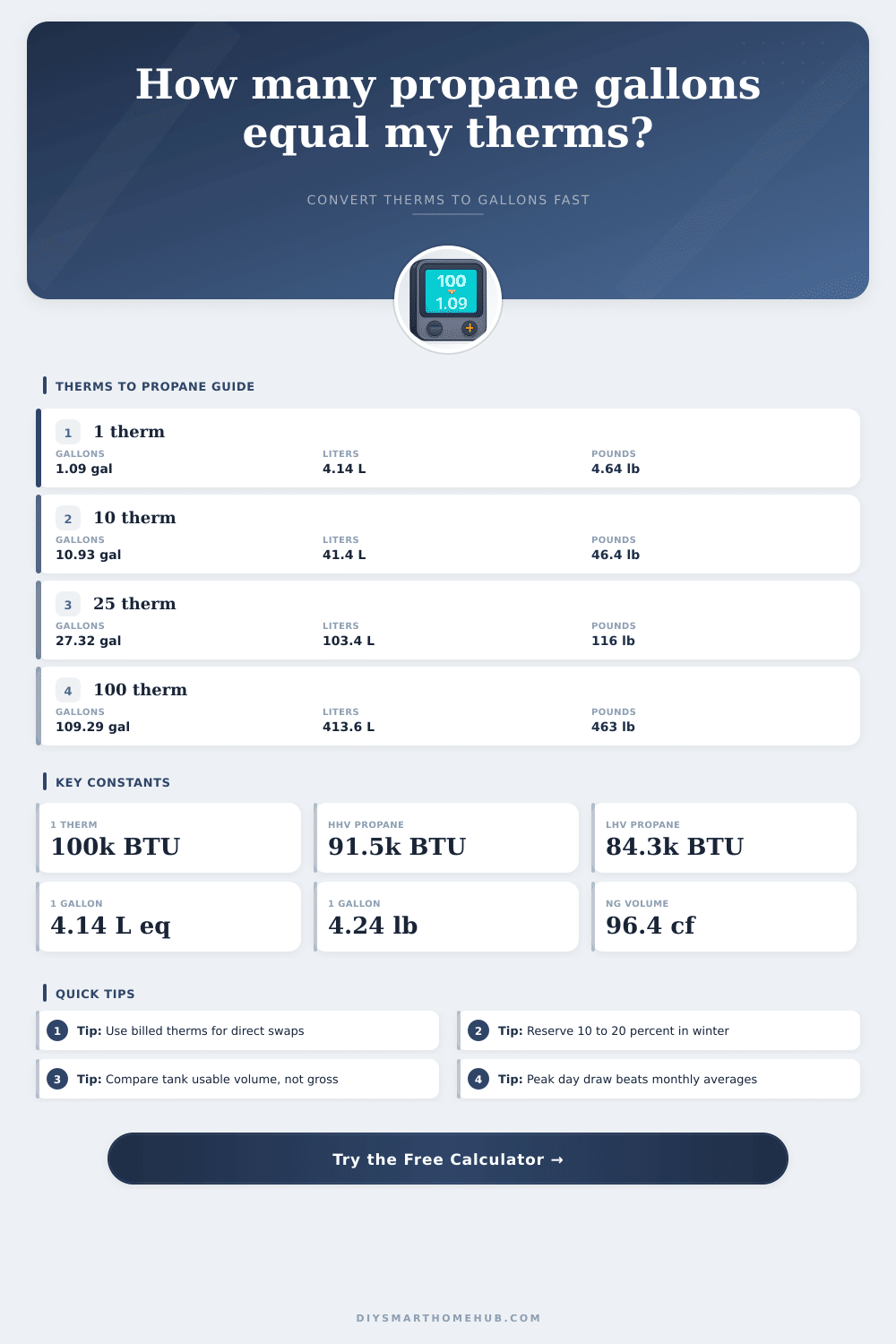
Convert therms into propane gallons, liters, pounds, and refill planning numbers. Match raw fuel energy or adjust for equipment efficiency when comparing natural gas with propane storage.
A 500 gallon tank with a 10% reserve can cover this load in one fill. Your cold-weather refill trigger is driven by the peak-day draw, not the monthly average.
| Therms | BTU Input | Gallons HHV | Liters HHV |
|---|---|---|---|
| 1 | 100,000 | 1.09 | 4.14 |
| 10 | 1,000,000 | 10.93 | 41.36 |
| 25 | 2,500,000 | 27.32 | 103.38 |
| 50 | 5,000,000 | 54.64 | 206.75 |
| 100 | 10,000,000 | 109.29 | 413.51 |
| Storage Type | Gross Capacity | Usable at 80% | 75 Therm Load |
|---|---|---|---|
| 20 lb cylinder | 4.7 gal | 3.76 gal | Needs 21.8 fills |
| 100 lb cylinder | 23.6 gal | 18.88 gal | Needs 4.3 fills |
| 120 gal tank | 120 gal | 96 gal | 85% of one fill |
| 250 gal tank | 250 gal | 200 gal | 41% of one fill |
| 500 gal tank | 500 gal | 400 gal | 20% of one fill |
| Therms per Day | Gallons per Day | 500 Tank Days | Peak Day at 1.5x |
|---|---|---|---|
| 1 | 1.09 | 330 days | 1.64 gal |
| 2 | 2.19 | 165 days | 3.28 gal |
| 4 | 4.37 | 82 days | 6.56 gal |
| 6 | 6.56 | 55 days | 9.84 gal |
| 8 | 8.74 | 41 days | 13.11 gal |
| Source to Propane | Useful Heat Basis | Gallons for 100 Therms | Change vs Direct |
|---|---|---|---|
| 100% to 100% | Raw fuel input | 109.29 gal | Baseline |
| 80% to 95% | Delivered heat | 92.04 gal | 16% lower |
| 82% to 96% | Delivered heat | 93.42 gal | 14% lower |
| 90% to 90% | Delivered heat | 109.29 gal | No change |
| 95% to 82% | Delivered heat | 126.57 gal | 16% higher |
Residential tanks usually hold 80 percent usable liquid at delivery, and winter planning often keeps another 10 to 20 percent untouched for stronger vapor pressure and cleaner refill timing.
If the therm number came from a gas bill but the propane appliance will be more efficient, delivered-heat mode is the better comparison because it trims gallons to match useful BTUs instead of raw fuel input.
A person may wish to convert the natural gas bill into a propane equivalent because a persons may be moving from a home that utilize natural gas to one that uses propane as its heating fuel. Natural gas bill list the amount of energy that a household used in the unit of therms. One therm is equivalent to 100,000 British Thermal Units (BTUs) of energy.
Propane contains BTUs of energy as well, but propane is measured in gallon. One gallon of propane contains approximately 91,500 BTUs of energy. Thus, one therm (100,000 BTUs) is equivalent to 1.09 gallon of propane.
Convert Natural Gas Therms to Propane Gallons
This unit of 1.09 gallons per therm is the unit that may be used as a baseline estimate of the amount of propane that would be required to provide the same amount of heat as natural gas. However, not all heating appliance are of the same efficiency. For example, an old furnace may have been 82% efficient at providing heat to a home with the amount of natural gas that it used, but a new propane furnace may be 95% efficient.
Thus, the propane furnace will require less fuel to provide the same amount of heat as an inefficient furnace. Because heating appliances use efficiency in the generation of heat, it is important to consider efficiency in the estimation of the amount of propane that would be required to heat a home. Appliances that is inefficient will require more fuel to provide the same amount of heat to a home as appliances that are more efficient.
Thus, if fuel efficiency is not considered, it is possible to either overestimate or underestimate the amount of propane that is required to heat a home. Beyond the efficiency of the heating appliances in the home, the capacity of propane tank must also be considered. A propane tank cannot be filled to capacity.
Most propane tanks are filled to only 80% of their total capacity to allow for the propane liquid to expand when hot and to allow for the propane to vaporize and be delivered to the furnace or other heating appliance. For example, a propane tank that has a 500-gallon capacity will only hold 400 gallons of propane (500 gallons x.8). Furthermore, individual should also leave space in the tank for a reserve of propane.
The reserve of propane allows for the proper vapor pressure of propane to be maintained, especially during cold weather. Additionally, individuals should also consider the period of peak propane usage within the year. Propane usage is typically higher during periods of extreme cold weather.
For instance, if an individual uses an average amount of propane while the weather is mild, the individual will require more propane during a cold weather period. Thus, to ensure that an individual does not deplete a propane tank of its propane during the coldest weather periods, an individual could calculate the amount of propane that will be used during those peaks by multiplying the number of gallons of propane that would be used daily at an average rate by a peak factor (such as.1.35) to determine the number of gallons of propane that will be required. Finally, another factor to consider is the type of propane tank from which propane will be purchased.
For example, large propane tanks are typically used to heat entire homes, but smaller propane tanks (cylinders) are used to heat smaller areas of a home, such as a garage or kitchen range. One 20-pound propane tank holds approximately 3.8 gallon of propane. Thus, if an individual requires 75 therms of energy per day, that individual will require numerous 20-pound propane tanks to supply that amount of energy.
The 20-pound propane tanks would provide less energy than the large propane tanks required to heat an entire home. Another way to determine the amount of propane in gallons or liters that is required to provide the amount of heat that is measured in therms on a natural gas bill would be to utilize a reference table that shows the number of therms that a certain number of gallons of propane (or liters of propane) provides. For instance, a reference table may indicate that 100 therms is equivalent to 109 gallons (or 414 liters) of propane.
Furthermore, if an individual uses 4 therms of energy per day, the individual will use 4.4 gallons of propane per day. By knowing the number of gallons of propane that is used daily, an individual can determine how many days that the propane tank will provide heat for the individual or number of homes. Additionally, individual should continuously monitor the propane level in a tank so that propane deliveries can be scheduled in advance.
Propane gas is a delivered fuel; it does not remain within the home in the tank. Therefore, individual should schedule propane deliveries to occur prior to the propane tank becomes empty; deliveries may be delayed due to weather conditions. If individual knows the heating needs of the home and can provide for a propane reserve to last through the coldest portion of the winter, the individual will have enough propane to provide heat to the home throughout the winter season.