Thermocouple Voltage to Temperature Calculator
Convert raw thermocouple millivolts into compensated process temperature, compare common probe families, and see how cold-junction math, meter resolution, and probe drift affect the final reading.
📌Quick Presets
⚙Reading Inputs
Compensated Reading
Select a thermocouple type and convert a reading.
📊Thermocouple Family Grid
📖Type Comparison Table
Standard temperature spans come from the NIST ITS-90 thermocouple tables. Sensitivity values are practical near-room-temperature slopes for quick selection.
| Type | Range | Sensitivity | Best Environment | Watch For |
|---|
📏Millivolt Landmarks
These reference points show how far apart the families spread at the same actual temperature. Lower-slope noble-metal types demand cleaner millivolt resolution.
| Type | 0 °C | 100 °C | 500 °C | 1000 °C |
|---|
🌡Cold-Junction Offsets
The selected type decides how much millivolt offset a warm terminal block contributes before you solve for the actual hot-junction temperature.
| Terminal Temp | Equivalent EMF | Type Note | Use Case |
|---|
📋Preset Scenario Reference
Each preset back-calculates a realistic raw millivolt signal after subtracting the chosen cold-junction temperature for that scenario.
| Scenario | Type | Raw mV | CJ Temp | Hot Temp |
|---|
Tip: If your transmitter already reports a compensated millivolt equivalent, do not add cold-junction voltage again. Double compensation can shift the solved temperature by tens of degrees.
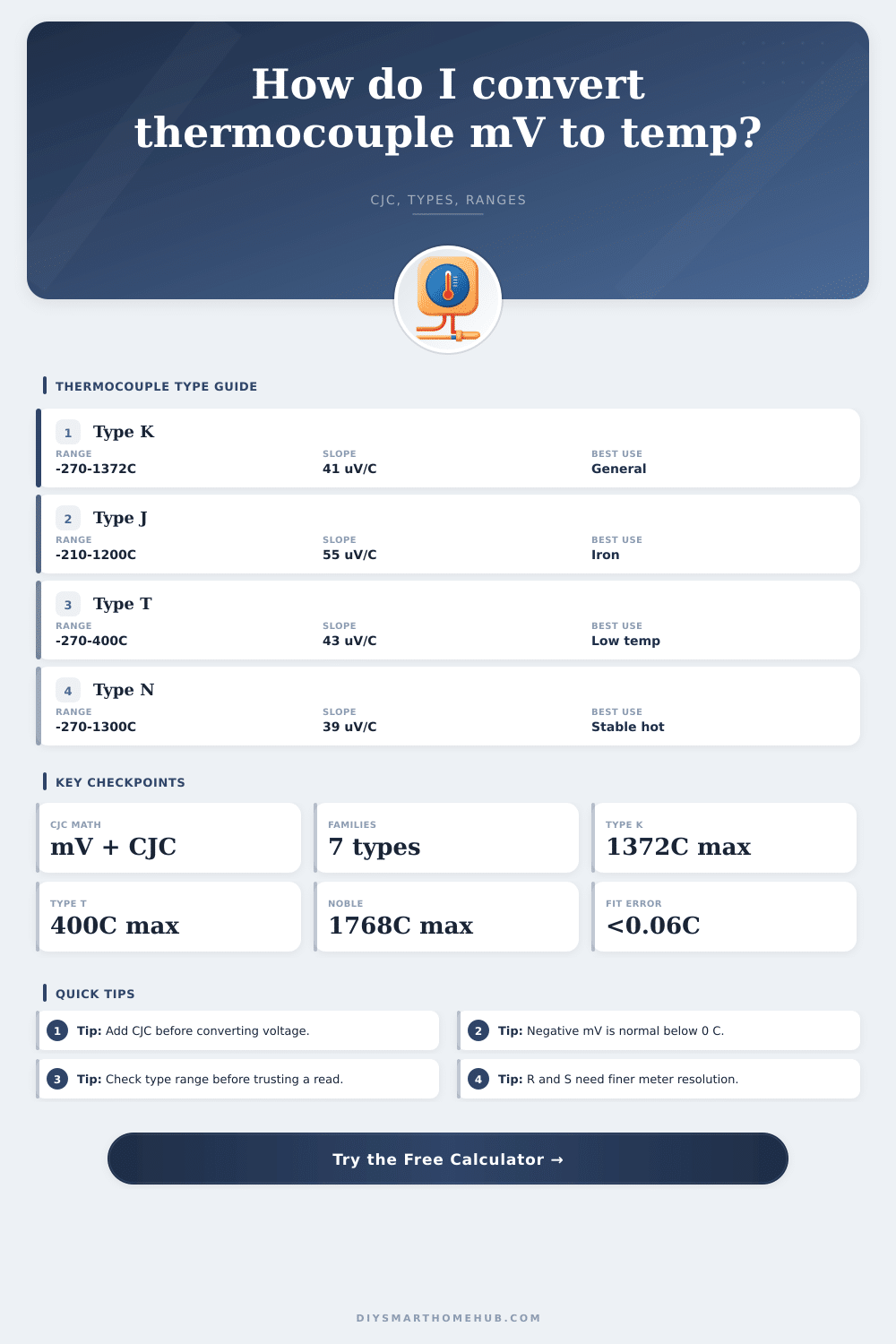
Tip: Negative thermocouple voltage is normal below 0 °C for base-metal types. Noble-metal types R and S have very small slopes, so poor terminal temperature estimates dominate the error fast.
Thermocouples dont measure the temperature; instead, thermocouples generate a small voltage based on the temperature difference between two junction. One junction is the hot junction, which is the part of the thermocouple that measure the temperature, while the other is a cold junction, which is the junction at the meter or transmitter. The thermocouple will produce a raw millivolt signal.
However, this signal is meaningless until the cold junction compensation are performed. If cold junction compensation is not performed, the temperature reading will be incorrect. For instance, the reading from an oven that measures 300 degree might display a much lower temperature if cold junction compensation isnt performed.
Thermocouples and Cold Junction Compensation
To convert the raw voltage from the thermocouple into degrees of temperature, the voltage must first be compensate for the reference junction, and then nonlinear polynomials must be used. Cold junction compensation must be performed because the temperature at the terminal blocks will affect the voltage that the thermocouple produce. Consider that the tip of a freezer probe is -30 degree.
The temperature of the tip will be lower than that of the terminal block, so the voltage will be negative. If cold junction compensation is not performed, the thermocouple will read the wrong temperature. Cold junction compensation add the equivalent voltage of the terminal temperature to the raw signal from the thermocouple.
Once you find the true hot-junction emf, it can be converted into the actual measured temperature using the NIST polynomials. Type T thermocouple are often used to measure low temperatures because the copper leg will keep the voltage linear. However, the voltage will no longer be linear when the temperature goes above 400 degree Celsius.
Thermocouples that use base metals, such as Type K, Type J, and Type T, are common. Base-metal thermocouples are common because they have decent sensitivity. Base-metal thermocouples will produce around 40 microvolt per degree.
For instance, a Type K thermocouple will read 300 degree Celsius in a duct reheat application. However, Type K thermocouples will have a significant slope between very low and high temperatures. Noble metal thermocouples will produce less voltage.
For instance, Type R and Type S thermocouple will produce 10 microvolt per degree or less. However, these types of thermocouples are ideal for furnaces that can reach 1600 degree Celsius because the base alloys will melt at those temperature. The issue with using inexpensive meters to measure noble metal thermocouples is that an error in millivolts will create a significant error in the degree that are displayed.
Cold junction errors will occur very frequent because the temperature at the terminals will differ from zero degrees. An ice bath will lock the temperature at zero degrees, but most control panels will be at 25 degree Celsius or higher. Using an RTD at the terminals can help reduce the error caused by cold junction compensation to less than one degree.
Guessing the temperature will result in an error of one and a half degree or more. For high accuracy in temperature measurement, use an industrial sheathed wire thermocouple with eight-sample averaging and fine resolution. These feature will allow the system to maintain an error of less than 0.6 degree Celsius.
The type of thermocouple that should be used with a process can vary. For instance, food boilers will use either Type J or Type K thermocouple. Additionally, smokers and mash tuns will use thermocouples of these two type.
For kilns, Type N thermocouple are used because they are more stable than Type K thermocouple. Furnaces will use noble metal thermocouples, specifically Type R and Type S thermocouple because they can withstand high temperatures. For cryogenic loops, Type T or Type E thermocouple are used because they have high voltage output.
Using the wrong type of thermocouple will damage the thermocouple; for instance, a Type J thermocouple will experience accelerated oxidation if used in a forge. The voltage that a thermocouple produces will change based on the type of thermocouple that is used and the temperature. For example, a Type K thermocouple will produce 4.2 millivolts at 128 degree Celsius in an espresso machine.
However, after cold junction compensation, the voltage will increase to 6 millivolts. For a Type N thermocouple in a pizza kiln at 850 degree Celsius, the voltage will be less than a Type K thermocouple because of the lower voltage slope of Type N thermocouple. For a Type R thermocouple used in a forge, 18 millivolt of emf will be produced.
However, the slope of Type R thermocouple is 10 microvolt per degree, so the temperature will vary significant at the control panel of the forge. The thermocouple will drift for a variety of reason. For instance, the thermocouple probe will age over time.
The industrial sheathing around the thermocouple will last longer in moist heat than in dry environments. Extension leads must be of the same alloy as the thermocouple; otherwise, the extra junction will impact the reading. Additionally, the radiant heat in the process can cause the sheathing to heat up unevenly.
This even heating will make the hot spots shift. Furthermore, the transmitter will perform cold junction compensation the first time. Performing the process a second time will create a large offset error.
Finally, negative voltage created by base-metal thermocouples when the temperature is below that of the reference junction are normal.