Tankless Water Heater BTU Calculator
Size a realistic tankless burner input from peak hot-water flow, temperature rise, unit efficiency, altitude derate, recirculation load, and reserve margin in one pass.
📋Preset Scenarios
🔧Project Inputs
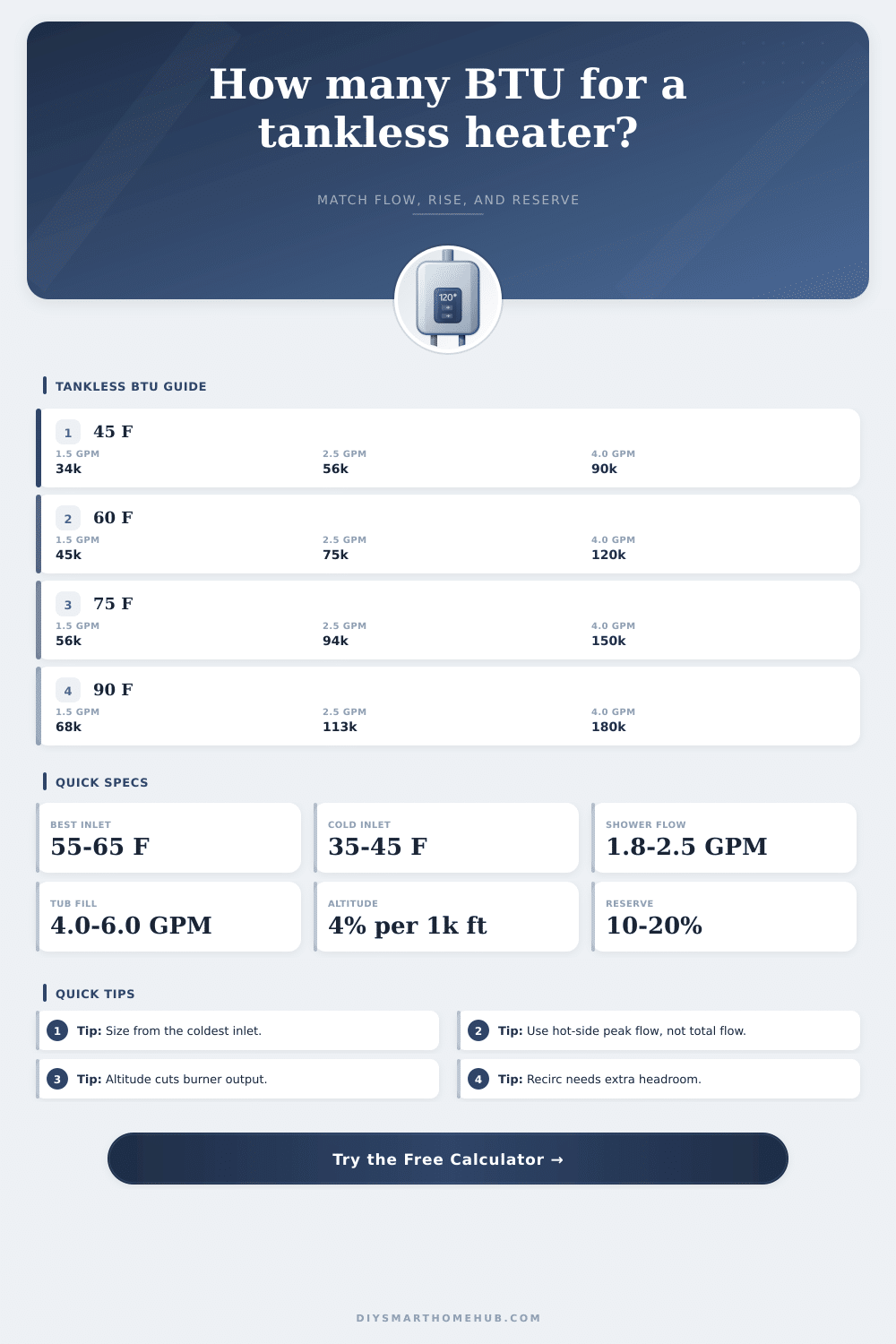
BTU per hour equals hot flow in GPM multiplied by 500 and then multiplied by the temperature rise in F.
This model uses a 4% derate for each 1,000 ft above 2,000 ft, capped so extreme sites still stay realistic.
If a shower head is 2.0 GPM and only about 70% is hot water, the tankless hot-side draw is closer to 1.4 GPM.
📊Results
💻Device and Spec Snapshot
🔍Device Comparison Grid
140k Compact
Usually fits one bathroom homes or warm-climate point-of-use loads.
- Best near 45-55 F rise
- About 2.6 GPM at 60 F rise
- Often non-condensing or compact condensing
160k Family Core
A common step for steady two-shower homes in moderate climates.
- About 3.0 GPM at 60 F rise
- Good with normal reserve margin
- Works best with short recirc demand
180k High-Demand
Useful where winter inlet water is cold and two fixtures overlap often.
- About 3.4 GPM at 60 F rise
- More forgiving in cold climates
- Frequently paired with condensing venting
199k Max Single
The common residential gas ceiling for all-house performance.
- About 3.8 GPM at 60 F rise
- Best single-unit option before staging
- Ideal benchmark for this calculator
250k Light Commercial
Typical next step when one large residential unit will not hold the peak.
- About 4.8 GPM at 60 F rise
- Works for salon, office, or ADU clusters
- Often needs commercial vent and gas review
Twin 199k Staged
Two staged units spread peak demand and maintain better redundancy.
- Near 7.6 GPM at 60 F rise
- Great for three-bath rush hours
- Improves service and maintenance flexibility
📚Reference Tables
| Climate Example | Winter Inlet | Rise To 120 F | Sizing Read |
|---|---|---|---|
| Warm coast | 60-65 F | 55-60 F | Usually easiest single-unit match |
| Moderate suburb | 50-55 F | 65-70 F | Typical family sizing case |
| Cold inland winter | 40-45 F | 75-80 F | Needs higher BTU for same flow |
| Mountain cold snap | 35-40 F | 80-85 F | Worst-case single-unit test |
| Fixture Mix | Hot-Side Flow | Peak Use Window | Why It Matters |
|---|---|---|---|
| Low-flow shower | 1.3-1.7 GPM | 6-12 min | Baseline one-bath sizing anchor |
| Standard shower | 1.8-2.3 GPM | 8-15 min | Most common residential hot demand |
| Kitchen sink rinse | 0.6-1.0 GPM | 1-5 min | Adds overlap more than total volume |
| Clothes washer fill | 1.0-1.8 GPM | 2-6 min | Often overlaps with shower starts |
| Soaker tub fill | 3.5-5.0 GPM | 4-10 min | Pushes single-unit flow limits fast |
| Temperature Rise | BTU For 1 GPM | BTU For 2.5 GPM | BTU For 4.0 GPM |
|---|---|---|---|
| 45 F rise | 22,500 BTU/h | 56,250 BTU/h | 90,000 BTU/h |
| 60 F rise | 30,000 BTU/h | 75,000 BTU/h | 120,000 BTU/h |
| 75 F rise | 37,500 BTU/h | 93,750 BTU/h | 150,000 BTU/h |
| 90 F rise | 45,000 BTU/h | 112,500 BTU/h | 180,000 BTU/h |
| Unit Band | Net Output At 95% | Flow At 70 F Rise | Typical Fit |
|---|---|---|---|
| 140k input | 133,000 BTU/h | 3.8 GPM | One bath or warm climate |
| 160k input | 152,000 BTU/h | 4.3 GPM | Two-bath moderate climate |
| 180k input | 171,000 BTU/h | 4.9 GPM | Cold climate family home |
| 199k input | 189,050 BTU/h | 5.4 GPM | Highest common single home unit |
| 2 x 199k staged | 378,100 BTU/h | 10.8 GPM | Large homes or light commercial |
Tankless heaters are limited by temperature rise. A unit that looks generous in summer can fail the first cold morning if the groundwater temperature drops by 15 F or 20 F.
A shower head rated at 2.0 GPM does not need 2.0 GPM of hot water unless the valve is fully hot. Estimate the hot-side share or your BTU target will be inflated.
This calculator estimates gas tankless input using the standard 500 constant, heater efficiency, altitude derate, demand overlap, recirculation load, and reserve margin. Final selection should still be checked against the specific manufacturer performance chart.
Tankless water heaters give always fresh warm water. They help homes with many users, because ensure that none stays without warm water. Moreover, they really lower the cost of energy.
Although tankless water heater cost more at first than usual model, it usually lasts more long. It has fewer running and energy costs, what can pay back the high price. Even more energy saving happen, if you install demand water heater at every warm water pipe.
Benefits of Tankless Water Heaters
You find many kinds to fit to home needs. Rheem offers energy-saving home tankless water heaters in gas, propane, and electric versions. State Water Heaters have range of natural gas and propane tankless models for steady warm water flow.
A. O. Smith is known maker with gas tankless series, that stores ENERGY STAR certified devices. These use feature X3 Scale Prevention Technology for skip annual cleaning. Other options are home and business tankless models, hybrid heat pumps and armored tanks.
Exist also small electrical models under the sink. Some reaches 3500W, are portable with digital screen for kitchens or bathrooms. They work in 110V and allow to set temperature of 85 until 140 degrees Fahrenheit.
Tankless devices work only when water flows, rather to armored, that uses energy always. They do not use electricity or propane when nothing flows. Even so, the price of the device itself are at least double compared to like model.
Setting up can be more hard. For instance, you must often make hole in outside wall for the tankless unit.
Attention belongs to owning of these systems. Simple annual cleaning by means of five dollars of vinegar are needed. Because no tank lets buildup occur, that is normal.
With hard water, you must repeat this wash process yearly, so that the heat exchanger no fry up. Many think, that tankless heaters give more energy. Hence the warm water feels endless.
Natural gas model even can use less than five dollars of gas for whole month.