⚡ Standby Power Calculator
Calculate vampire power drain from idle & standby devices — find your total phantom load in kWh per year
| Device Name | Device Type | Standby Watts (W) | Quantity | Remove |
|---|
| Standby Watts | Daily kWh | Monthly kWh | Annual kWh | Equiv. Hours @ 60W Bulb |
|---|---|---|---|---|
| 0.5 W | 0.012 kWh | 0.36 kWh | 4.38 kWh | 73 hrs |
| 1 W | 0.024 kWh | 0.73 kWh | 8.76 kWh | 146 hrs |
| 2 W | 0.048 kWh | 1.46 kWh | 17.5 kWh | 292 hrs |
| 5 W | 0.12 kWh | 3.65 kWh | 43.8 kWh | 730 hrs |
| 10 W | 0.24 kWh | 7.30 kWh | 87.6 kWh | 1,460 hrs |
| 15 W | 0.36 kWh | 10.95 kWh | 131.4 kWh | 2,190 hrs |
| 20 W | 0.48 kWh | 14.60 kWh | 175.2 kWh | 2,920 hrs |
| 50 W | 1.20 kWh | 36.5 kWh | 438 kWh | 7,300 hrs |
| Device | Standby Mode | Avg Watts | Annual kWh (20h standby) | Notes |
|---|---|---|---|---|
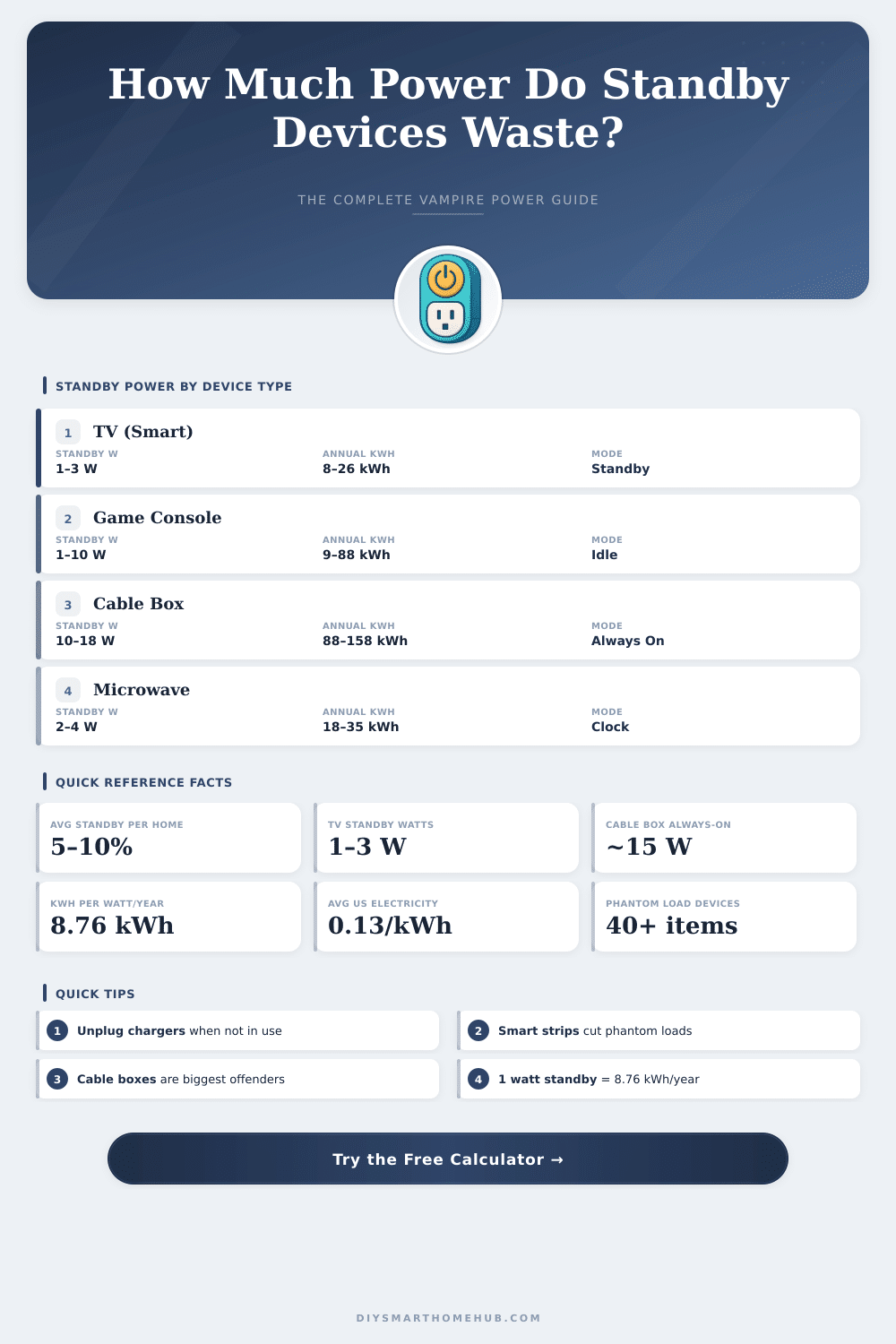
| Smart TV (LED) | Standby | 1–3 W | 7–22 kWh | Quick-start mode uses more |
| Cable/Satellite Box | Always on | 10–18 W | 73–131 kWh | Biggest single offender |
| Streaming Stick | Idle | 1–3 W | 7–22 kWh | Lower than cable box |
| Game Console (PS5/XBox) | Rest mode | 1–10 W | 7–73 kWh | Varies by update settings |
| Desktop Computer | Sleep | 1–5 W | 7–37 kWh | Hibernate uses < 1 W |
| Laptop (plugged in) | Sleep | 0.5–2 W | 4–15 kWh | Adapter draws power even off |
| WiFi Router | Always on | 5–20 W | 37–146 kWh | Necessary always-on device |
| Microwave | Clock/display | 2–4 W | 15–29 kWh | Clock draws constant power |
| Coffee Maker | Standby | 1–4 W | 7–29 kWh | Programmable models higher |
| Phone Charger | Plugged in, no phone | 0.1–0.5 W | 1–4 kWh | Low but multiplied by many |
| Smart Speaker | Listening mode | 1–3 W | 7–22 kWh | Always listening for wake word |
| Home Security DVR | Recording | 10–30 W | 73–219 kWh | 24/7 operation required |
| Room | Typical Devices | Avg Total Standby W | Annual kWh |
|---|---|---|---|
| Living Room | TV, cable box, streaming, stereo | 18–35 W | 131–255 kWh |
| Home Office | PC, monitor, printer, router, chargers | 20–50 W | 146–365 kWh |
| Kitchen | Microwave, coffee maker, dishwasher display | 8–15 W | 58–110 kWh |
| Bedroom | TV, alarm clock, phone charger, lamp dimmer | 5–12 W | 37–88 kWh |
| Entertainment | Receiver, game console, projector, soundbar | 15–40 W | 110–292 kWh |
| Whole Home Total | All devices combined | 50–150 W | 365–1,095 kWh |
Standby-power is the energy that devices use when they are turned off or stay in standby mode. Almost every modern device for instance televisions, microwaves and air conditioners, use energy all day, often without the owner even knowing that. Some devices seem to be off from the screen, but actually they run in another state, handling tasks like clock or waiting for a remote control signal.
This kind of energy use has several names. Many call it vampire energy or phantom energy. No matter the name, it adds up quickly.
Why Devices Use Power When Turned Off
Only in the United States, standby-power makes up more than 100 billions of kilowatt-hours of electricity each year.
The idea of standby-power existed for a long time. It became real after the creation of the AC-DC-converter, that could connect to home electrical grids. The converter stays active always, so that works like a doorbell sound as soon as one presses the button.
The second device, that used standby-power, was the remote controlled garage door opener, invented in 1931.
When one fully disconnects a device, it uses no energy. Even so, if it stays in standby, it uses a bit of energy based on the kind of device. Less new devices usually have bigger use in standby then the new ones.
A small modern television uses less than a big old model, because low energy standards already for many years force that. Converters of levels IV, V and VI mostly fix the causes of vampire energy in many new products.
In most chips, around 90 percent of the circuit are digitally based. Still energy and leakage energy both add to the standby use. Leakage energy is that, what gets used when no signal passes through the circuit.
Still energy comes from current sources and other parts of the circuit, when there is no data or clock activity.
Inverters are another field, where problems of standby-power appear. An inverter left with no load attached can use 40 to 50 watts constantly. This is critical, when one uses batteries for the function.
If a fridge works 10 hours in a day, the inverter stays idle during 14 hours. A 40-watt standby use wastes 560 watt-hours daily, while a 12-watt inverter wastes only 168 watt-hours. That difference reaches almost 1200 watt-hours in three days.
The ability to easily turn offan inverter is important, because it can waste 20 to 40 amp-hours from battery reserve whole day in standby.
The most useful way to save energy is not simply closing a computer, but fully turning it off after that. Monitors in sleep mode with orange lights still use little, but not zero amount of electricity. All those little devices add up, when standby-power runs day and night.