Solar Panel Shading Calculator
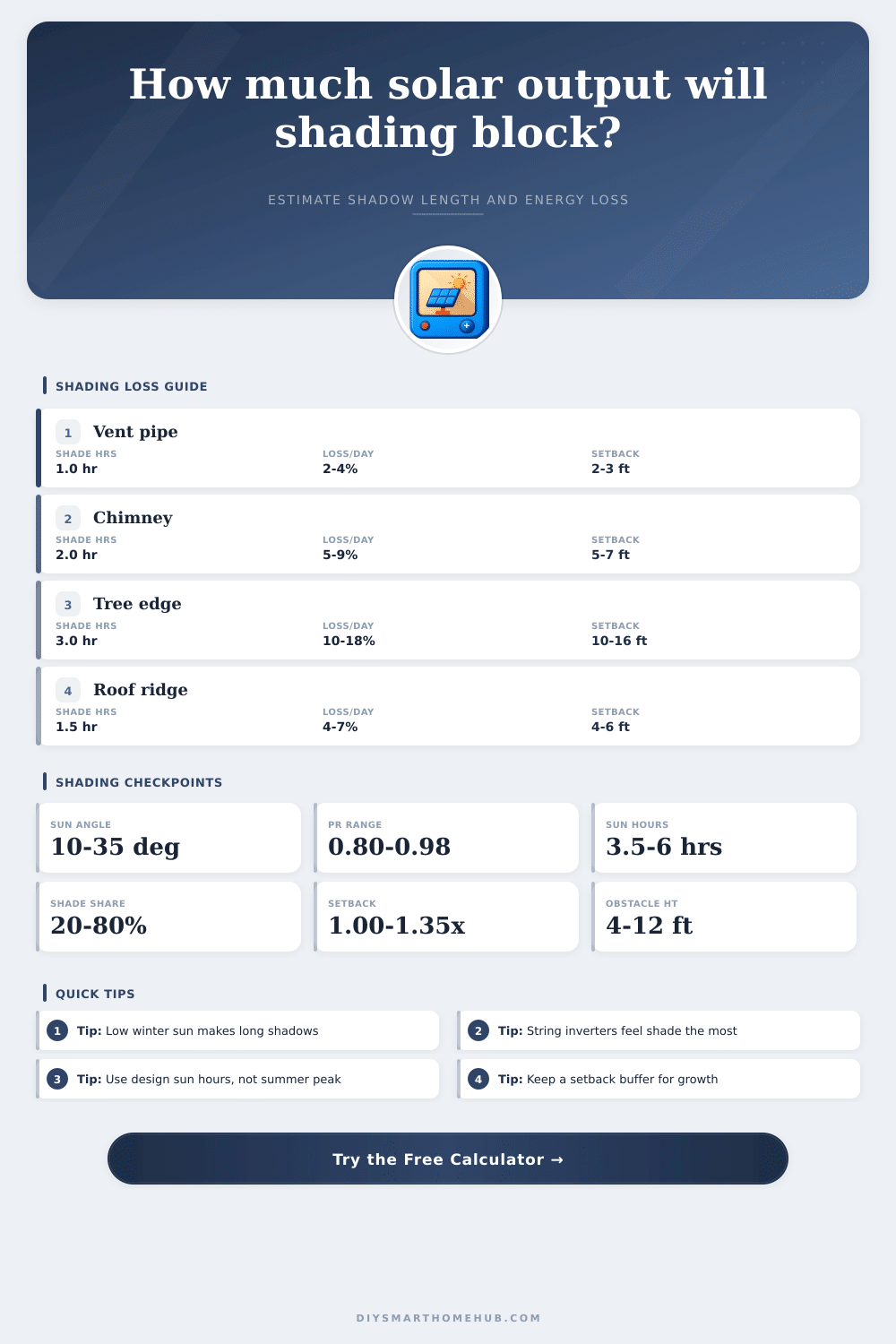
Estimate shadow length, shaded module share, setback distance, and production loss for trees, vents, chimneys, ridges, and nearby roof obstructions before you lock in panel placement.
Shade that only appears near noon in winter can matter more than a light summer edge shadow because the low sun angle makes the shadow longer and reaches deeper into the array.
Roof clearance tells you whether the shadow reaches the panels at all. Architecture tells you how much extra mismatch loss shows up once part of the array is actually shaded.
Shading from objects like trees, chimneys, or vent pipes can reduce the energy production of a solar array. To understand how shading can affect a solar array, one must know that shading can reduce the total amount of electricity that a solar array will produce. The effect of shading on solar panels is most significant during a winter months when the sun sit the lowest in the sky.
When the sun is low in the sky, solar panels will cast long shadows that can cover the solar panel. Using the following formula, it is possible to calculate the length of the shadow that a solar panel will cast: the height of the obstruction divided by the tangent of the angle of the sun. Even short obstructions like vent pipes can cast long shadows during the winter months when the sun angle is low in the sky.
How Shade Affects Solar Panels
The way that an object shade the solar array will have a significant effect on the total power output of the solar array if an object shade the solar array. If a person use a traditional string inverter, the shading of one solar panel will reduce the power output of all of the solar panels in that group. This is due to the fact that a traditional string inverter combine all of the panels into one unit.
However, if the person uses optimizers and microinverters, the shading of one solar panel will not significant impact the power output of the other solar panels in the array. To ensure that the solar panels stays in continual exposure to the sun, the distance between the shading object and the solar panels must be measured. This distance should be measured from the source of the shade to the edge of the solar panel.
A safety factor should also be included in this distance. A safety factor will ensure that new growth of items like trees will not shade the solar panels. If this safety factor isnt included in the initial measurement of the distance between the shading object and the solar panels, the growth of that tree may lead to the shading of the solar panels.
If the shadow from an obstruction reaches the solar panels, the solar panels will experience a loss in energy production. Many people make the mistake of designing their solar array based off the sun angles that exists during the summer. People should base their solar panel angles on the sun angles in the winter months.
During the summer, the sun is high in the sky, so the shadows are short. During the winter, the sun is low in the sky, so the shadows are long. By only considering the shadows that the solar array will experience in the summer, people will not account for the shadows that will fall on the solar array during the winter months.
In addition to the angle of the solar array, the production of solar energy is also lower in the winter due to less peak sun hours. Different types of trees will have a different impact on the energy that reaches the solar array. Deciduous trees will lose their leaves in the winter, allowing for the solar array to receive more sunlight during the summer.
However, deciduous trees will still cast shadows during the winter. Evergreen trees will retain their leaves throughout the year, meaning that they will be casting shadows on the solar array throughout each month. One must account for the type of tree that is growing near a solar array when creating the solar array to determine how many hours of shading the solar panels will experience.
People should avoid using an estimation of the shade of the objects from ground level. Instead, people should use a solar modeling tool to determine where the shadows will fall on the roof. The cost of using microinverters or solar optimizers is more higher than using traditional string inverters.
However, microinverters and optimizers will reduce the energy losses caused by shading on the solar array. If the solar array experiences many shading issues, investing in microinverters or optimizers may be necessary. Finally, people must plan for the future to ensure that they dont place trees or other obstructions in such a way that they dont create shading on the solar panels in the future.