Solar Panel Azimuth and Tilt Calculator
Estimate the best equator-facing azimuth, a field-ready magnetic compass heading, season-adjusted tilt, and how far a roof or rack setup sits from the target orientation.
Load a common site and mounting scenario, then fine-tune latitude, roof facing, tilt, and declination for your exact project.
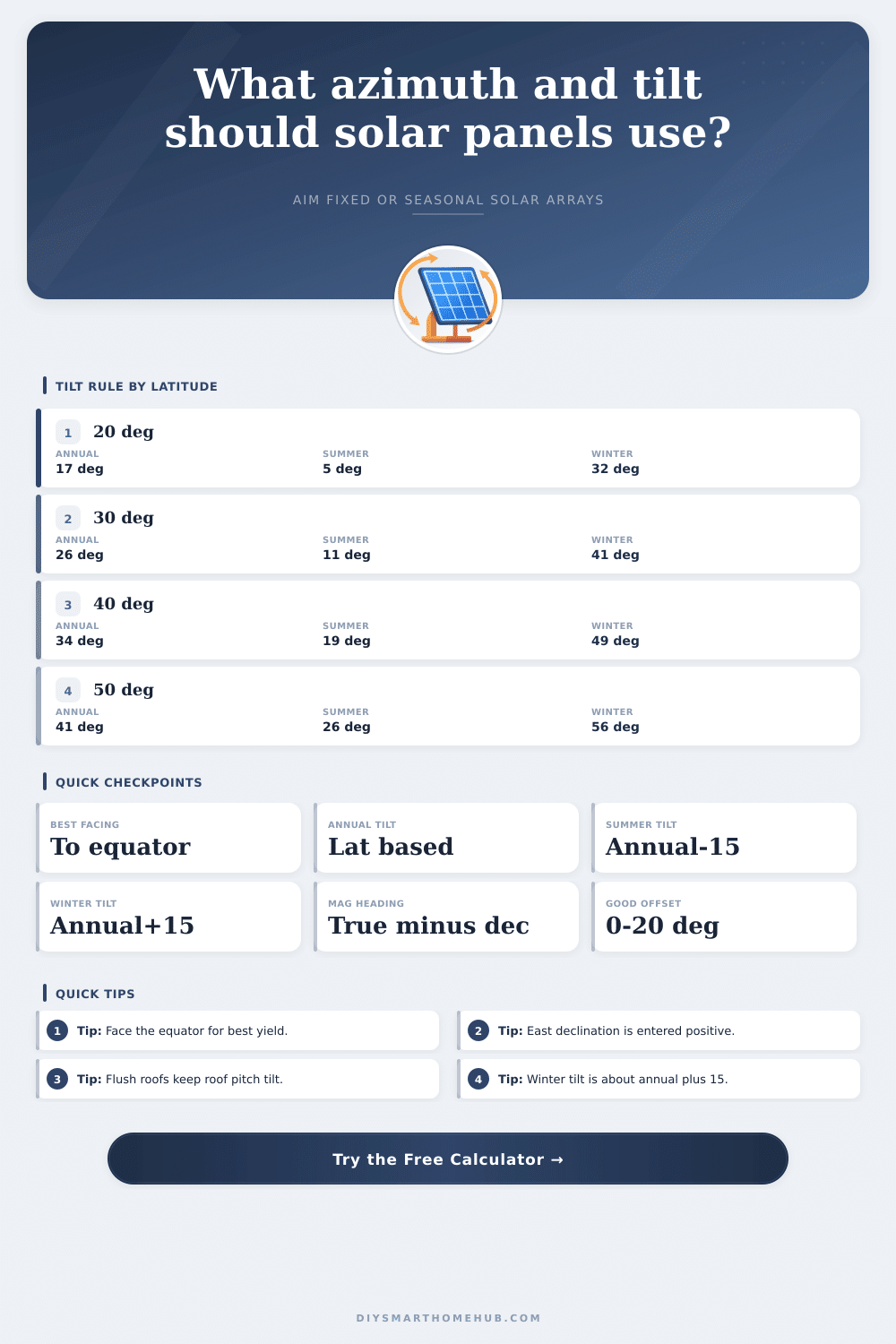
For a fixed array, annual tilt tracks local latitude. Lower-latitude sites can usually run a slightly flatter angle than latitude itself.
Warmer-season bias reduces tilt so the array favors high summer sun and sheds less wind load on low-angle roofs.
Cold-season bias steepens the array to match lower sun angles and can improve snow slide-off where winter performance matters.
True azimuth is the design target. Subtract east declination or add west declination to get a field compass heading.
These rows summarize the same quick rules used in the calculator. Annual tilt follows a latitude-based fixed-array estimate, then summer and winter shift by roughly 15 degrees.
| Latitude Band | Annual Tilt | Summer Tilt | Winter Tilt | Typical Use |
|---|---|---|---|---|
| 15 to 25 deg | 13 to 22 deg | 5 to 10 deg | 28 to 37 deg | Tropical roofs and RV arrays |
| 26 to 35 deg | 23 to 30 deg | 8 to 15 deg | 38 to 45 deg | Sun belt home systems |
| 36 to 45 deg | 30 to 37 deg | 15 to 22 deg | 45 to 52 deg | Four-season fixed arrays |
| 46 to 55 deg | 38 to 45 deg | 23 to 30 deg | 53 to 60 deg | High-latitude winter focus |
| Offset From Target | Alignment Class | What It Means | Common Action |
|---|---|---|---|
| 0 to 10 deg | Excellent | Array closely matches the target | Keep roof geometry or small rack trim |
| 11 to 20 deg | Very good | Usually minor orientation compromise | Accept roof face or small standoff rack |
| 21 to 35 deg | Workable | Noticeable mismatch but still usable | Consider rack tilt and shading review |
| Over 35 deg | Large offset | Strong directional compromise | Move to a better face or ground rack |
| Scenario | Facing | Tilt Strategy | Best Fit |
|---|---|---|---|
| Miami flush roof | 180 deg true | 18 deg roof pitch | Low-latitude annual output |
| Denver roof rack | 175 deg true | Winter target near 48 deg | Cabin and cold-weather use |
| Austin PM bias | 195 deg target | Annual tilt with west bias | Late-day cooling loads |
| Sydney north roof | 0 deg true | 29 deg annual target | South-hemisphere homes |
Solar panels are device that capture the energy from the sun. The amount of energy that solar panels capture, however, is dependent upon the azimuth and the tilt of the solar panel panels themself. Each of these factors have a direct impact upon the amount of energy that the panels create.
Azimuth refers to the direction in which the solar panels faces. The tilt of the panels refers to the slope of the panels. Each of these factors can have an impact upon the amount of energy that the panels create; if either of these factors are incorrectly set up for the location of the panels, the panels will not be able to capture the maximum amount of energy from the sun that passes through the area.
Best Direction and Tilt for Solar Panels
Azimuth is the horizontal direction of the solar panels. Azimuth is measured in degrees, and a measurements are made in relation to true north. For individuals in the northern hemisphere, south is the best direction for the solar panels to face.
For individuals in the southern hemisphere, north is the best direction for the solar panels. A compass can be used to determine the azimuth of the panels. Compasses, however, do not point to true north, but rather to magnetic north.
Magnetic north and true north are not the same due to a concept known as magnetic declination. Magnetic declination is the difference between magnetic north and true north. Magnetic declination has the potential to cause individuals to point their panels in the wrong direction.
If an individual dont take magnetic declination into account when installing the panels, the panels will face the wrong direction, and the panels will produce less energetic. Tilt is the vertical angle of the solar panel. The tilt of the panels impacts the amount of direct sunlight that reach the panels.
The panels should not be installed in a perfectly flat structure, as the panels only capture the maximum amount of energy from the sun if they are located near the equator. The ideal tilt for the panels is often the same than the latitude of the location where they are installed. For instance, if the installer is to install the panels at a latitude of 30 degrees, the tilt should be between 25 and 30 degrees.
This type of tilt is beneficial for ensuring that the panels capture the sun’s rays during both winter and summer month. Racks can be installed on the panels that allow for seasonal adjustments in the tilt of the panels. During the summer months, the panels can be adjusted to be flatter to the ground.
During the winter months, however, the panels can be adjusted to be steeper to the ground. The roof of the house where the panels are to be installed may limit the azimuth and the tilt of the panels. Many houses have roofs that do not face true south (for the northern hemisphere), or true north (for the southern hemisphere).
Additionally, the pitch of the roof may not match the ideal pitch of the panels. If flush mount systems are used for installing the panels, the panels must face the same angle as the roof. Flush mounts are often used due to their ease of installation, but they may result in the panels creating less energy.
If racking system are used, however, the panels can be tilted differently from the roof. Ground mounts allow the panels to be installed in any azimuth or tilt, but require more space and permit to install. Another of the factors that impact solar panel efficiency are the times of year when the panels need to perform their tasks.
During the summer, the panels may need to be flatted so that they can capture the sun during the summer months when the sun is high in the sky. During the winter, however, the panels may be tilted steeper to the ground to capture the sunlight that is coming through the winter sky. Shading is another consideration for the installation of solar panel systems.
Any structure that may create shadows over the solar panels will reduce the amount of energy that the panels create. These structures may include trees, chimneys, and other building. Any individual that plans to install solar panel systems should check for these type of shadows during the summer and winter months.
The total error in each of the azimuth and the tilt will impact the efficiency of the solar panel system. If the error in both the azimuth and the tilt is less than ten degrees, the panels will function very well. If the error is between ten and thirty-five degrees, the panels will function, but not as efficient as they could.
If the error is more than thirty-five degrees, however, the panels should of been installed in a different location altogether, as they will not create enough energy to be effective solar panel systems. Thus, managing the azimuth and the tilt will ensure that the solar panels create as much energy as possible during the year.