Solar Inverter Sizing Calculator
Translate roof geometry, usable panel fit, module wattage, DC-AC ratio, service voltage, and warm-weather derate into a practical inverter class for standard, hybrid, microinverter, or three-phase home solar designs.
☀Solar Sizing Presets
⚙Array and Inverter Inputs
Inverter Sizing Summary
Run the calculator to compare your roof fit and PV array with the selected inverter family.
📊Selected Inverter Family Specs
Balanced target for this inverter family.
Upper planning limit before clipping and thermal pressure become excessive.
Tracker count and voltage window expected for this family.
Useful for estimating daily AC energy after inverter conversion losses.
📑Reference Tables
| Inverter family | Target ratio | Max ratio | Best fit |
|---|---|---|---|
| Residential string | 1.18 | 1.35 | Clean roof faces with predictable irradiance |
| Hybrid battery-ready | 1.22 | 1.45 | Backup-ready homes with battery coupling plans |
| Microinverter | 1.05 | 1.20 | Mixed azimuth roofs and module-level monitoring |
| Three-phase residential | 1.18 | 1.35 | Larger villas, pumps, and balanced three-phase loads |
| Module class | Watts | Footprint | Panels in 400 sq ft usable |
|---|---|---|---|
| Compact 108-cell | 400-430 W | 18.5-19.8 sq ft | 20-21 |
| High-output 108-cell | 435-455 W | 20.0-21.4 sq ft | 18-20 |
| Large 144 half-cell | 500-550 W | 25.0-27.0 sq ft | 14-16 |
| Premium all-black | 380-420 W | 17.5-19.0 sq ft | 21-22 |
| AC service | Phase math | 5 kW current | 10 kW current |
|---|---|---|---|
| 240V split-phase | P / V | 20.8 A | 41.7 A |
| 230V single-phase | P / V | 21.7 A | 43.5 A |
| 208V three-phase | P / (1.732 x V) | 13.9 A | 27.8 A |
| 400V three-phase | P / (1.732 x V) | 7.2 A | 14.4 A |
| Project | Usable area | Array DC | Inverter AC |
|---|---|---|---|
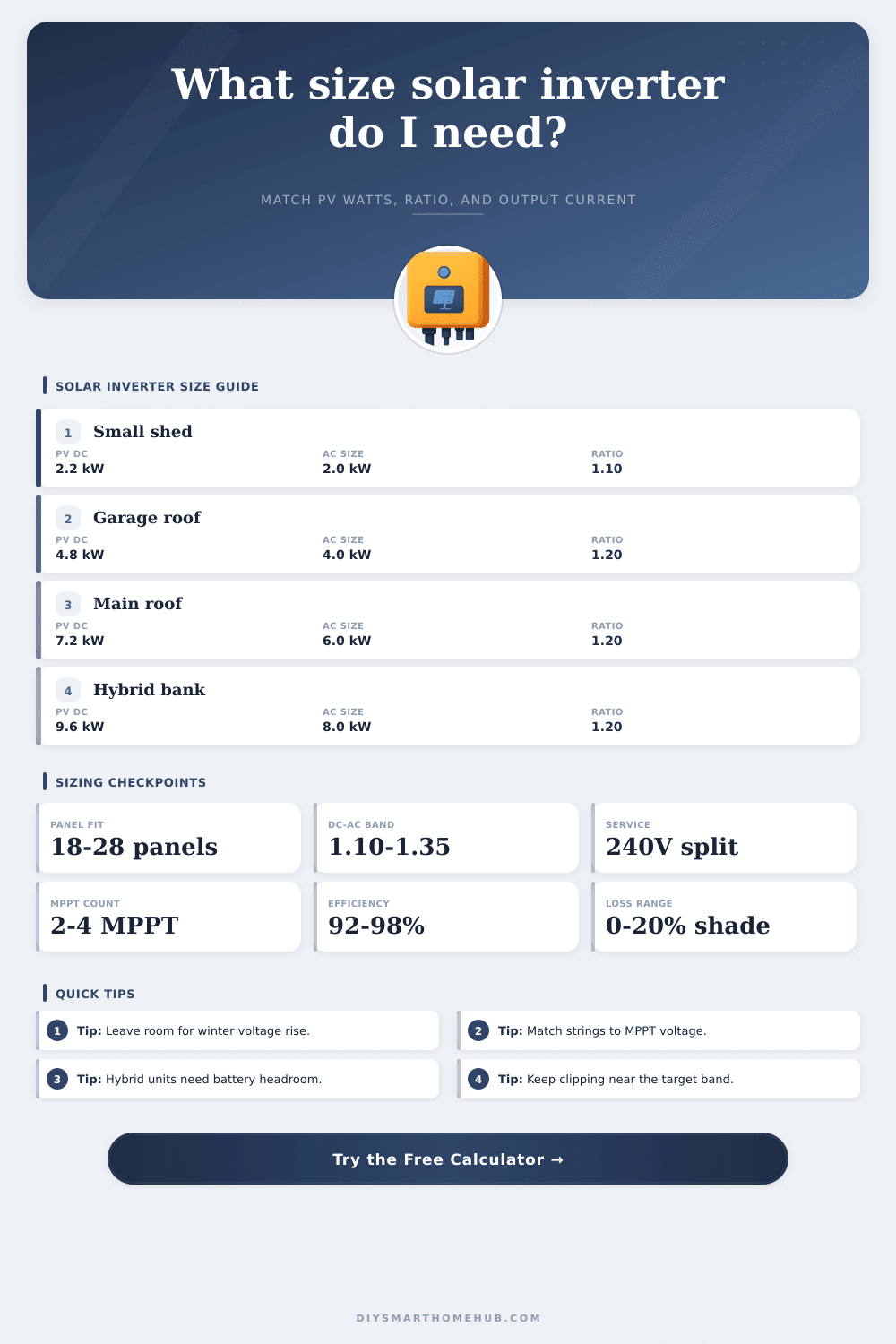
| Small detached shed | 120 sq ft | 2.2 kW | 2.0 kW |
| Single-car garage | 410 sq ft | 4.8 kW | 4.0 kW |
| Townhouse roof plane | 560 sq ft | 6.6 kW | 5.0-6.0 kW |
| Large hybrid home | 820 sq ft | 9.6 kW | 8.0 kW |
Modules produce higher string voltage on bright cold mornings. Keep the final string design within the selected inverter's maximum DC input window, not just its ideal MPPT band.
Start with the modules you can actually fit after setbacks, then size the inverter around that real DC total. Brochure wattage alone often leads to impossible roof counts.
When planning a solar energy system, you must decide on the number of solar panels to use and the size of an inverter. Solar panels produces direct current (DC) electricity. Inverters change that direct current (DC) electricity into alternating current (AC) electricity that the home can use.
If you pick an inverter that is too small for the solar panel capacities, the inverter will limit how much electricity the solar panel can produce. However, if the solar panel are too large for the inverter, the inverter may sit idle when the solar panel isnt producing enough electricity to fulfill the inverter capabilities. Therefore, it is important to match the solar panel to the inverter to create an efficient solar energy system.
How to Match Solar Panels and Inverters
The layout of a roof will dictate how many solar panels can be place on a roof. Additionally, the roof’s layout will have an impact on the total electricity that the solar panels can produce. When determining how many solar panel to purchase for a roof, a person must account for any setbacks, vents, or dormers that exists on the roof.
These feature will reduce the amount of usable space for solar panels. Therefore, if a roof has many obstacles to the installation of solar panels, the number of solar panels will be limited. To determine how many solar panels a person should install on a roof, that individual should measure the amount of usable space for solar panel installation on the roof.
The usable space for solar panels on a roof will dictate the total wattage that the solar panel array will produce. It is critical that the solar panel array is sized appropriately for the inverter that will be use in the solar energy system. If the solar panel array is too large for the inverter, the inverter will overwhelm the inverter.
Additionally, if the solar panel array produces too little electricity, the inverter will not be able to handle the electricity from the solar panels. The DC-to-AC ratio show the relationship between the capacity of the solar panels and the capacity of the inverter. Many individuals will want to make the solar panel capacity 10 to 35 percent larger than the capacity of the inverter.
This is due to solar panel production of the most electricity during the morning and evening, yet the inverter can reach its peak capacity during the middle of the day. If the DC-to-AC ratio is too high, the inverter will experience clipping. Clipping occurs when the solar panels produce more electricity then the inverter can process.
If the DC-to-AC ratio is set too low, the solar panel will not produce enough electricity to use the inverter to its full potential. Another factor to consider with the sizing of inverters for solar panels is the service voltage and the electrical capacity of the homes. The service voltage will dictate how much electricity the home can take from the solar energy system.
One must check the circuit breaker box for the home. A home with a large solar panel array will have more amperage moving through the circuit breaker than a home with a small solar panel array. A 5 kW solar panel system will require 20 amps to move the electricity to the home, but a 10 kW solar panel system will require 40 amps for the same reason.
Another factor to consider is the impact of high ambient temperatures on the inverter. If the inverter is place in an area that is hot year round, the inverter may not be able to fulfill its electrical capacity to the solar panel array due to the high temperature. In this case, the inverter will have to be larger to compensate for the high temperature.
Different inverter type require different considerations in sizing the solar panel array. For example, if the inverter placed on the roofs panels is a string inverter, the roof will have to receive sufficient sunlight for the solar panel array to produce the amount of electricity required by the home. However, if an individual decides to use batteries to store the energy produced by the solar panels, a hybrid inverter will be used.
These inverters provides headroom for the batteries and can have a higher DC-to-AC ratio to allow for the inverter to fulfill the capacity needed for the batteries. Microinverters is installed on each solar panel on the roof. These types of inverters help manage any shade that may be blocking the solar panel from receiving sunlight.
Each microinverter can track the sunlight that each solar panel receive. The type of inverter that is selected will impact the size of the solar panel array for a home. Shade can impact the amount of electricity that a solar panel can produce.
A person should plan for a loss of 12 to 15 percent in the electricity that the solar panel array will produce due to shade from trees and dirt on the panels. If a tree shades the roof, the solar panel will produce less electricity than if it were exposed to the sun year round. Cold temperatures will increase the voltage of a solar panel string.
If the voltage of the solar panel string is too high, it will damage the inverter that is connected to the solar panel array. Therefore, it is critical that the voltage of the solar panel is check to ensure that it does not produce more voltage than the inverter can take. Matching the solar panel array to the available roof space and the inverter to the solar panel array will create a functional solar energy system.
Actualy, matching the solar panel array to the available roof space and the inverter to the solar panel array will create a functional solar energy system. You should of checked the roof space first. It is a lot of work, but it makes things more comfortabley.