Solar Battery Charge Time Calculator
Estimate how many solar hours and calendar days it takes to recharge a battery bank from a chosen SOC window, array wattage, peak sun hours, MPPT efficiency, chemistry, and charge taper behavior.
📌Real Solar Charging Presets
🔋Solar Charge Inputs
Solar Charging Result
Full Breakdown
⚙Battery And Solar Spec Grid
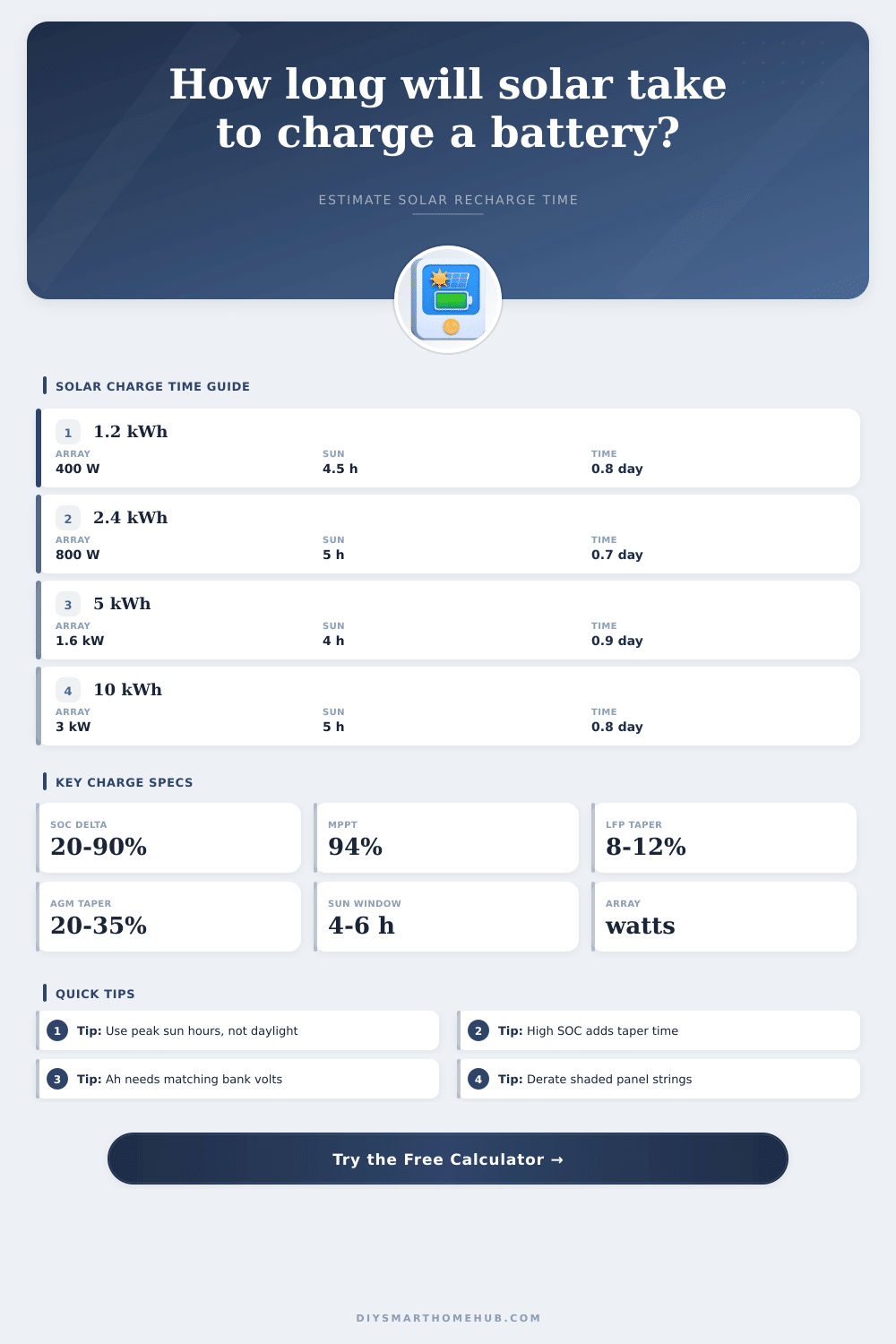
📊Solar Charge Time Reference
| Battery Scenario | SOC Window | Array Watts | Peak Sun | Estimated Result |
|---|---|---|---|---|
| 1 kWh portable station | 20% to 90% | 300 W | 4.5 h | About 0.6 day with BMS taper |
| 200 Ah 12 V LiFePO4 RV bank | 30% to 95% | 600 W | 5 h | About 0.6 day in clear sun |
| 5 kWh cabin battery | 25% to 90% | 1200 W | 4 h | About 0.8 day with MPPT losses |
| 10 kWh home backup module | 20% to 90% | 3000 W | 4.5 h | About 0.6 day before shade reserve |
🔌Battery Chemistry Charge Behavior
| Chemistry | Taper Starts Near | Absorb Or BMS Effect | Typical Charge Efficiency | Best Calculator Use |
|---|---|---|---|---|
| LiFePO4 | 90% SOC | Short top-end current reduction | 94-98% | Fast solar recharge estimates |
| Lithium NMC | 85% SOC | BMS slows the final band | 92-96% | Power stations and compact packs |
| AGM lead-acid | 80% SOC | Absorption stage can dominate | 80-88% | Conservative backup banks |
| Flooded lead-acid | 75% SOC | Long absorb stage to reach full | 75-85% | Golf cart or older off-grid banks |
| Gel lead-acid | 80% SOC | Lower charge current limit | 80-87% | Slow, voltage-sensitive charging |
☀Array Size Versus Battery Size
| Battery Size | Moderate Array | Strong Array | 5 Sun-Hour Daily Yield | Notes |
|---|---|---|---|---|
| 1 kWh | 200 W | 400 W | 0.9-1.8 kWh/day | Good for portable power and router backup |
| 2.5 kWh | 600 W | 1000 W | 2.7-4.5 kWh/day | Common RV and camper van range |
| 5 kWh | 1200 W | 2000 W | 5.4-9.0 kWh/day | Cabin or critical circuit storage |
| 10 kWh | 2500 W | 4000 W | 11.3-18.0 kWh/day | Home backup starts needing roof-scale array space |
🧮Formula Details Used By This Calculator
| Step | Formula | What It Means | Why It Matters |
|---|---|---|---|
| SOC energy | Battery kWh x SOC delta | Energy that must return to the bank | Charging 30% to 90% is not a full battery |
| MPPT output | Array W x efficiency | Solar watts after controller and wiring loss | STC panel watts are not delivered battery watts |
| Taper adder | Base hours x taper factor | Extra time near higher SOC targets | Lead-acid and BMS limits reduce late-stage current |
| Calendar days | Total hours / peak sun hours | Number of suitable solar days required | A five-hour sun window spreads charging across days |
🔍Solar And Battery Spec Comparison
Small DC Bank
12 V batteries are simple, but high charging watts create high current. Cross-check cable and controller amp ratings.
48 V Home Bank
Higher voltage lowers current for the same solar power, which helps larger MPPT controllers run efficiently.
Lead-Acid Bank
Absorption taper makes the last 15-25% much slower than the early bulk stage, especially near 100% SOC.
LiFePO4 Bank
Flat charge acceptance keeps solar recharge fast until high SOC, then BMS or voltage limits may taper current.
💡Charging Tips
This calculator estimates charge time from energy balance and taper behavior. Always compare the result with the battery maker's maximum charge current and the charge controller's voltage and amperage limits.
Understanding how long solar panel take to refill a battery bank is a task that many people perform in there day-to-day lives. In order to understand how long it takes for solar panels to refill a battery bank, there is several different factors that must be considered. Factors to consider include the amount of energy that the battery bank need to refill to, the efficiency of the system in moving that energy to the battery bank, and the way in which the battery bank itself begins to accept less energy as it reaches a full charge.
Each of these factor can help to reveal whether the battery bank can be refilled in the time period of one sunny day, or whether multiple days of solar production are required to provide enough energy to refill the battery bank. The amount of energy that the battery bank require is often less than the total capacity of the battery bank. Instead of providing energy to the battery bank until it reaches a 100% State of Charge, many individuals intends to provide energy to the battery bank from a percentage value to another percentage value.
How Long to Charge a Battery with Solar Panels
The difference between these two percentages is the State of Charge (SOC) of the battery bank. The smaller the SOC that is defined for the battery bank, the less energy that must be provided to the battery bank to fulfill that charge. Additionally, the SOC will also impact the length of time that the battery bank takes to complete that charge; the final percentage of a battery banks charge typically takes longer to complete than the bulk of the charge cycle due to the tendency of batteries to slowly accept charges as they approach 100%.
Thus, the State of Charge of the battery bank will impact the length of time that the battery bank remains in charge. Efficiency losses can occur in two main areas. The first area of losses occurs between the solar panels and the charge controller; charge controllers and the wiring between the solar panels and the charge controller will never be able to deliver to the battery bank each of the watts that is produced by the solar panels.
However, each of these components is lossy, but a well-designed MPPT system usually has an efficiency of about ninety-four percent. The second area of efficiency losses is within the battery itself; batteries converts electrical energy to chemical energy, but some of that energy is lost as heat. Lithium iron phosphate batteries lose about four percent of their energy when being converted, but lead-acid batteries loses closer to twenty percent of their energy during these chemical changes.
Thus, solar panels will have to produce more energy than is stored in the battery bank due to these efficiency losses. Taper behavior is another process that occurs within the battery bank; as the battery bank reaches a certain level of charge, the battery bank will naturaly begin to accept less energy from the solar panel system. Batteries produces this behavior to avoid damage to the battery bank; lead-acid battery banks enter an absorption stage that can take many hours to complete, but lithium batteries taper their charge more gentle through their battery management system.
Thus, another adjustment to the calculation is the application of a taper adjustment; the battery bank will not reach the full charge of its State of Charge as quickly as may be calculated, and providing that adjustment will allow for more accurate calculations of the length of time that is required to refill the battery bank. Sun hours differs from daylight hours, and is the most important variable in determining solar panel production. While a location may experience ten hours of daylight each day, the location may have only four hour of sun hours; in other words, the solar panels dont produce energy for four of those hours.
Sun hours may be impacted by a variety of factor, such as seasonal changes to the length of daylight, the angle of the roof relative to the sun, and any shade that may be placed between the solar panel system and the sunlight. For instance, if the solar panels are shaded during the winter months, the number of sun hours will decrease for those months relative to other parts of the year. Thus, an accurate measurement of the number of sun hours that are available for each location will allow solar panel systems and battery banks to be sized according to the conditions of each location.
The size of the solar array that is created relative to the capacity of the battery bank will also have an impact based off the rate at which the battery bank is replenished with energy from the solar panels. For instance, if the solar array has a relatively small amount of panels relative to the size of the battery bank, the rate at which the battery bank will be charged will be slow. However, if the solar array is large in relation to the battery bank, the solar array may produce large currents with the battery bank, which can impact the life of that battery bank.
Thus, any current created by the solar array should of been checked against the manufacturer’s specifications for the battery bank to ensure that the solar array is not too large for that battery bank. A number of other factors can impact the performance of the solar panel system. Factors include the temperature of the solar panels, the amount of dust and snow that may cover the solar panels, and the aging of those solar panel systems.
The temperature of the solar panels will impact the amount of energy that they produce. Furthermore, any dust or snow that covers any portion of the solar panel will likewise reduce the energy that is created by the system. Finally, the aging of the solar panels will naturally reduce the amount of energy that they produce.
Thus, calculations of the energy that will be produced by the solar panel system are merely a baseline, and more energy should be provided than that calculated. The goal in creating a solar panel system is to size the solar array such that the battery bank will be replenished within one or two sun hours. Thus, if the solar array is sized appropriately, the battery bank will be able to reach its targeted State of Charge within the length of one typical day of production by the solar panels.
Additionally, preventing the battery bank from being undercharged will help to prevent damage to that battery bank.