Solar Battery Backup Calculator
Estimate usable battery capacity, module count, and solar recharge from the backup floor area, critical circuit profile, and outage hours you want to support.
📍Preset Backup Scenarios
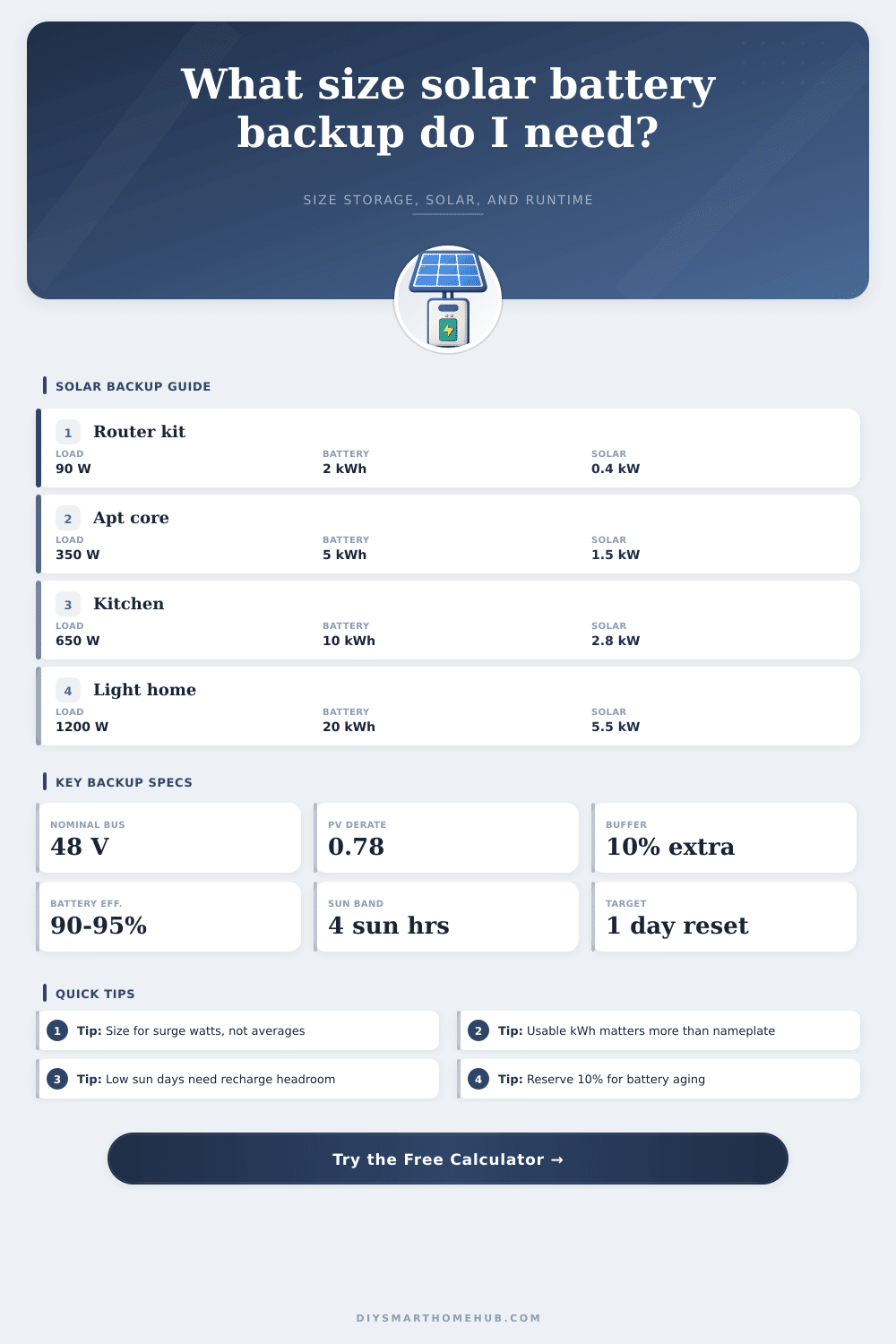
Preset scenarios change the backup geometry, battery class, circuit profile, autonomy target, and sun hour assumptions so you can benchmark outage plans before entering a custom case.
🔌Backup Zone Inputs
Backup Summary
Select a scenario or enter custom inputs to estimate solar battery storage, installed module count, and recharge array size for a resilient outage plan.
📦Battery System Spec Grid
📊Reference Tables
Critical Circuit Profiles
Average load density helps translate the protected floor area into a realistic battery workload before any custom appliance list is available.
| Profile | Base W | Area W/sq ft | Peak factor |
|---|
Battery Comparison
Use this table to see how usable storage, inverter output, and solar input scale as the battery bank moves from a closet backup to whole-home light support.
| Battery type | Usable | Output | Solar in |
|---|
Common Project Sizes
These snapshots show how the calculator behaves for typical backup targets when the recharge goal is a same-day reset and the reserve buffer stays at ten percent.
| Project | Protected area | Battery target | Solar target | Use case |
|---|
Peak Sun Hour Planning
Lower sun windows push the recharge array up quickly. The values below assume 10 kWh of outage energy and a 0.78 solar derate from panel nameplate to battery charge input.
| Sun hours | Array for 50% | Array for 100% | Array for 125% |
|---|
💡Planning Notes
A battery bank can have enough kWh for an overnight outage and still miss a refrigerator or well pump start if inverter surge support is too low. Check both counts.
If storm season drops your site from five peak sun hours to three, same-day recharge may require nearly double the array nameplate even when battery capacity stays unchanged.
Solar battery backups are systems that will provide electricity for you in the case that the main power grid fail. Using a solar battery backup system, you can ensure that the system will provide your essential device with power during a power outage. In order to purchase the appropriate solar battery backup system for your home, you will need to understand your power and solar battery backup system capability.
In order to purchase the proper solar battery backup system for your home, you will need to determine the load profile that your home require. The load profile measures the number of watts that your devices use. Different device in your home will have different power requirement, with some device requiring more power then others.
How to Plan a Home Solar Battery Backup
For example, your router will require less power than device like your refrigerator. In addition to the power that is required for your devices to remain on, you must also calculate the surge power that will be required to start those devices. Therefore, not only will you need to calculate the average watt that your devices use, but also the surge watts that your devices will require.
In addition to calculate the power that will be required for your devices, you must also consider the usable capacity of your battery backup systems. While the manufacturer lists a total capacity for the battery backup systems in kilowatt-hour, the batteries will not be able to use all of that capacity. For example, the energy that is lost in the process of storing and releasing the energy from the batteries, known as the round-trip efficiency of the batteries, will lose some of that energy.
In addition to this loss of energy, the batteries will naturaly degrade over time. For these reasons, the battery manufacturer will have to provide a battery with more energy than you calculate as your requirement for your devices. Additionally, the inverter that is included with the battery backup systems will also have an output that indicates how much power the system can provide to your devices.
The solar panel system will provide the solar recharge for the batteries to you. Additionally, you will want to recharge your batteries during the same day that you use the power that is stored in those batteries. In order to determine how many solar panel you will need to provide this recharge, you will first need to calculate how many peak sun hour are available in your area each day.
Peak sun hours are the number of hours during the day when you will receive the most sunlight to your area. In addition to peak sunlight hours, solar batteries will lose some of their power through losses within your solar panel array. When you are designing your solar battery backup system, you can use the presets built into many of these systems.
These presets allow you to select the type of device that you would like to power with your battery backup systems. For example, you can set the preset to power only a router or power a whole house. These presets establish benchmarks for how much power is required for each area of the house.
Therefore, if you change the size of the area that is to be protected by the battery backup systems, the power requirement for those batteries will change. There are a few mistakes that you can make when building your solar battery backup system. One of the most common is focusing only on the nameplate capacity of the battery backup systems.
Another mistake is in the sizing of the solar panels relative to the amount of energy that is generated by the batteries. For example, solar panels are sized according to annual average of the energy that is produced, but during the winter, there are fewer sunlight hours for the panels to capture. Therefore, you will need more solar panels if you live in an area where the winter days have fewer sunlight hour than the summer months.
Finally, you should ensure that you include a buffer in your system for the power requirement of your devices, as this will protect the system against the natural aging of the batteries. Additionally, the physical systems of installing the battery backup systems will also impact the efficiency of the system. For example, the roof on which the solar panel will be installed will have an impact on how much sunlight reaches the panel.
Additionally, some roofs will have more sunlight on them than others based off their orientation. For example, roofs that face south will receive more sunlight than those that face east. The electrical wiring of the systems will also lose some of the energy from the batteries, as the wires will use some of that power to function.
Additionally, you can purchase different types of battery backup systems for different parts of your property. For example, you can purchase a system that is designed to be rack-mounted on a garage, or you can purchase units that can be placed in sheds. In order for a solar battery backup system to work correctly for your home, your load profile will have to match your actual usage of electricity.
Your energy needs, power needs, and surge needs must be calculated. Your runtime will be calculated based on your energy needs. If you determine that you will have extra capacity compared to your target, you will have extra power for other devices.
Additionally, if the solar panels that you build for your area will generate more energy than the battery backup systems can accept, you will need to adjust the solar controllers that are established in the system. By calculating your energy needs and your solar recharge capacity, you will ensure that the system will function proper and provide power to your devices when the power grid fails. You should of considered the total load first.