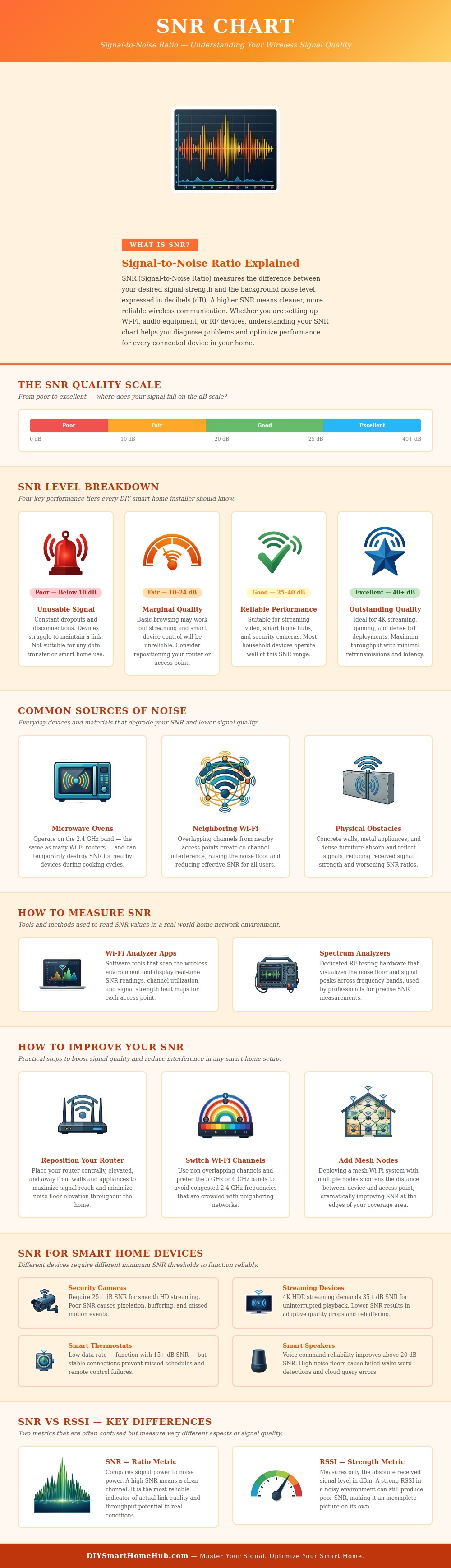
Signal-to-noise ratio compare the amount of signal with the amount of noise. Signal-to-noise ratio will determine how well the wireless device function. A wireless signal contains the amount of usable information.
However, the wireless signal also contain random electrical noise. Signal-to-noise ratio measure the amount of usable information that reaches the device compared to the random electrical noise that reaches the device. If the signal-to-noise ratio are too low, the device will have issues in functioning.
What Signal-to-Noise Ratio Means for Home Wi-Fi
Signal-to-noise ratio can be divided into four different tier to show the quality of the wireless signal. If the signal-to-noise ratio is lower then the lowest range of measurements, then the device will not be able to maintain a link to the wireless network. If the signal-to-noise ratio is within the second range of measurements, then the individual can perform basic task with the wireless device but cannot stream videos.
If the signal-to-noise ratio falls within the third range of measurements, most of the equipment in the house will work normal. Finally, if the signal-to-noise ratio is within the highest range of measurements, the wireless network will be able to support multiple 4K streaming video and multiple sensors throughout the house. Many object in the house can reduce the signal-to-noise ratio in the wireless signal.
One of the most common object is the microwave. If the microwave and the wireless router use the same frequency, the microwave will create more noise in the signal. Additionally, any wall that contains concrete or plaster will absorb part of the wireless signal.
The signal strength that comes through the wall will be less than that of the signal that originate from the router. Another object that can lower the signal-to-noise ratio is the neighbor’s wireless network. If the neighbor’s wireless signal use the same channel as the individual’s wireless router, the device will experience background noise that will interfere with the signal-to-noise ratio.
Depending on the device, signal strength alone will not provide an accurate reading of the signal-to-noise ratio. Signal-to-noise ratio take into account the strength of the signal and the amount of background noise. Signal-to-noise ratio can be measured using a laptop or phone application.
Both of these devices will allow an individual to measure the signal strength and the amount of background noise in the signal. Taking the strength of the signal and subtracting the amount of background noise from that signal calculates the signal-to-noise ratio. As the individual walk through the house while utilizing the scanning application, the signal-to-noise ratio will change.
The graph will display weak spot in the wireless signal. An individual can use this information to better place the wireless equipment in the house. An individual can increase the signal-to-noise ratio by changing the placement of the wireless equipment or the setting of the wireless signal.
The router signal can be moved away from the metal appliances in the house. Additionally, the router can be moved to a higher spot in the house to increase the signal strength. The signal-to-noise ratio can also be increased by changing the frequency setting of the wireless network to one that is less crowded by other device.
Adding a second access point to the wireless network can also increase the signal-to-noise ratio. By adding a second access point, the distance that the signal from the router must travel will be less. This will allow more of the signal to reach the devices in the house.
The signal-to-noise ratio necessary for device in the house can range from high to low. Devices like smart thermostat do not require much signal strength because there is little data that must travel from the device to the network. Security cameras, however, will require a high signal-to-noise ratio because they require a high amount of data to travel from the camera to the network to stream video.
Voice assistant will require a moderate signal-to-noise ratio because they must recieve a high amount of background noise to identify the voice command but do not require as much data as a security camera. In some instance, a house with a lower signal strength can provide a better wireless connection than a house with a higher signal strength. This is only true, however, if the house with the higher signal strength have a very high amount of background noise.
The house with the lower signal strength contains less background noise. This means that the house with the lower signal strength has a higher signal-to-noise ratio. A higher signal-to-noise ratio provides for smoother performance of the wireless device in the house.
An individual should of focus on finding a location in the house that is quieter than others rather than one that has the strongest signal strength.