Smart Thermostat Savings Calculator
Estimate how much HVAC runtime a smart thermostat can trim by combining setback depth, occupancy hours, climate, home size, and system response into one practical annual savings model.
📌Quick smart thermostat presets
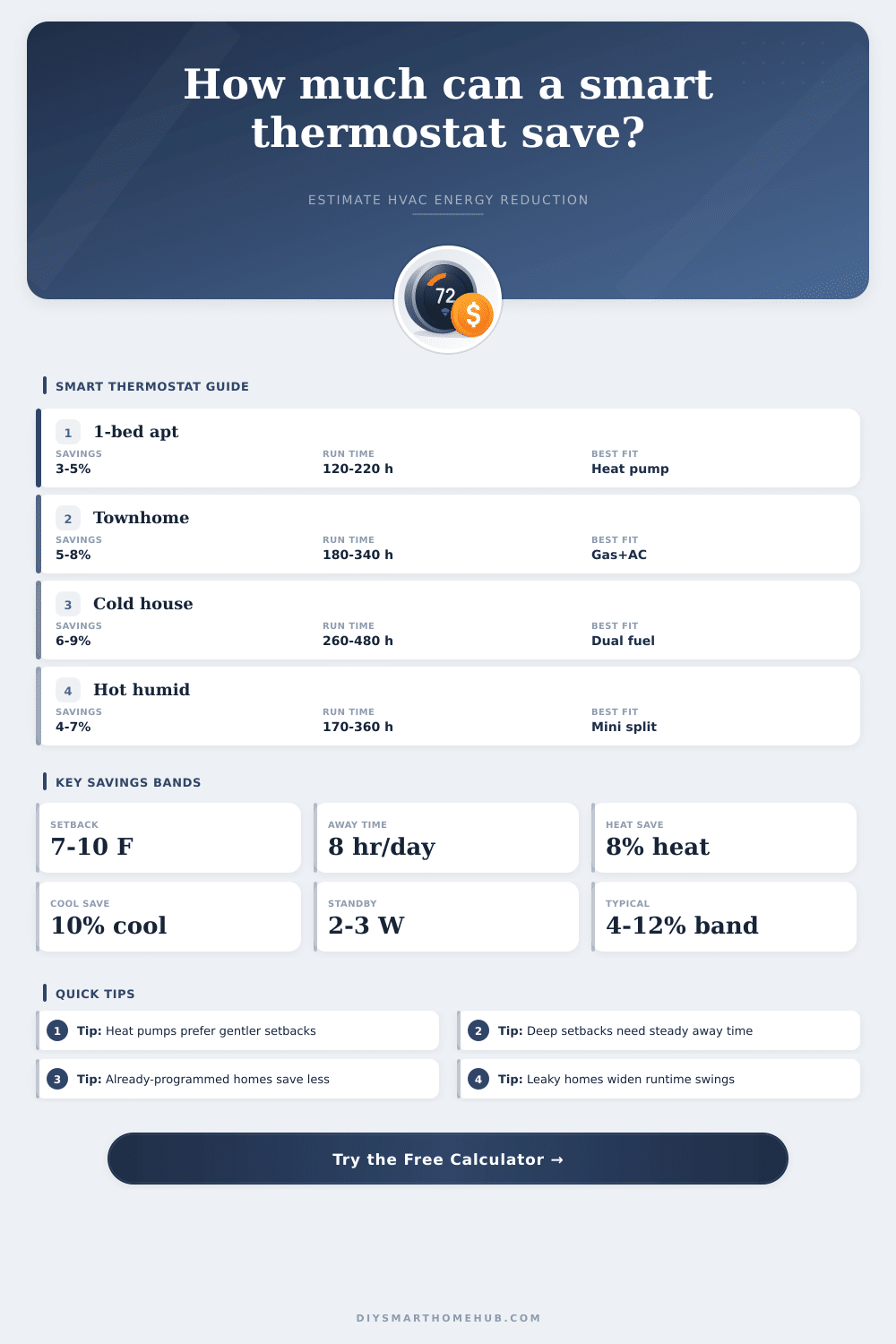
This model is anchored to two public guidance points: DOE setback guidance of roughly 1% annual savings per 1°F over an 8-hour setback window, plus ENERGY STAR smart thermostat runtime reduction thresholds around 8% heating and 10% cooling. The final estimate adjusts those anchors for HVAC type, baseline control quality, climate mix, occupancy consistency, and a user-selected safety buffer.
📏Project inputs
Choose a home shape to estimate conditioned floor area, then add climate, setback hours, and control quality to see how much heating and cooling runtime a smart thermostat could avoid each year.
💡Live planning notes
📈Smart thermostat savings results
📊Smart thermostat reference grid
🌎Climate savings table
| Climate | Heat share | Cool share | Typical smart-save band | Best use case |
|---|
🔧HVAC response table
| System | Heat cap | Cool cap | Recovery penalty | Planning note |
|---|
🏠Preset scenario table
| Scenario | Area | Base runtime | Runtime saved | Read |
|---|
🛠Practical smart-control notes
If savings look weak, check whether the home was already following a disciplined programmable schedule. Smart thermostats add the most value when schedules drift or occupancy changes often.
When the model shows a larger recovery penalty, the thermostat can still help, but gentler setbacks usually hold comfort better and avoid overshooting the savings estimate.
Smart thermostats can reduce the energy costs of an home due to the fact that smart thermostats are able to manage the heating and cooling cycle of a home more efficienty than a person is able to with a manual thermostat. A person may forget to adjust the manual thermostat when they are about to leave there home. If the thermostat isnt adjusted, the furnace will continue to heat the empty house.
The energy cost of the house will increase as a result, due to the furnace continuing to run when there are no individual in the home. Smart thermostats can mitigate these issue, which can automatically adjust the temperature of the house when it detect that the home is empty. Some of the savings that an individual can achieve by utilizing a smart thermostat include adjust the temperature of the house when an individual is sleeping or when they are away from the home.
How Smart Thermostats Save Energy and Money
Each degree that the thermostat adjust the temperature of the house will result in the heating system running less, and thus reducing the energy needed to heat the home to the desired temperature. Additionally, the same concept can be applied to cooling the home, and the savings from cooling may actualy be higher than the savings achieve from heating the home. HVAC systems dont turn on and off like a light switch, but instead cycle on and off to heat or cool a home; by using a smart thermostat, the number of cycle that the HVAC system must perform is reduced.
The physical characteristic of the home can influence the savings that is made by employing a smart thermostat. For instance, compact apartments retain heat better than large houses with high ceiling. Thus, compact apartments will experience more savings than larger homes when adjusting the temperature of the home.
Homes with high ceilings allow for more air to be condition by the HVAC system than apartments with low ceilings. As a result, more hours is required for the HVAC system to heat or cool a home with high ceilings than with low ceilings. Additionally, older homes with drafty doors or windows will experience more temperature swing within the home than well-insulated homes.
Consequently, savings in well-insulated homes may be only an eight to ten percent reduction in the energy use of the HVAC system. Savings will be less in homes without a regular routine for the occupants to adjust to. The climate in which a home is located, as well as the type of HVAC equipment in each home can impact the savings made with the use of a smart thermostat.
Homes in climates with both heating and cooling seasons will experience savings with both heating and cooling periods. Homes in cold climates may experience savings with the heating of the home, especially if the smart thermostat adjust the temperature of the home to a lower setting overnight when there are no individual in the home sleeping. Homes in hot and humid climates will experience savings with cooling and dehumidification of the home.
Finally, the type of HVAC equipment in the home will impact the savings made. For instance, if the home uses a gas furnace, it will quickly recover from a temperature setback. However, if the home has a heat pump for climate control, adjustments to the temperature of the home may require the use of auxiliary heat that increases the energy costs of the home.
The habits of the individuals in the home can impact the savings that is made by using a smart thermostat. Individuals with a regular routine for heating and cooling the home will experience fewer benefits from the smart thermostat than individuals whose routines are irregular. For instance, if one of the habits of the individuals that live in the home is to leave the home for eight-hour blocks throughout the day, the smart thermostat may experience the most savings if those eight-hour blocks are utilized to adjust the temperature of the home to a setting that is comfortable to the individuals when they are sleeping or away from the home.
However, if the routine of the individual is to leave the home for shorter periods of time, there will be savings with the smart thermostat, but the savings will not be as great as if the individual has a schedule that include longer periods away from the home. Additionally, if the smart thermostat adjusts the temperature of the home too drastic, one of the individuals may become uncomfortable in the home, or the smart thermostat may use too much energy to heat or cool the home to the desired temperature. Reducing the number of hour that an HVAC system is required to run will result in a few different benefits.
For starters, the costs of the fuel or electricity that the HVAC system uses to perform its task will decrease. Additionally, the HVAC system will experience less wear and tear on its components due to the reduction of the number of cycle that the HVAC system must perform in order to heat or cool each home. Less wear and tear on the HVAC system will result in an increase in the longevity of that HVAC system.
The smart thermostat can calculate the percentage of savings that can be achieved by reducing the number of cycle that the HVAC system must perform. In addition to the features that each smart thermostat has natively, there are also additional features that can increase the efficiency of the thermostat. For instance, geofencing permit the smart thermostat to detect when an individual has left the home with their mobile phone.
Additionally, occupancy sensors can detect if an individual is in a specific part of the home with the smart thermostat. These additional sensors will allow for the smart thermostat to save the most energy if an individual establishes a routine with the thermostat that include periods when the home is to be left unoccupied. Finally, one of the benefits of employing a smart thermostat is that an individual has to devote less mental load to remembering to adjust the thermostat to reflect their plans for the home.
You should of considered how much money you could save.