Smart Plug Overload Calculator
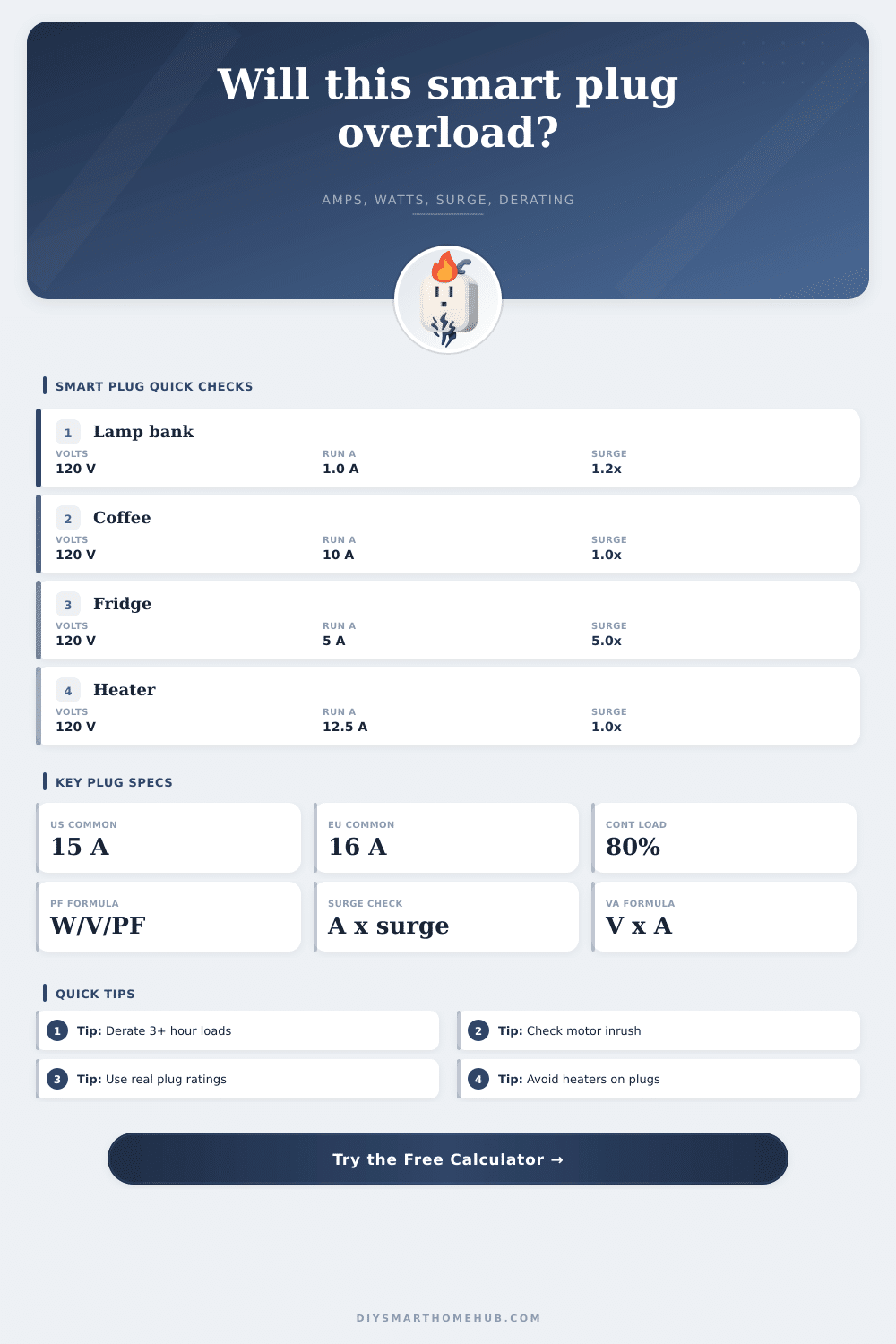
Check whether a smart plug can safely handle a device by comparing watts, amps, voltage, power factor, continuous-load derating, relay VA, and motor or compressor inrush. Use real nameplate values whenever you have them.
🎯Real load presets
⚙Smart plug and load inputs
Smart plug overload results
📊Live plug stress snapshot
🔌Smart plug/spec comparison grid
| Smart plug class | Typical rating | Continuous check | Best match | Caution zone |
|---|---|---|---|---|
| Compact 10 A plug | 10 A, 1200 W at 120 V or 2300 W at 230 V | 8 A after 80% derate | Lamps, routers, fans, small electronics | Space heaters, kettles, compressors |
| US 15 A smart plug | 15 A, often 1500 W to 1800 W | 12 A after 80% derate | Lighting, dehumidifier, coffee maker, many appliances | Loads near 12 A for many hours |
| EU/UK 16 A smart plug | 16 A, often 3680 W at 230 V | 12.8 A after 80% derate | Kettle timing, washer monitor, electronics | High heat in tight wall sockets |
| Energy-monitoring plug | Same current rating, adds metering shunt | Use the printed amp rating | Measuring real watts and PF before automation | Heat-sensitive enclosed locations |
| Smart outlet module | 15 A or 20 A branch-circuit dependent | 12 A or 16 A continuous | Permanent outlet control with known wiring rating | Unknown box fill or shared circuits |
📐Reference amperage table
| Device load | Typical watts | 120 V running amps | 230 V running amps | Inrush note |
|---|---|---|---|---|
| LED lamp group | 30 W to 150 W | 0.3 A to 1.3 A | 0.1 A to 0.7 A | Usually low, driver dependent |
| WiFi router and modem | 15 W to 40 W | 0.2 A to 0.4 A | 0.1 A to 0.2 A | Small supply surge |
| Coffee maker | 900 W to 1500 W | 7.5 A to 12.5 A | 3.9 A to 6.5 A | Mostly resistive |
| Space heater | 750 W to 1500 W | 6.3 A to 12.5 A | 3.3 A to 6.5 A | Continuous heat load |
| Refrigerator | 120 W to 700 W | 1 A to 6 A | 0.5 A to 3 A | Compressor surge 3x to 7x |
| Sump pump | 400 W to 1200 W | 4 A to 12 A | 2 A to 6 A | Locked-rotor surge can be high |
💡Power factor and surge reference
| Load profile | PF to try | Surge multiplier | Formula focus | Interpretation |
|---|---|---|---|---|
| Pure resistive heat | 0.98 to 1.00 | 1.0x to 1.2x | A = W / V / PF | Continuous derating usually decides |
| LED driver bank | 0.60 to 0.95 | 1.1x to 2.0x | VA = V x A | Poor PF raises current for same watts |
| Compressor appliance | 0.65 to 0.90 | 3.0x to 7.0x | Surge A = run A x inrush | Relay contacts see high starting stress |
| Computer power supply | 0.90 to 0.99 | 1.5x to 3.0x | W and VA both matter | UPS or PSU startup can trip weak plugs |
| Battery charger | 0.80 to 0.99 | 1.2x to 2.5x | Runtime + current | Long sessions need continuous derating |
🚦Derating and verdict guide
| Condition | Calculator test | Good range | Warning range | Overload range |
|---|---|---|---|---|
| Running current | Load A / allowed A | Under 80% | 80% to 100% | Over 100% |
| Real power | Load W / plug W | Under 80% | 80% to 100% | Over 100% |
| Continuous load | 3+ hours uses derate | Below derated A | Near derated A | Above derated A |
| Surge/inrush | Run A x multiplier | Below surge rating | Within 10% | Above surge rating |
| Relay VA | Voltage x running amps | Below plug W/PF limit | Near limit | Exceeds practical VA |
A smart plug is more than just an device that allow you to turn on and off appliances from your phone. It is also a device that carry the current from the outlet to the appliance and, therefore, have a limit to the amount of power that it can handle. If the appliances that is connected to the smart plug require more power then the smart plug can handle, the relay within the smart plug can heat up or fail.
This is especially true for appliance that are required to be on for long periods of time. When considering the safety of a smart plug, several factor should be considered. The wattage of the smart plug is just one of this factors.
How to Keep Your Smart Plug from Overheating
The startup surge of the appliance should be considered. The power factor of the appliance should be considered. Additionally, you should also consider the derating rule for smart plugs.
The derating rule states that any load that runs for three hour or longer should not use more than 80 percent of the amps that is rated for the smart plug. If you dont consider this factor when purchasing a smart plug, the smart plug can overheat even if the wattage of the smart plug is within the limits of the appliance’s wattage. Appliances like refrigerators is examples of appliances that exhibit a startup surge.
While refrigerators may only use a few hundred watts while running, the compressor that runs the refrigerator can draw five or six times that amount of current while starting up. This can lead to overheating or failure of the relay of the smart plug. Other appliances, like dehumidifiers and window air conditioning units will also exhibit this same startup surge.
For these reasons, dehumidifiers and window air conditioning units are harder on smart plugs than appliances like heaters of the same wattage. Another factor to consider is the power factor of the appliance. Power factor determine the amount of current that will pass through the smart plug.
Appliances that use resistive loads, like kettles and space heaters have a power factor of almost 1.0. This means that the voltage and the current are in phase and the wattage is the wattage that is reported for the appliance. Appliances with motors, like gaming PCs and battery chargers have a power factor of 0.75 or less.
This means that they require more current through the outlet and smart plug than the wattage would indicate. Another factor to consider is the number of hour that the appliance will be running. Any appliance that will run for three hours or more should be considered a continuous load.
The rule of thumb for continuous loads is that the appliance should have some head room in the smart plug. Most smart plugs are rated for their amps at short burst of time. However, if the appliance, like an electric vehicle trickle charger or aquarium heater, is to run for three hours or more, the current must be 80 percent or less of the amps for the smart plug.
A simple calculator can help to determine the safe amount of current for any appliance. The calculator takes into account the wattage of the device and how long it will be running. The calculator will automatically calculate the safe current for the device.
It might be tempting to only look at the wattage of the smart plug and the appliance. However, this is not the safest method of determining if the smart plug will handle the appliance. The safety of the appliance is even further complicated by the fact that higher-rated smart plugs are not always better for appliances that have a high startup surge or that run for long periods of time.
The wiring behind the smart plug may not be as thick as the smart plug’s description and the outlet behind the outlet may become very hot. The relay of the smart plug can also experience failure from being on and off so often that the relay switches wear out. In addition to the factors discussed above, some of the real world conditions may affect the smart plug.
For instance, if the smart plug is behind a piece of furniture, it will heat up more than a smart plug placed directly into an outlet. Additionally, the voltage fluctuation from the utility may cause the outlet to draw more current than expected from the appliance. To avoid these potential issues, the best method for ensuring that a smart plug will not overheat is to measure the current of the appliance while it is running.
Additionally, it is important to note the startup surge of the appliance. Furthermore, it is important to note how many hour the appliance will be running. By making a comparison of these factors to the continuous rating of the smart plug rather than the maximum rating of the smart plug, it is possible to ensure that the smart plug will not overheat when the appliance is running.