🔊 Decibel Calculator
Calculate dB levels, combine sound sources, and plan smart home audio with precision.
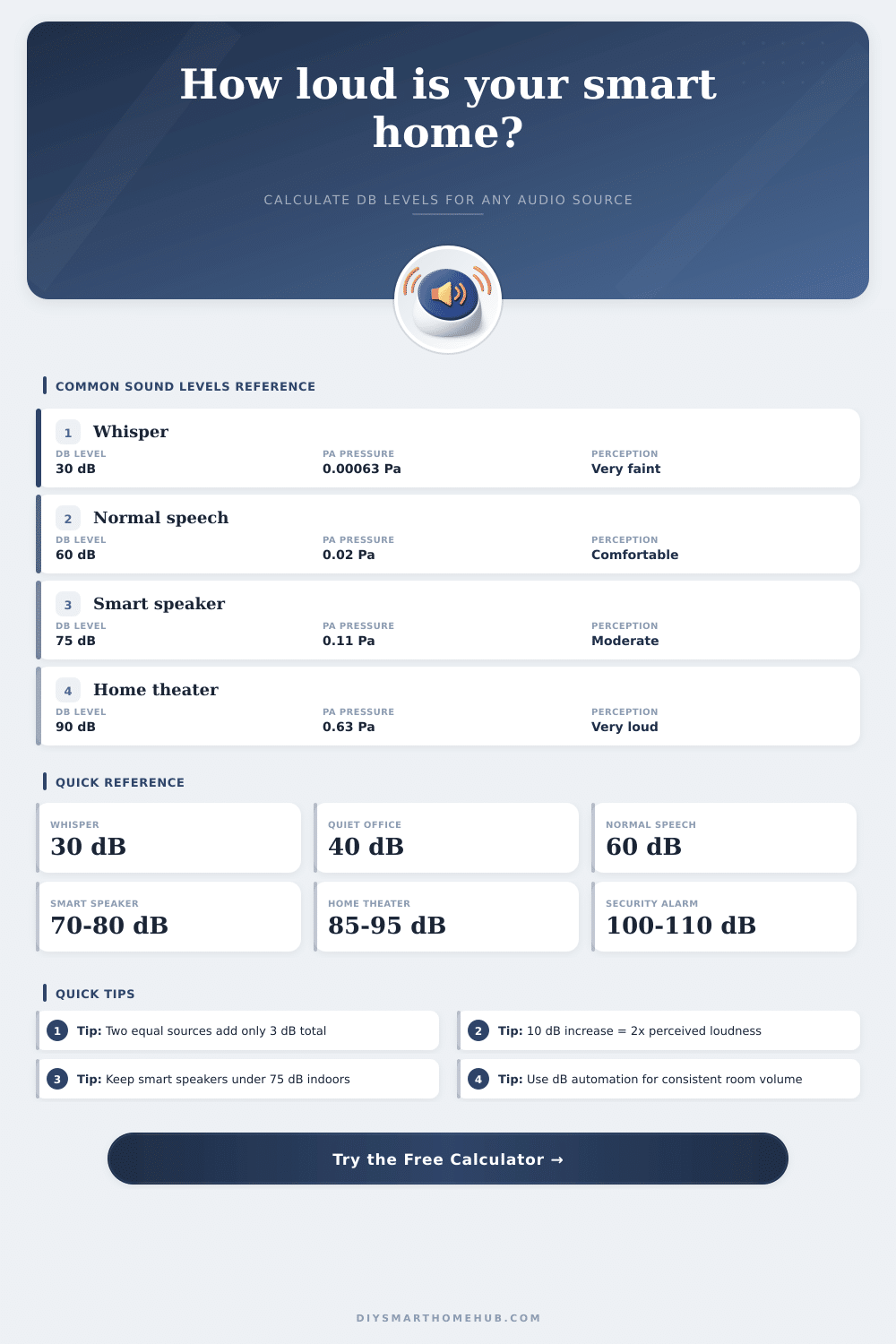
| dB Level | Example Sound | Pressure (Pa) | Loudness Perception | Safety Note |
|---|---|---|---|---|
| 0 dB | Threshold of hearing | 0.00002 Pa | Inaudible | Safe |
| 20 dB | Rustling leaves | 0.0002 Pa | Very faint | Safe |
| 30 dB | Whisper, quiet library | 0.00063 Pa | Faint | Safe |
| 40 dB | Quiet office, HVAC hum | 0.002 Pa | Soft | Safe |
| 50 dB | Moderate rainfall | 0.0063 Pa | Moderate | Safe |
| 60 dB | Normal conversation | 0.02 Pa | Comfortable | Safe |
| 70 dB | Busy traffic, vacuum | 0.063 Pa | Loud | Safe |
| 75 dB | Smart speaker (high) | 0.11 Pa | Moderately loud | Safe short-term |
| 80 dB | Doorbell, blender | 0.2 Pa | Very loud | Safe short-term |
| 85 dB | Home theater immersive | 0.36 Pa | Quite loud | Limit exposure |
| 90 dB | Lawnmower, subway | 0.63 Pa | Extremely loud | Limit to 2 hrs |
| 100 dB | Security alarm, chainsaw | 2 Pa | Painfully loud | Limit to 15 min |
| 110 dB | Concert, fire alarm | 6.3 Pa | Threshold of pain | Very limited only |
| 120 dB | Thunder, jet flyover | 20 Pa | Painful | Avoid exposure |
| Device Type | Typical dB Output | Recommended Listening dB | Room Size |
|---|---|---|---|
| Compact smart speaker | 70-80 dB max | 55-65 dB | Small (up to 150 sq ft) |
| Mid-size smart speaker | 80-90 dB max | 60-70 dB | Medium (150-300 sq ft) |
| Soundbar (basic) | 85-95 dB max | 65-75 dB | Medium living room |
| Soundbar (premium) | 95-105 dB max | 70-80 dB | Large living room |
| Home theater system | 100-110 dB max | 75-85 dB reference | Dedicated room |
| HVAC system (indoor) | 40-55 dB | Below 45 dB ideal | Any room |
| White noise machine | 50-65 dB | 50-60 dB sleep | Bedroom |
| Smart doorbell chime | 60-80 dB | 65-70 dB audible | Entry / hallway |
| Baby monitor speaker | 60-75 dB | 55-65 dB | Nursery / bedroom |
| Security siren (indoor) | 95-110 dB | N/A (alert only) | Whole home |
Decibel calculator is real rescue when you try to understand sound levels, power gains and voltage values. Because decibels appear almost everywhere, in acoustics, electronics and communication, you use them to express signal strength and other ratios in ways that actually make sense The best part of these calculators? They do the logarithmic math, that otherwise would make your head spin if you tried to count it manually.
There is very big range of such calculators. Some focus on adding and subtracting dB values in the typical acoustic spectrum, that usually goes from 0 until 200 dB. Others use different method to convert between decibels, voltage ratios or power gains.
Easy Guide to Decibels and Decibel Calculators
You put in one of the three values and receive the other two. It is very helpful when you have only one bit of infoamtion and need to find the rest.
The math behind these tools is not as scary as it seems. The power-based formula is dB = 10 × log₁₀(P₁ / P₂). For amplitude or voltage, it is dB = 20 × log₁₀(V₁ / V₂). Interesting thing is, that when voltage doubles, the power ratio jumps about 6 dB. Use basic calculator is simple…
You enter the ratio of two power or intensity levels (that must be positive), and press the button to count the result.
Also exist other calculators created specifically to find sound pressure level and intensity level in decibels. Sound intensity measured by means of decibels is represented by means of the beta symbol β. The human ear hears sounds that range from 10⁻¹² Wm² until 1 Wm².
That lowest threshold, 10⁻¹² Wm², is called zero bel and serve as benchmark intensity.
Here where it becomes interesting: decibels operate logarithmically. Change of only 1 dB mean approximately 26% change in sound energy. When sound intensity or acoustic energy doubles, you see increase of +3 dB.
Even so, the perceived loudness. That what you actually hear, double only at jump of +10 dB. This difference commonly confuses folks: acoustic energy and that what our ears perceive is not the same thing.
Modern web apps use the AudioContext API to measure noise and sound levels in decibels in real time. Give access to the microphone and let it operate. The dB(A) scale is weighted measure created to match as human ears perceive loudness.
Rather than the standard dB(L) scale, dB(A) reduce the weight of very low and very high frequencies.
Add decibels together require other method than ordinary addition. The proper formula is SPL = 10log(10^(L1/10) + 10^(L2/10)). If you want something faster, exists shortcut: subtract the dB values and divide by 10 to find the orderofmagnitude.