Smart Curtain Opening Time Calculator
Estimate how long a motorized curtain track takes to open by combining track length, draw direction, motor speed, fabric stack, center overlap, acceleration delay, and partial-open travel.
1Real curtain presets
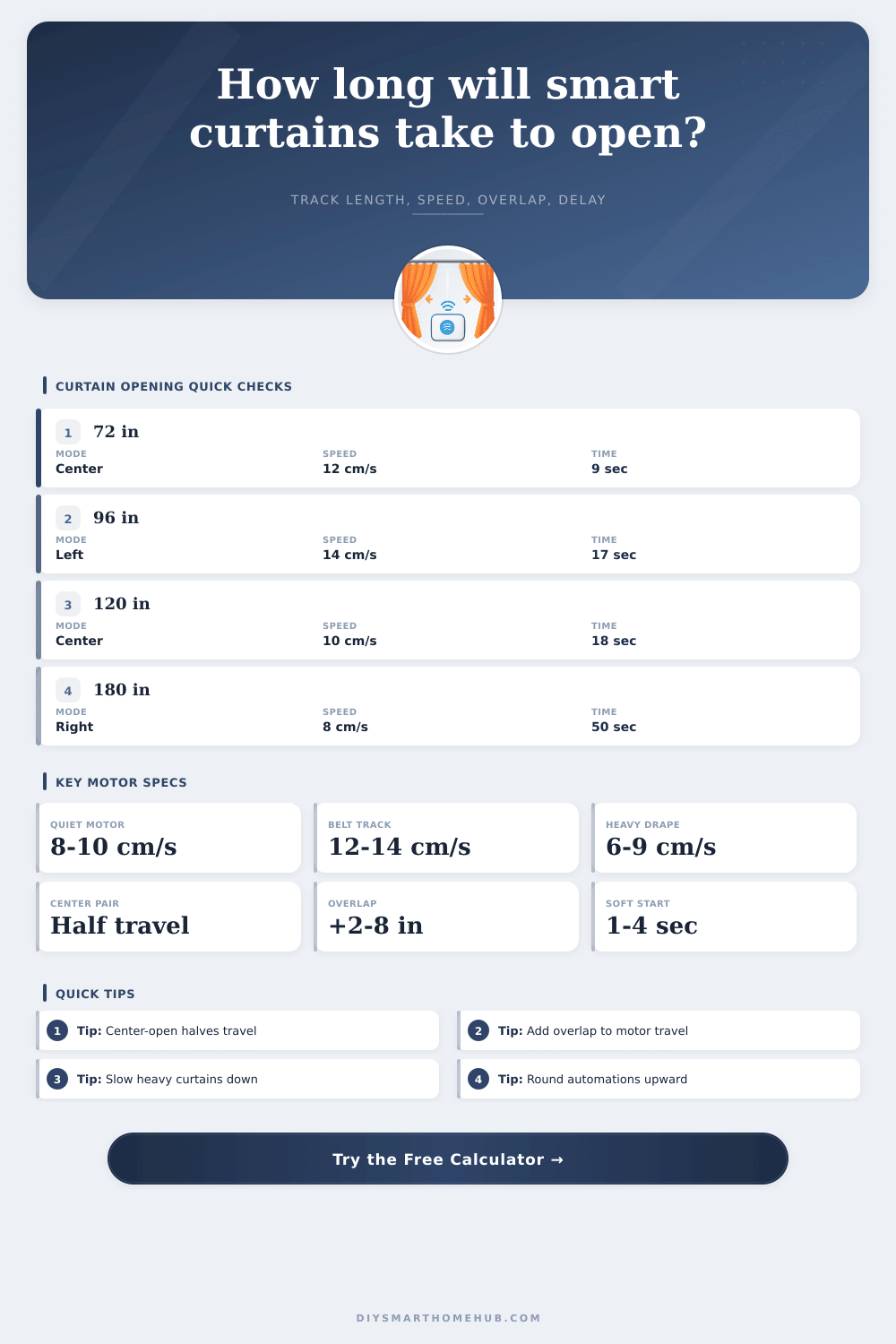
Each preset loads a realistic window, track direction, speed profile, overlap, and soft-start delay so you can compare one-way and center-opening tracks quickly.
2Calculator inputs
Opening time result
Your calculated curtain travel time will appear here.
3Curtain motor and spec comparison grid
| Travel direction | Distance formula | Best use | Timing effect |
|---|---|---|---|
| Center-open pair | (Track / 2 - stack) + overlap / 2 | Two panels meeting at center | Fastest for wide windows |
| One-way left stack | Track - stack + overlap | Door or window clearing to left | Full-length travel |
| One-way right stack | Track - stack + overlap | Door or window clearing to right | Full-length travel |
| Tandem pair, one motor path | Track - largest stack + overlap | Two panels pulled on one side | Longer than split pair |
| Corner or curved track | (Track - stack + overlap) x bend factor | Bay and L-shaped tracks | Adds friction time |
| Motor profile | Nominal speed | Typical track | Timing note |
|---|---|---|---|
| Battery rod motor | 8 cm/s | Retrofit rod or compact rail | Quiet but slower on long spans |
| Quiet belt track | 12 cm/s | Bedroom and living room tracks | Balanced speed and noise |
| AC standard track | 14 cm/s | Hardwired straight track | Good for daily full-open scenes |
| Fast sheer track | 17 cm/s | Light sheers and low-friction carriers | Shorter open time |
| Heavy drape motor | 7 cm/s | Tall blackout or theater curtains | More torque, less speed |
| Common project | Track length | Mode | Expected open time |
|---|---|---|---|
| Small bedroom window | 60 to 72 in | Center-open | 8 to 12 sec |
| Patio sliding door | 84 to 108 in | One-way stack | 16 to 24 sec |
| Wide living room glass | 120 to 180 in | Center-open | 16 to 28 sec |
| Office glass wall | 160 to 240 in | One-way or tandem | 35 to 70 sec |
| Curved bay track | 100 to 160 in | Corner or curved | 25 to 55 sec |
| Input change | Formula impact | What to watch | Best calculator use |
|---|---|---|---|
| Longer track | Raises travel distance | One-way tracks grow fastest | Compare split versus one-way |
| More overlap | Adds extra motor travel | Center overlap is usually shared | Fine-tune meeting point timing |
| Soft-start delay | Adds fixed seconds | Matters most on short windows | Set automation lead time |
| Heavy load factor | Reduces effective speed | Bends and tall fabric compound | Model real carrier friction |
| Partial opening | Scales travel distance | Delay still remains fixed | Morning light scenes |
A curtain can need a few extra inches of travel for overlap, returns, and carrier spacing, so the motor path is often longer than the visible clear gap.
If a sunrise scene must be fully open by a specific moment, use the automation lead value rather than the raw travel time.
Motorized curtains takes a specific amount of time to move from one position to another. The time it takes for motorized curtains to move from one position to another dont depend on the length of the track the motorized curtains travel on. It does not depend on the speed of a motor.
Many people makes the assumption that if they know the length of the track and the speed of the motor, they can calculate how long it will take for the motorized curtain to travel the length of the track. However, motorized curtains involve three extra factors that must be accounted for: the distance of the overlap, an allowance for the fabric to stack on the motorized track, and the time the software takes to start the motor. All of these factor must be included in finding the time it takes for the motorized curtain to travel from one position to the next.
Why Motorized Curtains Take Time to Move
Motorized tracks involve a carrier that moves along a belt or rod to pull the fabric of the curtain along a predetermined path. The path that the motorized curtain travels almost always takes the curtain more long than the width of the window. This is because the fabric of the curtain must stack onto one end of the motorized curtain track.
Additionally, there is often an overlap with motorized curtains so that there is no gap between the two edge of the curtain. To calculate the distance a motorized curtain must travel, people have to input the length of the track, the direction of travel, and the distance of the overlap. People often use the speed of the motor to determine the speed with which the motorized curtain will travel.
However, the actual speed of the motor may change. The motor can change the speed based on the weight of the curtain and the shape of the motor track. If the curtains that are being used are heavy blackout curtains, the heavy weight of these drapes will slow the motor.
Similarly, if the motor track is shaped in such a way that creates friction between the curtain and the track, this will create resistance that slow the motor. These different types of motors are listed with their nominal speeds in a reference table on the page to allow people to compare the different motors and there speeds. Motors take a while to reach the full speed at which they are rated.
Most motorized curtain systems uses a soft start ramp to the ensure the fabric does not jerk as the motor moves it. A soft-start ramp is a period of time in which the motor gradually increase the speed at which it moves the curtain. A soft start ramp is measured in seconds, not inches.
The length of the ramp is a constant value regardless of the length of the track. Thus, a soft start ramp will represent a larger percentage of the total time it takes for the motorized curtain to travel from one position to the next on a short track than on a long track. The curtain calculator incorporates this soft-start ramp into the total time.
The direction in which the motorized curtains travel can change the distance that the motor must move. If there is a center-opening pair of curtains, the motor will travel half the total distance of the track. If the motorized curtain is a one-way stack, the distance that the motor must travel is almost the entire length of the track.
Thus, a one-way stack will take more time to travel from one position to the next than a center-opening pair of curtains. The field for entering the direction in the curtain calculator will automatically multiply the length of the track by the appropriate factor to ensure the distance that the motor must move is represented in the calculation of the time for the motor to complete its journey. Many people select a partial opening for their motorized curtains.
Using a partial opening will make the motorized curtain stop moving short of the end of the track. Only the portion of the track between the opening and the window will be traveled by the motor. However, the length of the soft start ramp will remain the same regardless of the length of the track.
Thus, the time that the motor takes to travel from one position to the next is not linear in relation to the setting of a partial opening. The percentage of the travel distance will be applied to the portion of the track that the motor actualy travels to ensure that the time is realistic. The profile of the motor must be the correct profile for the curtains in the room.
One of the most common motor profiles is the battery rod motor. These motors are easy to install. However, battery rod motors tend to be slower than other motor types.
Belt tracks are in the middle range in terms of the speed of the motors and the type of fabrics they handles best. Fast sheer motors are used for moving light fabric quickly. There is a spec grid on the page for the different types of motors to allow people to compare the specifications of the motors and to ensure that they purchase the appropriate motor for there curtains.
The time it takes for the motorized curtains to move from one position to the next can change due to a few different factor in the room. For instance, there may be dust on the hardware on which the motor moves the curtain. Additionally, the temperature in the room may affect the tension of the belts on the motor.
Because these factors cannot easily be accounted for, it is best to use the calculated time as a baseline; some extra time should be accounted for in the schedules for the motorized curtains. Adding a buffer in time for motorized curtains to open and close is of particular importance for sunrise scenes so as to not startle the people in the room who may be sleeping. Thus, once people understands each of these factors, they will understand why motorized curtains move the way that they do.