Signal Strength Calculator
Estimate received signal level, fade margin, obstacle loss, and practical link reach for Wi-Fi, Zigbee, Z-Wave, BLE, LoRa, or LTE smart-home paths before you move an access point, hub, repeater, or outdoor radio.
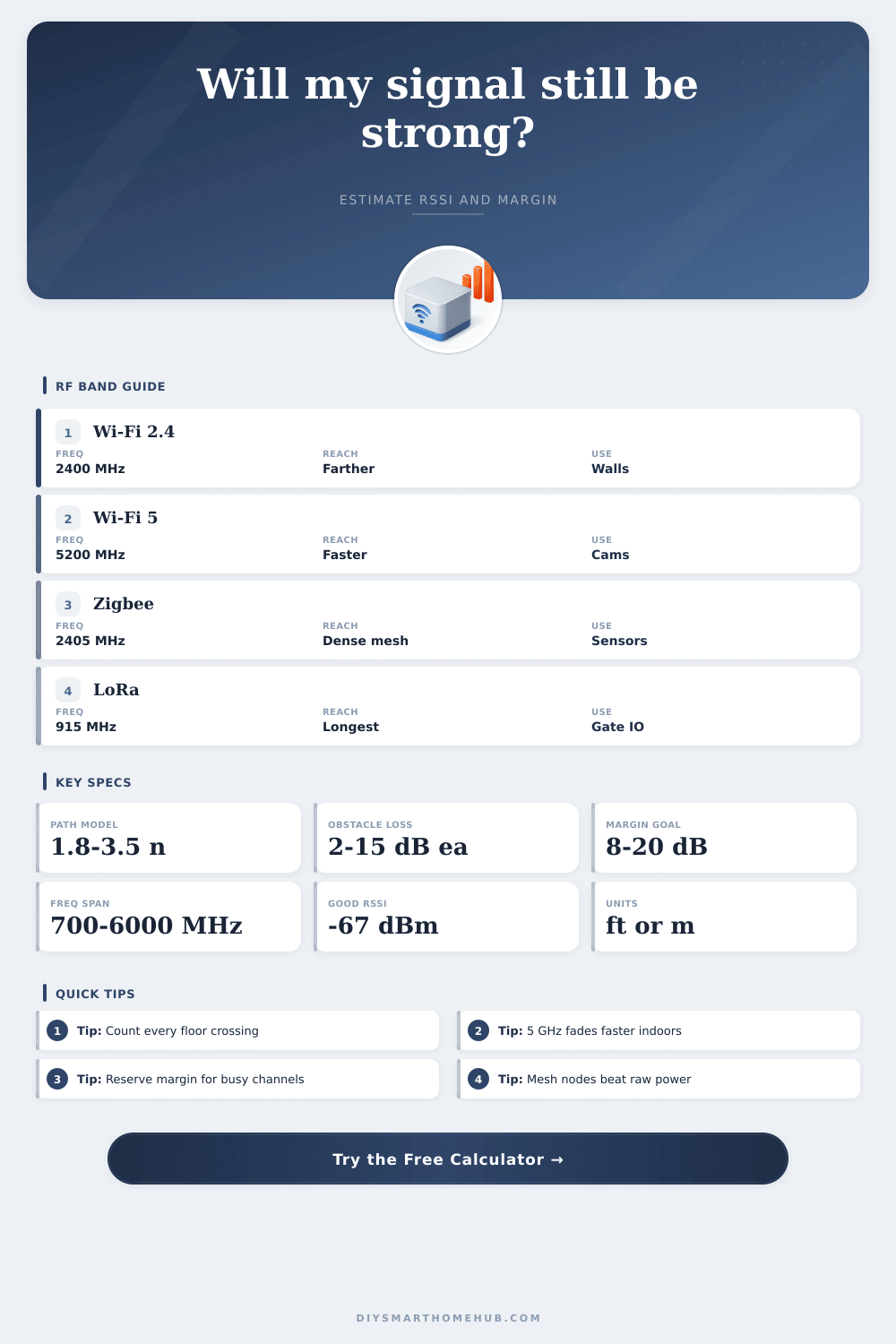
| Radio | Typical Band | Healthy RSSI | Common Use |
|---|---|---|---|
| Wi-Fi 2.4 GHz | 2401 to 2473 MHz | -67 dBm or better | General rooms and smart plugs |
| Wi-Fi 5 GHz | 5180 to 5825 MHz | -65 dBm or better | Cameras and higher throughput |
| Zigbee | 2405 to 2480 MHz | -80 dBm or better | Mesh sensors and bulbs |
| LoRa 915 | 902 to 928 MHz | -110 dBm or better | Long telemetry and gate sensors |
| Obstacle | Loss Each | Where It Shows Up | Planning Note |
|---|---|---|---|
| Drywall wall | 3 dB | Bedrooms and halls | Two or three walls add up quickly |
| Glass window | 2 dB | Doors and patio glazing | Low-E film can be worse |
| Brick or stone | 7 dB | Exterior walls and chimneys | Hurts higher bands first |
| Concrete or block | 12 dB | Basements and utility cores | Often worth bypassing with mesh |
| Floor crossing | 15 dB | Upstairs and basements | Count every level transition |
| Quality Band | Margin | Behavior | What To Expect |
|---|---|---|---|
| Excellent | 20 dB plus | High reserve | Room for traffic peaks and weather |
| Usable | 12 to 19 dB | Stable daily use | Usually fine if channels stay clean |
| Fringe | 1 to 11 dB | Intermittent dips | Expect retries or lower data rates |
| Failing | 0 dB or less | Below threshold | Needs less loss or more gain |
A couple of brick or concrete crossings can multiply the effective path length several times. That is why moving a hub one room over can outperform simply turning radio power higher.
If the model barely clears sensitivity, real life will still fail during busy hours, wet weather, or battery sag. A mesh relay or a cleaner placement is usually the smarter fix.
Smart home signal strength relies upon the way in which the radio waves travels from one device to the next. Signal strength is a factor in whether a smart home system operate smoothly or if the devices require troubleshooting to function. Unlike light, radio waves do not travel in straight lines.
Instead, radio waves has the potential to bend and even bounce off various obstacles within a home. Various obstacle within a home can lead to the reduction of the signal strength of a smart home device. Such a reduction in signal strength are referred to as attenuation.
What Makes Smart Home Signals Weak
For instance, a drywall partition will cause some degree of attenuation to the signal. However, if there are numerous drywall partitions that the signal encounters, the attenuation will be more significant. The frequency of the radio signals can also impact the way that the signal interact with obstacles within the home.
For instance, radio signals in the 900 megahertz band can travel through brick and plaster more easy than other frequency bands. Higher frequency bands, such as 5 gigahertz and 6 gigahertz, allow for higher data transfer speeds but suffer from more attenuation from the various surface within the home. The materials that people use to construct a home can also impact the amount of attenuation of the signal.
Homes with wood-frame walls and insulation permit the signals to travel through the walls more easy than homes with chimneys and basement walls made of concrete. Additionally, the floor within a home will also cause the signal strength to attenuate due to the joists and subfloors within the structures of those floors. Finally, the windows within the home may also cause signal attenuation if the windows have low-emissivity glass coating.
These types of glass coatings will cause more attenuation to the signal than plain sheets of glass. Signal calculators can help a designer to calculate the number of these obstacle that a signal may encounter during travel within a home. Repositioning smart home devices will often be more effective than increase the transmit power of each device within the network.
Distance between devices will impact the signal strength between each device, but not in a linear way. Signal strength diminish with distance in the open air, but over shorter distances within a home, signal strength drops more rapid. Additionally, various forms of clutter within the home will cause further attenuation of the signal.
For instance, a 2.4 gigahertz Wi-Fi signal may be able to reach the backyard where a patio is located, but a 5 gigahertz signal may not reach the same distance. Finally, the sensitivity of the device to receive the signal will impact the strength of the signal that it requires to effectively receive the signal from other devices. Devices with low power, such as sensors, can tolerate weaker signal than devices that require high data transfer speeds.
The fade margin is the buffer within the signal strength that exist above the threshold at which the device can receive the signal. This fade margin protect the signal against interference from other devices, battery drain from smart devices, and signal fluctuations from other devices in the same area. The fade margin should be set to between twelve and twenty decibels.
If the designer does not provide the fade margin for the devices with sufficient strength, the signal between those devices may drop packet of data or experience a loss of connectivity at different times of the day. Further, the fade margin should also be provided for busy channel within the network in cases where devices such as Bluetooth devices or cordless phones may create interference with the smart home devices. Signal calculators include the ability to preset various example of smart homes and the devices within those homes.
For instance, a designer can make a preset for a sensor located within the basement of a home or an LTE router that is located near a window of the home. Such presession of the devices allow the designers to ensure that there is an appropriate amount of power and gains of the antenna to ensure that no variable in the device creation are overlooked. The signal calculators allow designers to create custom setting for devices like directional bridges or LoRa gateways.
Additionally, the signal calculators will reveal the number of obstacles that may reduce the signal strength of the devices and at what distance those signal reductions may occur. The signal quality will be displayed in terms similar to signal bar for mobile phones so that the designers can easily understand the signal strength. There are some mistake that should be avoided in the construction of smart homes.
For instance, increasing the transmit power for smart home devices can create issues with the heat limit of those devices and may increase the potential for interference with other devices of other individuals. Antenna placement within a home should be the focus of each designer. Antennas should be placed in elevated positions to avoid attenuation from the various form of clutter within a home.
Another mistake that should be avoided is the use of mesh networks. Mesh networks can help with signal strength by altering the path that devices must travel for their signals to reach their destinations to include several short paths rather than one long path. However, feedline losses within coaxial or pigtails will reduce the power of the signal that is radiated from each device.
Beyond signal power, various environmental factor can impact signal strength. For instance, the weather outside of the home can impact the signal strength of devices that transmit their signal outside of the home. Rain fall, for instance, can reduce the strength of the signals from those devices, and the effect of rain will be more significant on devices with higher frequency bands than those with lower frequencies.
Additionally, indoor humidity may impact the signal strength of devices whose signals travel through wooden surfaces. Finally, the age of the devices can impact the strength of the signals that they create; over time, the antenna that radiates the signal from each device may detune. Both the signal strength of all the devices in the smart home should be tested under the worst-case scenario for that signal strength, such as with the doors of the home in a closed position or during times when the Wi-Fi is experiencing high usage.
If the signal margins between devices are too thin for effective data transfer, a powered signal repeater may be more effective than purchase an additional device with a higher battery.