Solar Panel Calculator for RV
Estimate the solar array, panel count, battery bank, controller current, and roof fit your camper needs based on daily energy use, sun hours, losses, and battery type.
Choose a starter profile, then fine-tune the numbers for your exact loads, sun window, and roof layout. Every preset fills the form and runs the sizing math automatically.
Daily load is the watt-hours you expect to use in 24 hours. Losses cover temperature, charge conversion, wiring drop, and less-than-perfect panel angle.
Your RV Solar Results
Calculation Breakdown
These spec cards update from your current form settings so you can sanity-check the design assumptions before comparing panel count and roof fit.
| Load Group | Typical Watt-Hours | Notes | Solar Impact |
|---|---|---|---|
| LED lights + pump | 180 to 320 Wh | Night use and short pump cycles | Base load |
| Compressor fridge | 500 to 900 Wh | Varies with weather and door opening | Constant draw |
| Laptop + router | 350 to 700 Wh | Remote work days or streaming | Midday demand |
| Roof fans | 250 to 650 Wh | Summer ventilation can run for hours | Seasonal spike |
| TV + chargers | 150 to 350 Wh | Mostly evening inverter time | AC conversion |
| Microwave bursts | 120 to 250 Wh | Short use but high inverter surge | Battery stress |
| Panel Class | Typical Watts | Approx Area | Use Case |
|---|---|---|---|
| Compact rigid | 100 W | 8 sq ft | Small vans and add-on roof zones |
| Mid rigid | 175 W | 12 sq ft | Balanced fit for most trailers |
| Large rigid | 200 W | 13.5 sq ft | Common sweet spot for RV arrays |
| High-output | 220 W | 14.2 sq ft | Best when roof width allows longer modules |
| Flexible | 100 to 150 W | 7 to 10 sq ft | Curved roofs where low height matters |
| RV Profile | Daily Use | Array Range | Battery Range |
|---|---|---|---|
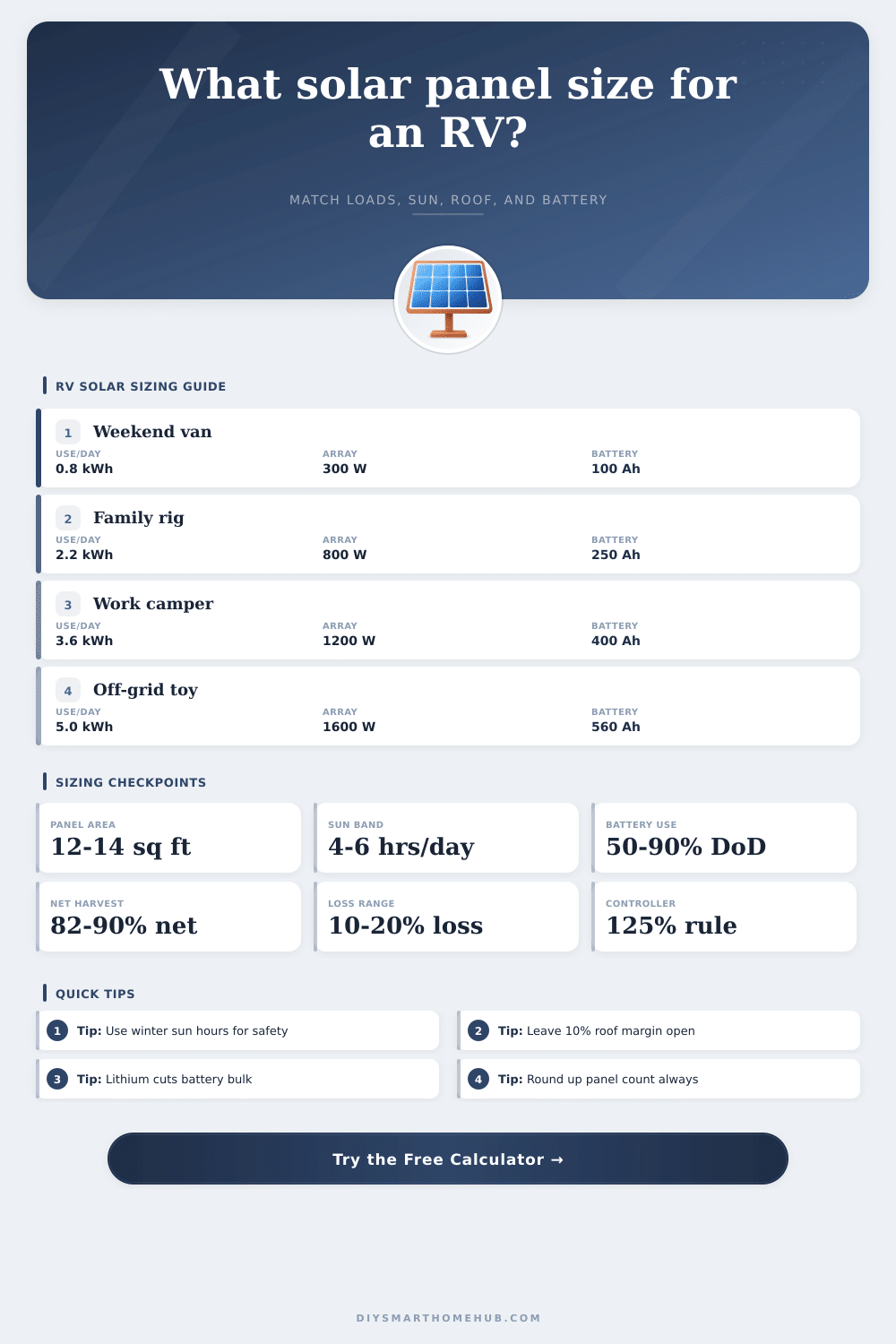
| Weekend van | 0.6 to 1.0 kWh | 250 to 400 W | 100 to 150 Ah at 12 V |
| Couple camper | 1.2 to 1.8 kWh | 450 to 700 W | 180 to 280 Ah at 12 V |
| Family travel trailer | 2.0 to 2.8 kWh | 750 to 1000 W | 250 to 360 Ah at 12 V |
| Remote work rig | 2.8 to 3.6 kWh | 950 to 1300 W | 300 to 450 Ah at 12 V |
| Full-time boondock | 4.0 to 5.5 kWh | 1300 to 1800 W | 450 to 650 Ah at 12 V |
Use the weakest sun month
If the rig must work year-round, size the array using your worst expected sun window so the system does not look strong on paper but fail in shoulder season.
Keep roof space honest
Roof obstacles and service access reduce usable area quickly, so a small reserve margin often matters more than squeezing in one extra module.
To size an RV solar system, you need to calculate the relationship between your energy usage, available sunlight, and available roof space. The wattage of your solar panels must equal your energy draw, but you must also account for variable like the amount of sunlight that your RV will receive each day and the physical limit of your RV roof. The first step in sizing your RV solar panel array is to calculate your daily energy draw.
Your daily energy draw is the total amount of watt-hours that your RV will use every 24 hours. Different appliance will use different amounts of energy than others. To calculate your energy draw, you must write down every appliance that you plan to use in your RV and the amount of energy that each appliance use.
How to Size an RV Solar System
Appliances like lights and water pumps use less energy than others, like compressor refrigerators. Compressor refrigerators has to cycle on and off while running to avoid overheating. Other appliances that use energy include fans and electronic device like laptops and phones.
If your RV use an inverter to convert DC to AC energy, you must factor in inverter inefficiency. Inverters can lose between 8 and 20 percent of the energy that they convert. To account for this energy loss, you must add to your calculated energy draw.
The solar panel array will have to generate more energy to account for the energy that the inverter loses. The second step in sizing your RV solar panel array is to calculate how many available sun hour you have. The sun hours that you calculate for your RV should not be based on the summer sun hours in your area.
Summer sun hours are the highest in any given year in most areas. Instead, calculate the available sun hours for the weakest month in your area, such as a cloudy season or winter season. Even with high available sun hours in your area, solar panels will not always generate the energy that the panel is rated to produce.
High temperatures, dirt accumulation on the panels, wiring issues, and the angle of the panels can cause the efficiency of solar panels to be lost. To account for these lost hours and energy output, oversize your solar panel array by 10 percent. The third step in sizing your RV solar panel array is to size the battery bank.
The battery bank should be sized to provide enough reserve energy for however many days you want to have power when there is no sun shining on the RV. For instance, someone might want to include a battery bank that provides enough energy to run the RV for one and a half day. The chemistry of the batteries will limit how much of the energy that you store in the battery bank can be used.
You should not discharge Absorbent Glass Mat (AGM) batteries to less than 50 percent of their stored energy; using an AGM battery to less than 50 percent can damage the battery. Lithium batteries, on the other hand, can be discharged to 90 percent of their stored energy without damaging the batteries. Because lithium batteries can be deeply discharged, they contain less energy than AGM batteries to produce the same output of energy.
The fourth step in sizing your RV solar panel array is to measure the available roof space on your RV. To measure the roof area, measure the total area of the RV’s roof. Then, subtract the area that is taken up by vents, air conditioning unit, and antennas on the RV.
Additionally, leave some space on the roof for walkways so that you can walk on the RV’s roof to clean and maintain the RV. If you have a relatively small amount of available roof area on your RV, you will have to use flexible solar panels. Flexible solar panels are typically more expensive than rigid solar panels.
Once you calculate the available area for your solar panel array on your RV, you can calculate how many solar panel will fit on the RV’s roof. Sizing an RV solar panel array involves a few tradeoffs. For example, if you use your RV for weekend trips only, you will need a smaller solar panel array and battery bank than if you use your RV as a full-time residence.
Full-time RV residents use more watt-hours each day than those on weekend trips. Additionally, you can size your RV solar panel array for either 12-volt, 24-volt, or 48-volt system. The higher the voltage in your RV solar panel system, the thinner the wires that you need to run throughout your RV.
To maintain your RV solar panel system, perform a few task. First, clean the solar panels every month to remove the dirt and bird droppings that accumulate on the panels and that could reduce the energy that the panels generate. Second, ensure that your RV is parked in a location where the solar panels can face the sun.
Solar panels generate the most energy when they are facing the sun direct. Third, if the battery bank in your RV is low on energy, use a generator or portable solar panels to add more energy to the battery bank. By calculating the energy draw of your RV, the available sun hours for your location, the size of the battery bank for your RV, the available area for the solar panel array on your RV, and by considering the tradeoffs in the sizing of the RV’s solar panel system, you can create an RV solar panel system that meets your energy need.