Ridge Vent Calculator
Estimate required attic ventilation, exhaust net free area, ridge vent length, product NFA capacity, intake balance, and pitch or obstruction derating for a balanced roof ventilation plan.
🏠Real ridge vent presets
⚙Vent sizing inputs
📊Live sizing cues
🧱Ridge vent spec comparison grid
📐Ventilation rule reference
| Rule path | Total NFA formula | Exhaust target | Best use |
|---|---|---|---|
| 1/300 balanced attic | Attic sq ft x 144 / 300 | Usually 45% to 55% of total NFA | Balanced intake and exhaust with vapor control or code-accepted reduction. |
| 1/150 conservative attic | Attic sq ft x 144 / 150 | Twice the 1/300 total NFA basis | Older attics, uncertain vapor control, limited intake, or high moisture risk. |
| 1/240 moderate reserve | Attic sq ft x 144 / 240 | Middle path between the two common rules | Useful when the attic is near balanced but extra airflow margin is desired. |
| Intake balance check | Available intake NFA / required intake NFA | 100% or higher is preferred | Prevents ridge vents from drawing replacement air from living space or other exhausts. |
🏗Ridge vent product comparison
| Vent profile | Typical NFA per ft | Useful ridge condition | Planning note |
|---|---|---|---|
| Low-profile roll vent | About 9 in²/ft | Long straight ridge with easy intake | Needs more length, so short ridges can run out of capacity quickly. |
| Shingle-over vent | About 12 in²/ft | Common gable roofs | Good baseline when the vent listing and slot width match. |
| Baffled shingle-over | About 15 in²/ft | Wind-exposed or mixed weather roofs | External baffles can help maintain exhaust flow across the ridge. |
| High-flow baffled | About 18 in²/ft | Short ridges and larger attics | Often a better match for hip roofs with limited ridge run. |
| Wide-slot specialty | About 24 in²/ft | Large attics with very short ridge | Use only when the roof framing, slot, and manufacturer listing support it. |
⛰Pitch and obstruction factor table
| Condition | Factor used | What it represents | Calculator effect |
|---|---|---|---|
| 2/12 to 3/12 pitch | 0.88 to 0.94 | Lower stack effect and more weather sensitivity at the ridge | Requires more listed ridge length for the same target exhaust NFA. |
| 4/12 to 9/12 pitch | 0.98 to 1.03 | Normal roof pitch range for most attic ridge products | Keeps listed NFA close to the usable exhaust estimate. |
| 10/12 to 12/12 pitch | 1.00 to 0.96 | Steep geometry, shorter horizontal slots, and wind exposure effects | Small derate unless the ridge run is clear and continuous. |
| Interrupted ridge path | 0.62 to 0.92 | End gaps, hips, valleys, truss plates, tight baffles, or blocked slot cuts | Multiplies directly against rated NFA per linear foot. |
📋Common attic sizing examples
| Attic example | Area and rule | Exhaust NFA target | Ridge length at 15 in²/ft |
|---|---|---|---|
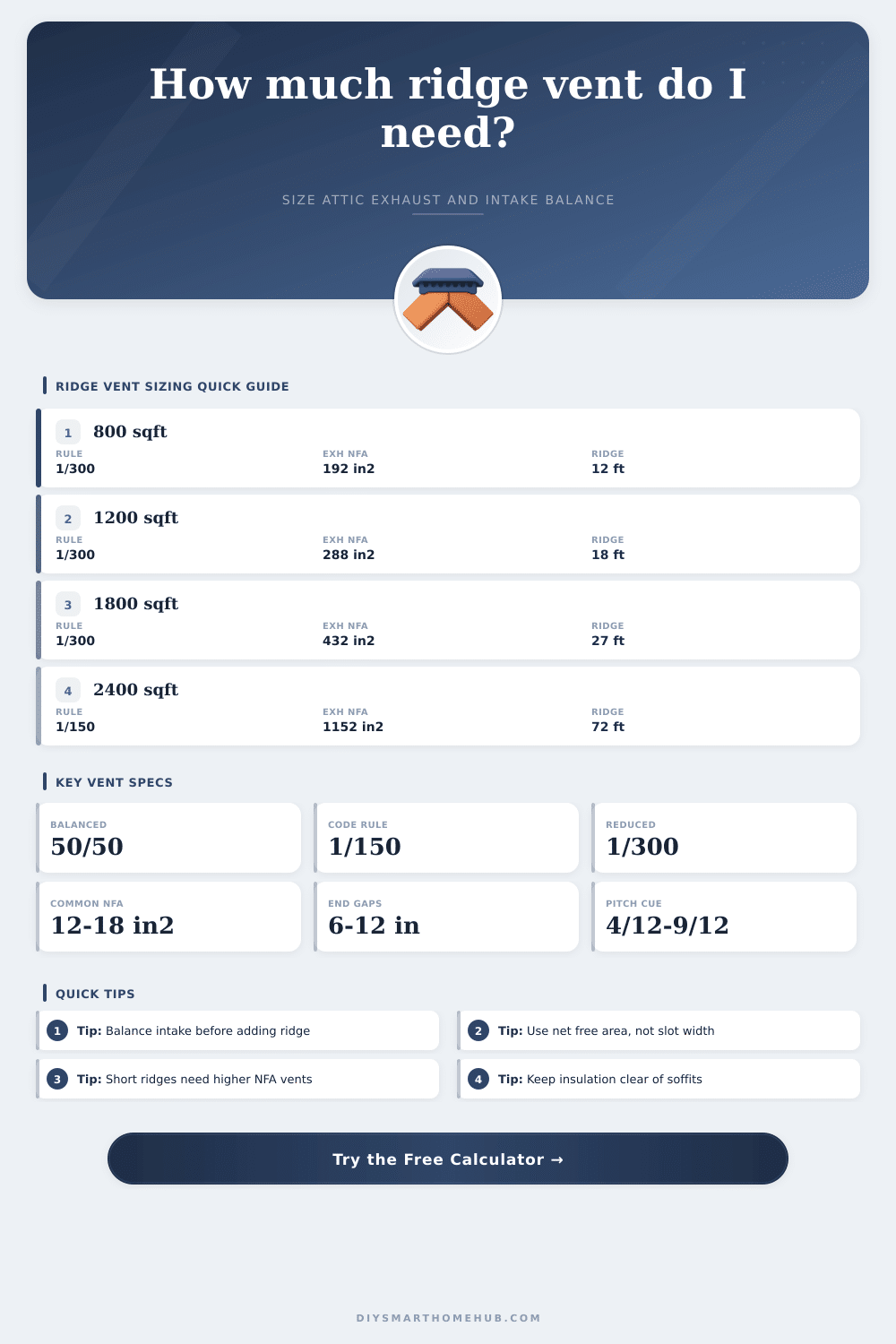
| Detached garage attic | 576 sq ft at 1/300 | About 138 in² | About 10 ft before derating. |
| Small ranch attic | 900 sq ft at 1/300 | About 216 in² | About 15 ft before derating. |
| Suburban gable attic | 1,350 sq ft at 1/300 | About 324 in² | About 22 ft before derating. |
| Large new-build attic | 2,400 sq ft at 1/300 | About 576 in² | About 39 ft before derating. |
| Conservative hot attic | 2,400 sq ft at 1/150 | About 1,152 in² | About 77 ft before derating. |
💡Ridge vent tip boxes
This calculator provides a planning estimate for net free area balance. Confirm final vent layout, code path, and product-specific slot requirements against local building rules and the selected vent listing.
Attic ventilation are another important system for the home. Attic ventilation performs important tasks like regulating the temperature and moisture levels that is within the attic. One component of the attic ventilation system is an ridge vent.
Ridge vents is located at the top of the roof, and they help to remove the hot and moist air from the attic. If the ridge vent is too small, the attic may remain stuffy within the home; however, if the ridge vent is too larger, then negative pressure will form within the attic, causing the attic vent to pull air from within the house rather than from the soffit vents. One way to determine the proper size for the attic ventilation system is to use a calculator.
How to Size a Ridge Vent for Your Attic
The calculator will ask for several different input from the attic vent installer to provide the proper calculations of the correct size for the attic. One question will be regarding the attic floor area. The attic floor area refers to the footprint of the attic floor, not the total area of the roof.
The attic floor area must be multiplied by 144 to convert the measurement from square feet to square inches. The resulting number should then be divide by a ventilation ratio. Common ratios includes 1/300 for attics with good vapor control, or 1/150 for attics with potential moisture and insulation problem.
Another question requires the person to input the exhaust share of the attic vents. This is the percentage of the ridge vent versus the intake (soffit) vent. For attics with standard roof feature, 50% for the ridge vent and 50% for the intake vents is typically used.
However, roofs with more intake vents than exhaust vents may requires different percentages. The third question requires the attic vent installer to input the usable ridge length for the attic. This length is not including feature like hips, valleys, chimney gap, or any required setback for the ridge vent manufacturer product.
Roof design with limited ridge lengths may require ridge vents with a higher capacity than those with longer ridges. The calculator will use pitch factor and obstruction factor to determine the rated net free area of the ridge vent. Factors are use because the pitch of the roof change the capacity of the ridge vent.
Steep roofs has more negative pressure in the ridge vents than low-slope roofs. Additionally, any obstruction along the ridge will reduce the effective area of the ridge vent. Intake vents are important to attic ventilation, but many people dont consider the importance of intake vent.
Ridge vents must exhaust air at the same rate as intake vents from the soffits of the attic. If the intake area is too small, the attic will pull air from other area of the attic, potentially causing moisture problems within the structure of the house itself. The reference table include information about the various type of ridge vents available.
These tables make it possible for the attic vent installer to determine whether the ridge vent that the installer is being select for the attic is realistic in regard to the ridge length of the house. The information within the reference tables can help the vent installer to remember that intake vents will determine the capacity of the attic ventilation system, but that the rated net free area of the ridge vent is not the same as the slot width of the ridge vent product. The calculator will provide the result of the calculations performed.
However, the attic vent installer will need to walk the ridge of the roof to ensure that the measurements is accurate. The ridge vent installer will need to measure the clear length of the ridge vent. Additionally, the ridge vent installer will need to ensure that insulation does not block the soffit vents.
The ridge vent product that is intended to be used on the ridge will need to have a net free area as state in the ridge vent’s profile menu. Finally, local building code may apply to the attic ridge vent project. The goal of attic ventilation is to even out the amount of air that pass through the ridge vent and the intake (soffit) vents to the attic.
If the capacities of each type of vent is within the same range, the attic will remain dry and the roof will last longer. Furthermore, if the intake and ridge vent capacities are evened out, the indoor comfort of the humans live in the house will be maintained throughout the year in each season.