Refrigerant Temperature Pressure Calculator
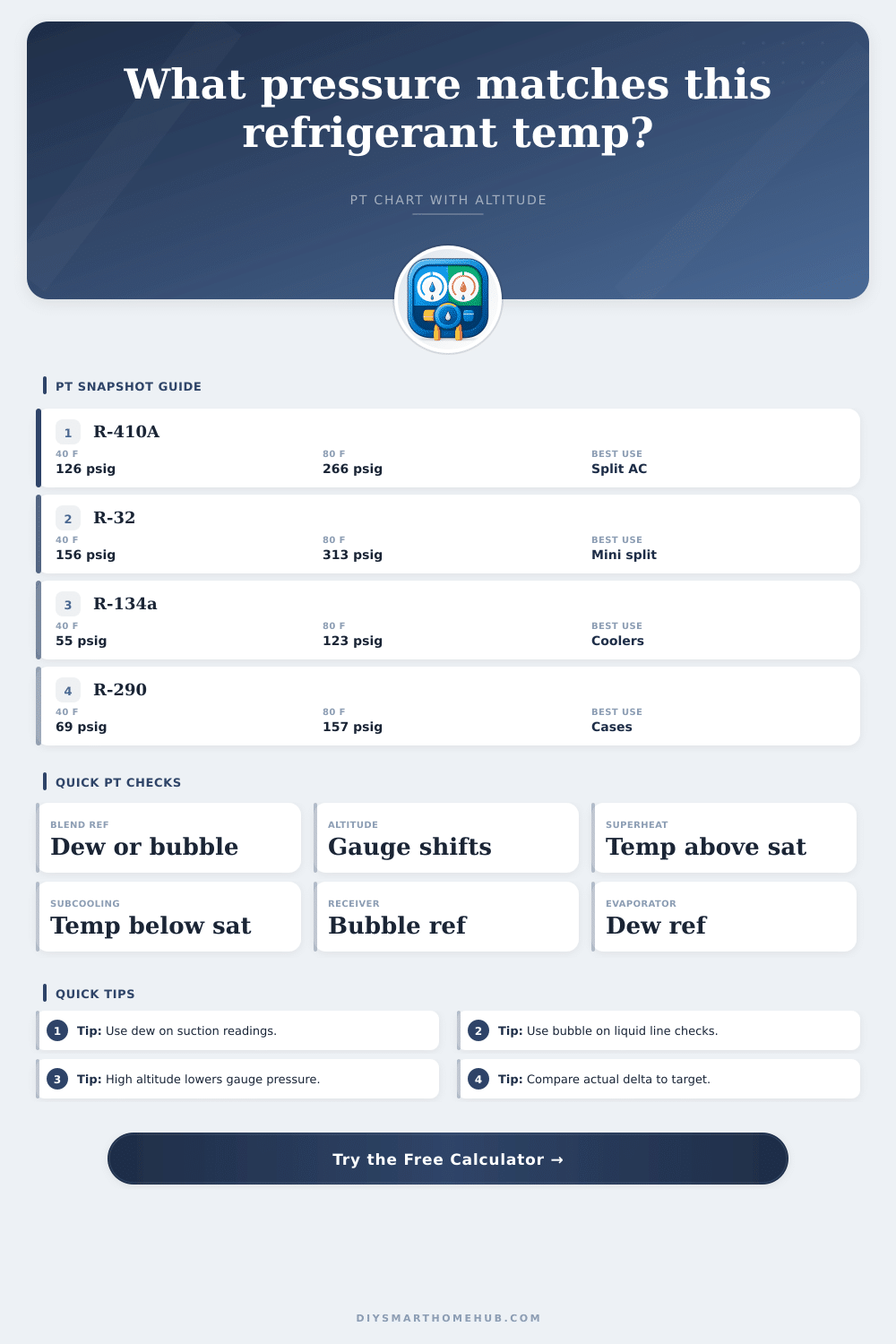
Convert measured line temperature and gauge pressure into saturation values, then compare actual superheat or subcooling with altitude-aware PT data and blend reference logic.
📌Service Presets
⚙PT Inputs
Atmosphere note: Local air pressure will update here after you change altitude.
PT Match Results
Your refrigerant snapshot will appear here after calculation.
📊Spec Comparison Grid
R-410A
Dew or bubble logic
Typical evaporator range
Typical condenser range
❄Selected Refrigerant PT Snapshot
This table updates for the selected refrigerant, your altitude, and the chosen dew or bubble reference.
| Sat Temp | Metric Temp | Local Gauge | Absolute | Basis |
|---|
📘Refrigerant Comparison Table
| Refrigerant | Pressure Class | Glide | Typical Use | Service Note |
|---|
🔧Operating Target Table
| Application | Evap Sat | Cond Sat | Superheat | Subcooling |
|---|
🌎Altitude Correction Table
The same absolute refrigerant pressure shows a different gauge reading as elevation changes.
| Altitude | Atmosphere | Gauge Reading | Metric Gauge | Why It Shifts |
|---|
Blend reference tip: Use dew for suction-side saturation and bubble for liquid-side saturation on glide refrigerants such as R-407C or R-454B so your superheat and subcooling math lines up with field practice.
Altitude tip: A remote site can make a healthy system look low on pressure. Converting the gauge reading to absolute pressure helps separate atmospheric shift from a real PT mismatch.
The pressure-temperature relationship for refrigerants are important for technicians who are attempting to correctly diagnose refrigeration systems. The relationship between refrigerant pressure and refrigerant temperature allow for technicians to determine if a refrigeration system is operating correctly. A technician will use refrigerant gauges to measure the pressure of the refrigerant and an thermometer to measure the temperature of the refrigerant lines.
The saturation temperature of the refrigerant will allow technicians to calculate the superheat or subcooling of the refrigerant. Superheat is the difference between the actual temperature of the refrigerant and the saturation temperature. Subcooling is the difference between the saturation temperature and the actual temperature of the refrigerant on the liquid line.
Refrigerant Pressure and Temperature Basics
These measurement are used to determine the state of the refrigerant within the system. Saturation is the process by which the refrigerant change from liquid to vapor or vapor to liquid states. Saturation occurs at specific refrigerant pressures and temperatures.
If technicians doesnt understand the concept of saturation, technicians will misinterpret the refrigerant pressure measurements. For instance, if the refrigerant pressure is low, technicians may believe that the refrigerant charge are low within the system. However, it is also possible that the refrigerant charge is normal if the system is at high altitude.
The altitude at which a technician is measuring refrigerant pressures will impact the way in which the refrigerant pressure is read on the refrigerant gauge. At altitudes above sea level, the atmospheric pressure are lower. For every 1,000 feet that the altitude increase above sea level, the atmospheric pressure decreases by 0.5 psi.
This drop in atmospheric pressure will cause the refrigerant pressure gauge to read a lower number then the charts suggest for refrigerant saturation temperatures. For these reasons, technicians must account for the altitude at which they are performing refrigeration system service. Altitude will impact the way in which technicians read refrigerant pressure and will alter the relationship between refrigerant pressure and refrigerant temperature.
For refrigerant blends like R-407C and R-454B, the pressure-temperature relationship are more complex than refrigerants that is composed of a single chemical compound. Refrigerant blends has what is known as a temperature glide. The temperature glide is the difference between the dew point and the bubble point of the refrigerant blend.
The dew point is the saturation temperature of the refrigerant blend at which the refrigerant condense into a liquid state. The bubble point is the saturation temperature at which the refrigerant blend begins to evaporate into a vapor state. For refrigerant blends, technicians must use the dew point temperature to calculate superheat level.
Additionally, technicians must use the bubble point temperature to calculate subcooling levels. If either of these temperature is not used within these calculations, the calculations will not accurately reflect the state of the refrigerant within the refrigeration system. The target readings for superheat and subcooling will vary depending upon the type of refrigeration system and its application.
For refrigeration systems that are used for comfort cooling, technicians will target 10-15 degrees of superheat at saturation temperatures of 40 degrees to ensure that no liquid refrigerant enter the compressor. For refrigeration systems that perform medium-temperature cooling, technicians will target superheat levels of 8-12 degrees as these refrigeration systems prioritize the removal of heat over compressor protection. Subcooling levels will typically be between 8-12 degrees for most refrigeration systems.
Subcooling ensure that the refrigerant is in a liquid state by the time that it reaches the expansion valve. If the superheat or subcooling levels is outside of the target ranges for that refrigeration system, there may be a refrigeration system restriction, metering problem, or air within the system. By understanding the relationship between superheat and subcooling levels, technicians can identify many potential refrigeration system problem.
For example, low superheat and high subcooling indicate an overcharge of refrigerant into the system. High readings for both superheat and subcooling indicate a refrigeration system restriction. Though the pressure-temperature relationship can indicate many potential refrigeration system problems, other measurement should be performed to gather further information about those problems.
For example, technicians should also measure refrigerant amperage draw and temperature difference across the condenser and evaporator coils. Additionally, the thermometer should always be clamped tight to the refrigerant line to ensure that the refrigerant temperature is accurately measured. By understanding the relationships between refrigerant pressure, refrigerant temperature, refrigerant blends, altitude, superheat, subcooling, and the symptoms of common refrigeration system problems, technicians can accurately diagnose the condition of a refrigeration system.