Refrigerant Superheat Calculator
Compare measured suction superheat to a target based on indoor wet bulb, outdoor dry bulb, airflow, elevation, and line length before deciding whether to add or recover refrigerant.
📌Quick Presets
⚙Superheat Inputs
Calculated Superheat Snapshot
Enter field readings to compare measured superheat with a target and estimate a refrigerant trim by weight.
📊Selected System Spec Grid
Chart family
Selected line factor
Adjustment rate
Operating target window
📘Reference Tables
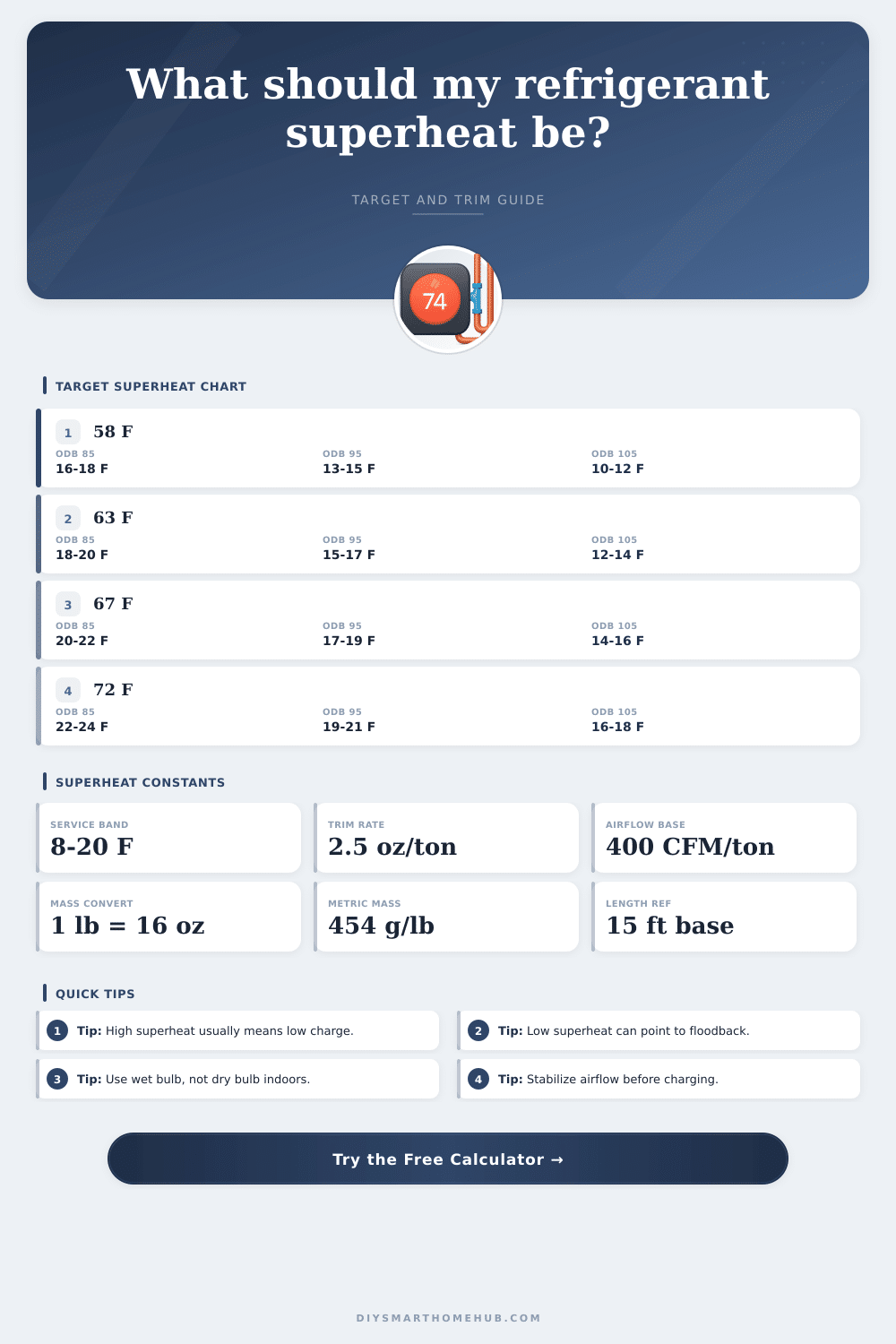
| Indoor Return WB | Outdoor 85 F | Outdoor 95 F | Outdoor 105 F |
|---|---|---|---|
| 58 F | 16 to 18 F | 13 to 15 F | 10 to 12 F |
| 63 F | 18 to 20 F | 15 to 17 F | 12 to 14 F |
| 67 F | 20 to 22 F | 17 to 19 F | 14 to 16 F |
| 72 F | 22 to 24 F | 19 to 21 F | 16 to 18 F |
| Liquid Line Size | Inside Diameter | Line Charge Factor | Metric Factor |
|---|
| Metering Profile | Target Band | Trim Rate | Best Match |
|---|---|---|---|
| Fixed Piston Split | 8 to 20 F | 2.4 oz/ton/F | Standard split AC cooling charge |
| Heat Pump Piston | 7 to 18 F | 2.2 oz/ton/F | Cooling mode with piston indoor coil |
| Package Unit Fixed Orifice | 9 to 21 F | 2.6 oz/ton/F | Rooftop or package equipment |
| Capillary Tube System | 10 to 24 F | 1.8 oz/ton/F | Small legacy or compact systems |
| Retrofit Blend Split | 9 to 19 F | 2.1 oz/ton/F | Blend refrigerants with higher glide |
| Long-Line Fixed Piston | 8 to 18 F | 2.8 oz/ton/F | Remote air handlers and long risers |
| Scenario | Refrigerant | Estimated Target | Running Charge |
|---|
Set blower speed and verify filter condition first. Airflow that is 25 to 50 CFM per ton low can push superheat several degrees off the chart before refrigerant is the real problem.
Let the system stabilize after each trim. Recover or add small measured amounts, then recheck saturation temperature and suction line temperature instead of chasing one quick reading.
Superheat is a measurement that can be used to determine if the refrigerant charge in an air conditioning system are correct. Superheat is calculated by taking the suction line temperature reading and subtracting the saturation temperature from that reading. Superheat is important in that the reading will show technicians if the evaporator coil is receiving the proper amount of refrigerants.
If the reading on the superheat gauge are too high, that indicates that the evaporator coil isnt receiving enough refrigerant, which can reduce the cooling capability of the air conditioning system. If the reading on the superheat gauge is too low, that indicates that liquid refrigerant may entering the compressor, which can damage the compressor. There is various factors that can influence the target superheat setting for an air conditioning system.
Superheat: What It Is and How to Check It
One factor to consider is the indoor wet-bulb temperature. The indoor wet bulb temperature will reflect the amount of moisture in the air that the evaporator coil must remove from the indoor air. If the indoor wet bulb temperature is high, then the capacity of the refrigerant to remove moisture from the indoor air will require that the system adjust the target superheat setting.
The outdoor dry bulb temperature is another factor that can impact the target superheat setting for an air conditioning system. Airflow is another factor that impacts the superheat reading that can be obtain from the system. Low air movement will create a higher superheat reading then normal, while high airflow will create a lower superheat reading than normal.
The length of the line set is another critical factor that technicians should consider when reading the superheat of an air conditioning system. Most air conditioning system manufacturers adds the refrigerant that is specified in the manufacturer’s guidelines to a line set length of fifteen feet. However, most air conditioning systems is installed with a line set that is thirty feet in length or longer.
Because the refrigerant will naturaly remain in liquid form along the line set, the longer line set will hold more liquid refrigerants. Therefore, the longer line set will cause the superheat reading to drop. Another factor to consider when measuring superheat is elevation.
Higher elevations have thinner air than lower elevations. Because the thickness or thinness of the air affect the condensing pressure within a refrigeration system, elevation will impact the condensing pressure. Additionally, another factor to consider is vertical lift.
If the refrigerant pools in vertical pipes, the technician will have to account for the extra refrigerant mass that pools in those vertical pipes. In order to calculate the measured superheat, the technician will use a thermometer to measure the temperature along the suction line of the refrigerant. Additionally, a technician will use a pressure gauge to find the saturation temperature of the refrigerant.
The technician will find the saturation temperature on a refrigerant pressure-temperature chart. By subtracting the saturation temperature from the suction line temperature, the measured superheat is found. Using the measured superheat, the technician can compare the value to the target superheat for that system.
If the measured superheat is much higher than the target, the system has a low refrigerant charge. If the measured superheat is much lower than the target, the system has a high refrigerant charge or there is an issue with the metering device. Before trusting the measured superheat, the system should be stabilize.
The air filters should be clean and the airflow should be set to the appropriate level. The refrigeration system should of been running for at least fifteen minutes and all doors and windows in the building should be closed. Additionally, when a technician adds or removes refrigerant from the system, it should be done in small amount.
By following this methodical procedure, a technician will not misdiagnose the refrigerant charge of the system due to incorrect airflow or incorrect environmental conditions within the refrigeration system.