Refrigerant Leak Rate Calculator
Compare baseline charge, current recovered mass, and any top-offs to estimate corrected leak loss, annualized rate, and the time left before your chosen action threshold is reached.
📌Service Presets
⚙Leak Rate Inputs
How the math works: corrected loss = baseline charge + all added refrigerant - current measured charge - one tolerance allowance. The tool then calculates both calendar annualized leak rate and a load-adjusted rate based on run hours and seasonal severity.
Leak-Rate Snapshot
Run the calculator to compare corrected leak loss, annualized charge loss, and the time left before the selected action threshold is crossed.
📊Selected Spec Grid
R-410A profile
Residential split AC
One tolerance subtraction
Leak increment
📘Equipment Trigger Table
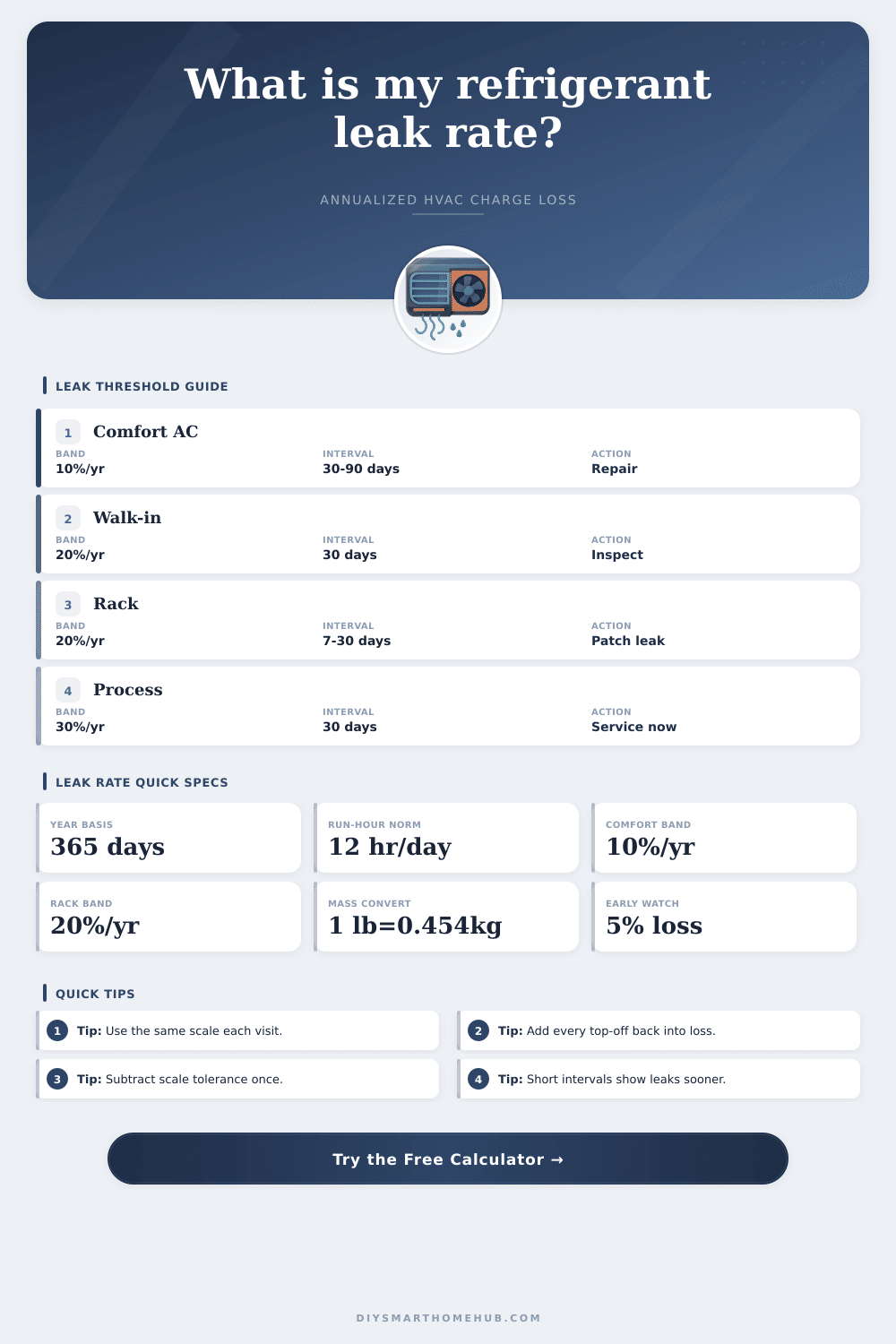
| Equipment Class | Default Band | Check Rhythm | Service Read |
|---|
These trigger bands are conservative service planning targets so teams can investigate losses before capacity, oil return, or environmental reporting issues become harder to manage.
🌡Refrigerant Reference Table
| Refrigerant | Safety Class | 100 Yr GWP | Typical Equipment | Leak Tracking Note |
|---|
Lower-charge A2L and hydrocarbon systems often have tighter service tolerances, while large comfort or process systems typically need trend tracking over several intervals to confirm repair priority.
📉Loss Benchmark Table
| Charge Loss | Mass in Selected Unit | Mass in Other Unit | Days at Current Leak |
|---|
Benchmark rows recalculate from the baseline charge you enter so you can see how fast a 2%, 5%, 10%, 15%, 20%, or 30% loss would arrive at the measured leak rate.
⏱Interval Multiplier Table
| Elapsed Interval | Annualize Multiplier | Best Use | Watchout |
|---|
Very short intervals highlight active leaks quickly, but a seasonal operating bias can inflate annualized rates unless run hours and load factor are normalized.
🛠Field Notes
Set the baseline only after the charge is verified, the circuit is stable, and non-condensables or oil logging issues are ruled out. Mixing a weak baseline with later weigh-ins makes leak trends look worse than they are.
Leak rate should reflect all refrigerant introduced between inspections. If a technician tops off a system and that mass is not added back into the loss equation, the annualized rate will read artificially low.
To determine the refrigerant leak rates at a system, you must use mathematical calculations to determine the refrigerant leak rate instead of using guesses as to what teh refrigerant leak rate is. The refrigerant leak rate allows technician to determine at what rate a system will lose refrigerant over time and to allow them to project the number of days until the slow refrigerant leak becomes a larger problem. To calculate the refrigerant leak rate, you must first establish a baseline refrigerant charge for the system.
To establish a baseline, you must measure the system while it is at a full charge of refrigerant, has had all non-condensable gas purged from the system, and the refrigerant oil levels is correct. If you do not take the time to establish such a baseline, you will have inaccurate measurements of the refrigerant leak rate for that system. To calculate the raw loss of refrigerant, you would subtract the refrigerant charge from the system from the baseline refrigerant charge for the system.
How to Calculate Refrigerant Leak Rate
You must also account for every ounce of refrigerant that you added to the system after the baseline refrigerant charge was established. After you have determined the raw loss of refrigerant for the system, you must subtract a scale tolerance to determine the corrected refrigerant loss. For example, you can account for a half percent tolerance for the refrigerant scale so that you do not waste time attempting to repair phantom refrigerant leaks that are created due to inaccuracy of the refrigerant scale measurements.
Another factor that plays a crucial role in determining the refrigerant leak rate is the time measurement of the refrigerant charge. For example, if you take refrigerant charge measurements every seven days, you will be able to recognize refrigerant leaks much more faster than if the refrigerant measurements were taken every ninety days. However, refrigerant charges may fluctuate with the season.
For this reason, you can calculate the system’s annualized refrigerant leak rate by dividing the total refrigerant charge loss by three hundred sixty-five days to calculate the system’s annual loss. This value can help you to compare refrigerant leak rates between different refrigeration system jobs. Another factor to consider in calculating the refrigerant leak rate is the runtime of the refrigeration equipment.
For example, if the refrigeration system utilizes one or more refrigeration compressors, the compressors do not run twenty-four hour per day. However, the load that the system performs during each season may differ. For example, the load that the system performs during the summer may be more different than the load that the system performs during the winter.
For this reason, you may calculate a seasonal load multiplier to account for the differences in the system load during each season. For instance, if the system has a ten percent calendar refrigerant leak rate, it may have a fifteen percent load-adjusted refrigerant leak rate during the summer due to the increased load that the system must perform. By calculating both the calendar and load-adjusted refrigerant leak rate, you will have a complete picture of the refrigerant loss for the system.
The thresholds for refrigerant leak rates may differ for different types of refrigeration equipment. For instance, a walk-in cooler may allow a twenty percent annual refrigerant leak rate before the technician will need to inspect the cooler. However, a variable refrigerant flow system may experience an increased cost to refrigerant loss if the system’s refrigerant leak rate reach ten percent.
Additional thresholds may exist for refrigerant racks and hydrocarbon case. For example, refrigerant racks may contain a much larger charge of refrigerant so that the refrigerant leak rate threshold will be much lower than for a walk-in cooler. Similarly, refrigerant hydrocarbon cases may have small refrigerant charge, so the refrigerant leak rate threshold will be lower than a system that has a much larger charge of refrigerant.
When you calculate the refrigerant leak rate for a system, thresholds for refrigerant loss can be used to make decisions about the system. For instance, if a refrigerant system contains a sensitive A2L refrigerant, the refrigerant leak rate threshold may be five percent because A2L refrigerants requires precise control of refrigerant charge for proper ventilation of the system. However, for a comfort air conditioning system, a ten percent refrigerant leak rate threshold may require that you repair the refrigerant system because such high refrigerant leak rates can lead to the air conditioning system becoming less efficient at providing comfortable air conditioning to the area that it serves.
Furthermore, the refrigerant leak rate can be used to project the number of days until the refrigerant leak reaches such thresholds. For instance, if the refrigerant leak rate calculations indicates that there are zero days until the refrigerant leak reaches the threshold for which a refrigerant repair is required, then the refrigerant leak must be patched as soon as possible. If the calculation indicates that there are six months until the refrigerant system reaches such a threshold, the refrigerant system can be logged and monitored to ensure that it does not reach the threshold too soon.
Common traps for refrigerant leak calculations include forgetting to include refrigerant top-offs in the system. If you do not include refrigerant top-offs, the refrigerant system may appear as if it does not have any refrigerant leak, when in fact it does have leaks. Additionally, you must normalize the runtime of the refrigeration system to ensure accurate refrigerant leak rate calculations.
If the refrigerant system’s runtime is not normalized, the calculations will overstate the refrigerant leak rate for systems during certain months of the year when the system may be experiencing less runtime than during other parts of the year. Furthermore, if the refrigeration system uses refrigerant R-410A, you will have to pair the refrigerant measurements with a performance measurement of the system’s refrigeration performance. This is because R-410A refrigerant blends contain component that can shift throughout the refrigerant charge.
A refrigerant leak can be an indication of another problem with the refrigeration system. For instance, vibration in the system may cause a slow refrigerant leak that has caused pinholes in the brazing along the system’s refrigeration components. Furthermore, a fast refrigerant leak can be caused by the evaporator components of the refrigeration system are corroding.
Another problem that you must rule out is refrigerant oil logging. Oil logging can lead to refrigerant losses that may be mistaken for refrigerant leaks. Furthermore, scales should be used during every refrigeration system visit.
Using the same scale for each visit will establish a reliable trend line for refrigerant loss for the system. Using a reliable trend line will allow the technician to make refrigerant leak rate related decisions based on math and logic instead of based on a technician’s gut feeling.