Refrigerant GWP Calculator
Estimate lifetime refrigerant climate impact from charge size, leak rate, recharge practice, and end-of-life recovery, then compare the same losses against a lower-GWP alternative.
📌Scenario Presets
⚙GWP Inputs
The calculator applies installation loss first, simulates yearly leaks and recharge across the chosen service life, then adds unrecovered refrigerant at retirement to estimate total direct CO2e.
Calculated Emissions Snapshot
Choose a preset or enter system values to estimate lifetime refrigerant climate impact.
📊Spec Comparison Grid
High direct impact
Lower GWP reference
Direct impact spread
End-of-life value
📘Refrigerant Impact Factors
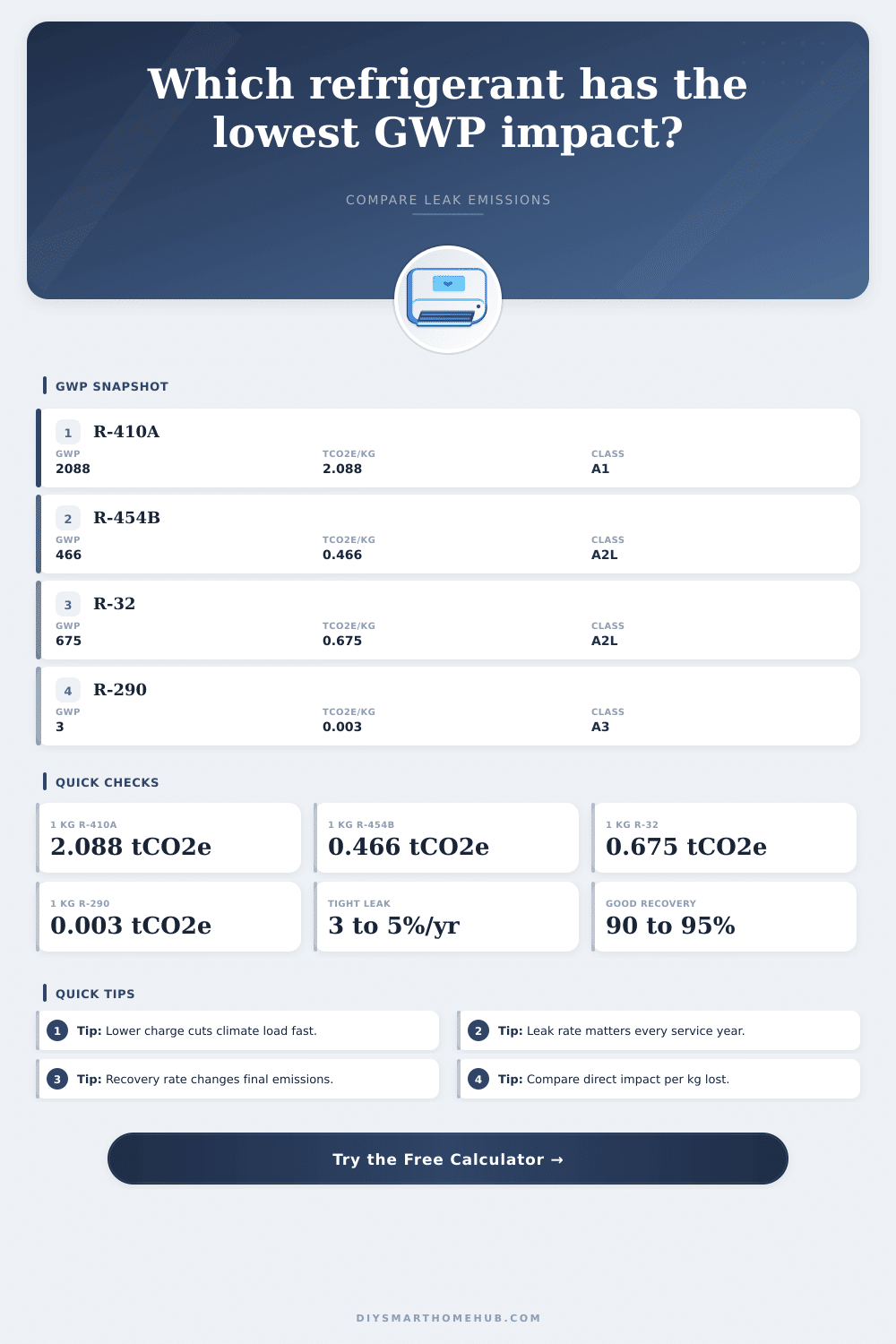
| Refrigerant | 100-Year GWP | tCO2e per kg lost | Safety Class | Typical use |
|---|
Each kilogram emitted creates direct climate impact equal to the refrigerant GWP value in kilograms of CO2 equivalent.
📈Leak Benchmark Table
| Equipment profile | Tight system | Typical field rate | High-loss threshold | Recovery target |
|---|
Use the benchmark row that matches your equipment profile to judge whether the entered annual leak rate is low, typical, or unusually high.
♻Recovery Outcome Table
| Recovery rate | Mass emitted at retirement | Direct impact | Interpretation |
|---|
This table updates with the selected refrigerant and the full installed charge so you can see how retirement practices change total direct emissions.
📋Scenario Comparison Table
| Preset | Refrigerant | Total charge | Leak rate | Lifetime direct impact |
|---|
Preset scenarios use the same modeling method as the live calculator so you can compare charge size, leak rate, and refrigerant selection side by side.
Cutting annual leak rate from 12% to 5% often prevents more climate impact over time than a small recovery improvement alone, especially on higher-GWP HFC blends.
If two designs use similar charge mass, compare tCO2e per kilogram lost first. That single factor quickly shows why lower-GWP alternatives shrink direct emissions.
A residential heat pump are an appliance that moves heat to keep a home cool or warm. Residential heat pumps use refrigerant to move the heat. Heat pumps may experience tiny refrigerant leaks over a period of fifteen years.
These tiny refrigerant leaks adds up over time. When refrigerant is lost from a residential heat pump, the refrigerant enters the atmosphere and creates a climate impact. The climate impact of refrigerant is measured in tons of CO2 equivalent.
How heat pump refrigerant leaks hurt the climate
The emissions from refrigerant from a single residential heat pump can be equivalent to the emissions from a car that is driven for several years. Refrigerant is different from other greenhouse gases because refrigerant have a high potency. Its Global Warming Potential measures the potency of refrigerant.
Global Warming Potential measures the rate at which one kilogram of a substance will trap heat as compared to one kilogram of CO2 over a period of one hundred years. Some refrigerants has a Global Warming Potential that is over two thousand times higher than CO2. Because of the high Global Warming Potential of refrigerant, even a small leak will result in a large amount of emissions. These direct emissions from refrigerant leaks are often more than the emissions of electricity used to power the residential heat pump.
Regulations require the use of low-GWP refrigerants and require heat pump service professionals to keep track of these numbers regarding refrigerant loss. The lifecycle of a refrigerant system are comprised of several stages during which refrigerant can be lost from the system. The first stage of a refrigerant system is the installation of the system.
Refrigerant can be lost during installation from the brazing of joints. The second stage of the lifecycle of a refrigerant system is the annual loss of refrigerant from the system. Refrigerant can be lost over time from refrigerant lines that have failed from vibration or from the addition of refrigerant during service calls.
Technicians will typically not add all of the refrigerant that is needed to the system during a service call. The final stage in the lifecycle of a refrigerant system is the retirement of the system. At this stage, technicians will recover refrigerant from the system.
The more refrigerant that is recovered, the less amount of refrigerant that will lead to the creation of emissions. The impact of refrigerant loss at each stage of the systems lifecycle will be multiplied by the Global Warming Potential of the refrigerant used in the system. Thus, refrigerant with a high Global Warming Potential will create high levels of emissions if it is in a system that has refrigerant leaks.
The type of equipment that is used in refrigerant systems can impact the Global Warming Potential of refrigerant leaks from those systems. Split systems have field joints during installation that can create leaks if those field joints are not created with high quality. Ductless mini splits use factory seals to avoid leaks, but the lines on those mini splits can lead to refrigerant leaks.
Commercial refrigeration racks can experience leaks from the vibration of the doors and refrigeration compressors. Refrigerant loops that are used in vehicles can also experience many leaks in these systems as they take a beating from the miles travelled on the road. By knowing the type of refrigerant system that is being used, refrigerant leaks can be prevented or avoided.
Refrigerant leak rates needs to be closely monitored for each refrigerant system. A refrigerant system that has a leak rate of three percent annually is considered to be a tight system. A refrigerant system that has an annual leak rate of ten percent or more is considered to be a high-leak system.
Thus, those with refrigerant systems with high-leak rates will experience an increase in the amount of refrigerant that leaks over time. A one percent annual refrigerant leak rate may not be noticeable with the systems current age, but over many decades, a one percent annual leak rate will result in the system losing half of its refrigerant. Many refrigerant systems lose refrigerant over time because of the way that technicians add refrigerant to the systems.
Instead, technicians should of avoid adding refrigerant to the systems. Furthermore, refrigerant systems will often lose refrigerant over time due to the process of reclaiming refrigerant at the end of the systems life span. When ninety-five percent of the refrigerant is recovered from a refrigerant system at the time of retirement, the system will exhibit a low rate of emissions from refrigerant.
If seventy percent of the refrigerant is recovered, the refrigerant system will emit the majority of its refrigerant by the time that the system is retired from use. Furthermore, the Global Warming Potential of the refrigerant has a direct impact on the emissions that are created by the system. The higher the Global Warming Potential of the refrigerant, the more important that refrigerant recovery is at the end of the system’s life.
The Global Warming Potential of refrigerant systems like R-22 is high, thus creating a high rate of emissions into the atmosphere. Presets can be used to model refrigerant scenarios in refrigerant systems. For instance, a model can be set up for a two-ton split system with an eight percent annual refrigerant leak rate.
The models will help engineers and refrigerant system designers to understand how refrigerant leaks create high emissions from the systems. Furthermore, the models can show how refrigerant systems with high refrigerant charges will create high levels of direct emissions. Chillers with many refrigerant circuits have high rates of refrigerant leaks.
Using low charge refrigerants like hydrocarbons results in negligible emissions from refrigerant leaks, even with a sloppy refrigerant recovery process. Furthermore, using these refrigerants will result in fewer environmental impacts for refrigerant systems. Furthermore, when refrigerant scenarios are modeled side by side, it is possible to determine the benefits of using a different type of refrigerant for refrigerant systems.
Furthermore, the service patterns for a refrigerant system can also impact the amount of refrigerant that is lost from that system. Systems that experience many service calls will experience many instances of technicians adding refrigerant to the systems. Each time that a refrigerant valve is opened, refrigerant can leave the system.
Furthermore, refrigerant systems that feature tight systems will experience benefits from performing proactive maintenance checks to find pinhole leaks before they become high-leak refrigerant system components. Poor systems may need to be redesigned to avoid refrigerant leaks. Furthermore, the amount of refrigerant that is within a system can be reduced.
Fewer refrigerant molecules will result in less refrigerant that can leave the system. Thus, the Global Warming Potential of refrigerant and the service practices with those refrigerants will have an impact on the amount of refrigerant that is lost to leaks in the system. The regulations regarding refrigerants are changing.
Currently, many refrigerants that are being phased out have high-GWP potential. These refrigerants are being replaced with mildly flammable A2L refrigerants and hydrocarbons. A1 refrigerants are being replaced by A2L and A3 refrigerants that have a lower potential for Global Warming Potential.
Furthermore, refrigerant adoption will be slow in the fields due to the training that technicians will need to learn to handle the new refrigerants. However, the climate and the environmental concerns for humans and the planet require such change in refrigerant type. Furthermore, heat pump service professionals can gain acceptance with their customers if they can demonstrate the direct impact of refrigerant leaks on the climate.
This impact can be quantified by modeling refrigerant leaks and providing estimates of CO2 equivalent emissions within the refrigerant system bids and audits. Refrigerant leaks can occur in a variety of ways. For instance, refrigerant leaks can be overlooked during installation of refrigerant systems.
Furthermore, refrigerant systems will not be recharged to fully compensate for refrigerant losses. Furthermore, refrigerant leak rates will be ignored over time as refrigerant continues to leak from those systems. Finally, many refrigerant systems will be overlooked in the refrigerant recovery process as many technicians will look to avoid the recovery process altogether.
Furthermore, models of refrigerant systems can be used to test these scenarios and identify which change is most beneficial to implementing into refrigerant system design and service practices. Furthermore, refrigerant management can exhibit impacts on the environment. For instance, the retrofitting of refrigerant systems with refrigerant with a lower-GWP can result in an eighty percent reduction of direct refrigerant emissions.
Furthermore, refrigerant systems that use propane will exhibit almost zero refrigerant system related emissions because the Global Warming Potential of propane is near zero. Finally, many refrigerant systems that currently use refrigerants with high-GWP potential, such as R-22, exhibit high rates of refrigerant system leaks and create ozone related emissions into the atmosphere. These systems need to be replaced with refrigerants with lower Global Warming Potential.
Refrigerant choice and refrigerant leak control are the two main strategies for controlling the direct emissions from refrigerant systems. Furthermore, tools can be utilized to model the entire lifecycle of a refrigerant system to help engineers and refrigerant designers to understand the impact of refrigerant types on the environment. Furthermore, these tools will display the total refrigerant emissions from a refrigerant system, as well as a detailed breakdown of those emissions that can help engineers to find refrigerants with lower emissions.
These modeling tools should be used when engineers are considering different service calls and refrigerant specifications. Even though backyard heat pumps may not seem to have much of an impact on the climate, using these tools to make informed decisions about refrigerant choice for these systems will help the industry to keep the climate load from these refrigerants in check.