Refrigerant Enthalpy Calculator
Estimate suction vapor enthalpy, liquid line enthalpy, refrigerating effect, and cooling capacity from evaporator saturation, condensing saturation, superheat, subcooling, and mass flow.
📌Service Presets
⚙Enthalpy Inputs
This calculator uses refrigerant-specific saturation tables plus simplified liquid and vapor heat capacity models to estimate the energy span across the evaporator and condenser.
Calculated Cycle Energy
Run a calculation to see enthalpy and capacity estimates.
📊Refrigerant Spec Grid
R-410A high pressure blend
Charge Reference
Evaporator Pressure
Condensing Pressure
📘Selected Refrigerant PT Slice
| Saturation | Metric | Pressure | Metric |
|---|
PT values are interpolated from service checkpoints so the same refrigerant selection drives both the displayed table and the enthalpy estimate.
📋Profile Target Bands
| Profile | Superheat | Subcooling | Lift | COP Guide | Use Case |
|---|
🧪Refrigerant Comparison Table
| Refrigerant | 40 F Pressure | 105 F Pressure | Latent Span | Glide | Best Fit |
|---|
📈Capacity Sanity Table
| Project Snapshot | Mass Flow | Delta h | Cooling Capacity | Read It As |
|---|
Enthalpy estimates get much more reliable when the suction reading is taken after a stable superheat location and the liquid line probe is downstream of the full condenser and receiver effect.
If the calculated lift is high but the subcooling is low, the cycle may be rejecting heat inefficiently, which usually drops COP before refrigerating effect falls noticeably.
Enthalpy is the measurement of the total heat content of the refrigerant. Enthalpy include the sensible heat, latent heat, and the effect of pressure. To understand how an air conditioning unit perform, it is important to gain an understanding of the concept of enthalpy.
By measuring the pressures and temperature of the refrigerant within the air conditioning system, you can gather data points regarding the refrigerant. However, the enthalpy of that refrigerant is a measurement of the total energy of the refrigerant within that system. To calculate the refrigeration cycle, it is necessary to find the difference between the enthalpy of the suction vapor and the enthalpy of the liquid refrigerant.
How Enthalpy Affects Air Conditioners
The enthalpy of the suction vapor is the energy of the refrigerant as it exit from the evaporator, and the enthalpy of the liquid refrigerant is the energy of the refrigerant as it enter the evaporator. The difference between these two enthalpies is the amount of refrigerating effect that the refrigerant will provide. This value is a measurement of the amount of cooling that the refrigerant will provide per pound of refrigerant in the system.
This value is essential to determining whether the air conditioning system is function properly as it can provide information that is more different than the measurement of superheat alone. To find the enthalpy of the suction vapor, it is first necessary to find the saturation temperature of the evaporator. You can find the saturation temperature by referring to the low-side pressure chart for the refrigerant, or by using the pressure-temperature conversion chart for that refrigerant.
Once you have found the saturation temperature, you can add the value of the measured superheat to this temperature to find the true suction temperature of the refrigerant. For refrigerant blends, it is essential to use the dew point for suction calculations. If you incorrectly calculate the superheat value, the value of the suction refrigerant enthalpy will be to low.
In addition to calculating the enthalpy of the suction vapor, it is also necessary to calculate the enthalpy of the liquid refrigerant that enter the condenser. The enthalpy of the saturated liquid will decrease as the refrigerant is subcooled. Subcooling is the process in which the refrigerant is cooled below its saturation temperature.
The subcooling of the refrigerant increase the density of the liquid refrigerant. An increased density of the refrigerant increases the net effect of the refrigeration cycle. Too little subcooling can lead to issue with the metering device.
Too much subcooling indicates that the refrigerant system may have been overcharged, or that the airflow within the condenser is poor. The total capacity of the air conditioning system can be found by calculating these two enthalpies and multiplying the difference in those two values by the mass flow of the refrigerant. Mass flow is the rate at which the refrigerant flow through the system.
The mass flow is one of the factors that will impact the total capacity of the air conditioning system. For instance, an air conditioning unit that can move four pounds of refrigerant per minute at 3 tons of cooling capacity may only move three pounds of refrigerant per minute at a low load. Thus, the capacity of the system is dependent upon the mass flow of the refrigerant.
Changes in mass flow will have an impact upon the capacity of the air conditioning system. For these reasons, it is not possible to rely solely upon enthalpy to determine the capacity of the system. The lift of the refrigerant system is the spread of the saturation temperature of the refrigerant between the evaporator and the condenser.
High levels of lift of the refrigerant will lead to the refrigerant having to perform more work in the compressor. High levels of lift will increase the temperatures of the refrigerant within the condenser, and will decrease the Coefficient of Performance of that refrigerant system. The Coefficient of Performance of the refrigerant system is a measurement of the cooling output of the system compared to the amount of power supplied to the compressor.
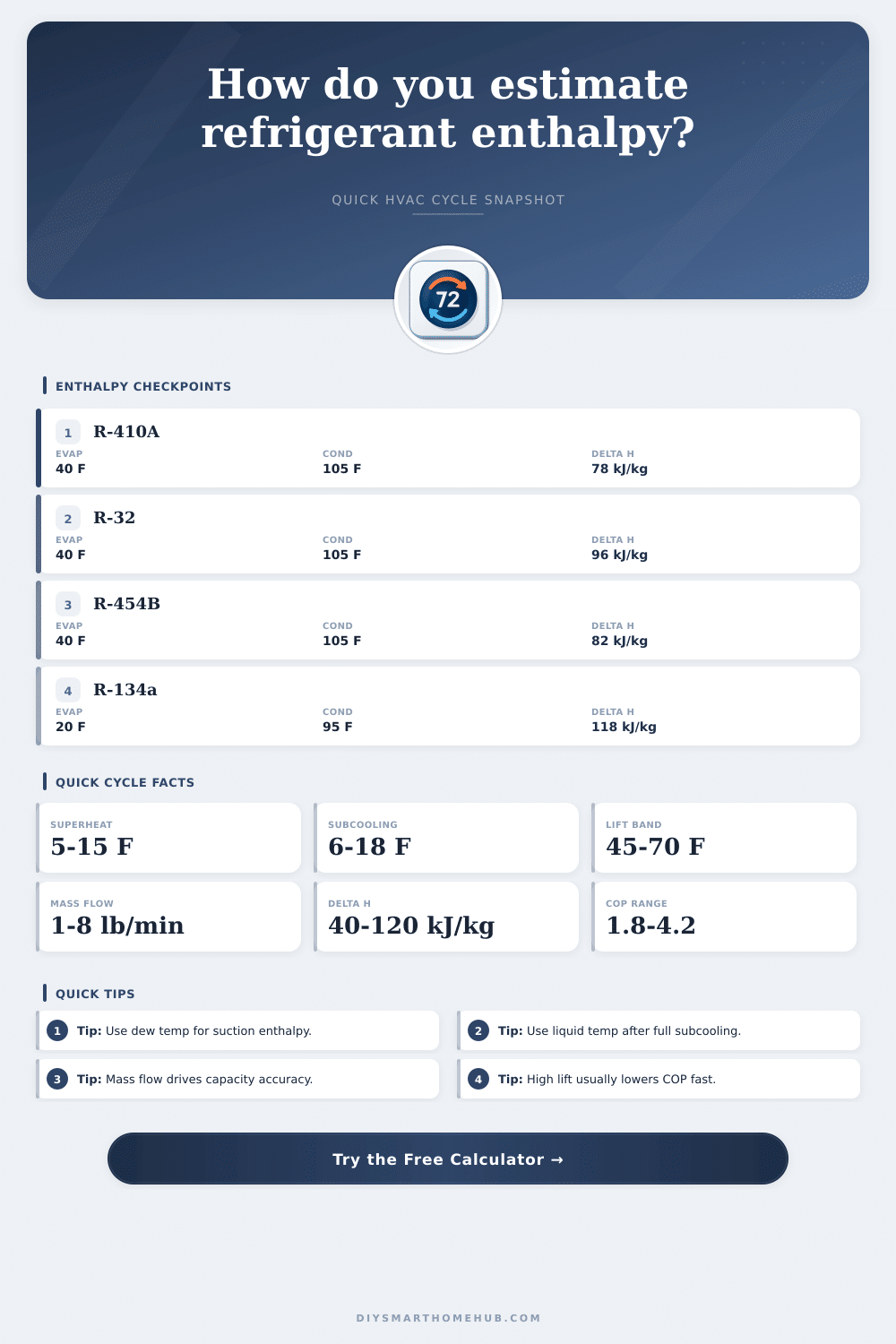
A high lift of refrigerant will create a decrease of efficiency in the system. Refrigerants contain different enthalpy value. For instance, R-410A refrigerant will have a different amount of enthalpy than refrigerants like R-32. R-32 refrigerant provides more cooling effect than R-410A refrigerant due to the higher amount of enthalpy provided by the refrigerant molecules.
R-134a refrigerant is another refrigerant that may be found in air conditioning system, though typically in those with medium saturation temperatures. R-134a refrigerant can be used due to the fact that it work at lower pressures than refrigerants like R-410A. Each refrigerant will have different properties that will impact the calculations of enthalpy for that particular refrigerant.
Furthermore, you must check refrigerant gauges for the specific type of refrigerant that is being use. Air conditioning systems can be diagnosed through determining the enthalpy of the refrigerant and comparing that enthalpy to the air temperatures within the system. For instance, the approach temperature is the difference between the air temperature within the space and the saturation temperature of the refrigerant within the evaporator coil.
A healthy evaporator coil will have a small approach temperature, but a dirty evaporator will have a higher approach temperature. Furthermore, it is also possible to determine the difference between the outdoor ambient air temperature and the temperature of the refrigerant condensing in the condenser. A high split of refrigerant temperature and ambient air temperature can lead to condenser airflow problem.
Many people make mistake when diagnosing air conditioning systems. For instance, many people will diagnose an air conditioning system by measuring the superheat of the refrigerant. However, by measuring superheat alone, a technician is ignoring the impact that the lift of the refrigerant has upon its enthalpy.
Furthermore, many people will also diagnose an air conditioning system by measuring the saturation temperatures and pressures of the refrigerant. These charts do not account for the impact of subcooling and superheat upon the refrigerant enthalpy. Furthermore, many technician can ignore the impact of mass flow as well.
People typically assume that the mass flow is the same as the nameplate capacity of the air conditioning unit. However, the capacity of the air conditioning unit to move refrigerant can decline if the refrigerant system is fouled, or if the system has been retrofitted with a different type of refrigerant. Refrigerants such as R-454B and R-410A have similar pressures within the system.
However, R-454B is a blend refrigerant with a slight glide within the refrigerant blend. Due to the glide of the refrigerant, you must use the dew point for refrigerant temperatures rather than the saturation temperature for suction refrigerant calculations. Refrigerants like hydrocarbons and HFOs also have different characteristics in relation to the amount of enthalpy that they contain.
Thus, the use of enthalpy is a means of understanding the amount of energy that is performed by the refrigerant within any air conditioning system. Furthermore, with the use of enthalpy to measure the energy of the refrigerant, it is possible to gain knowledge of whether the air conditioning system is performing according to the specifications of the design of that system.