Refrigerant Charge Calculator
Blend factory weigh-in data, liquid line volume, vertical lift allowance, and target subcool or superheat trim before adding or recovering refrigerant on residential cooling equipment.
📌Quick Presets
⚙Charge Inputs
First it estimates a clean weigh-in charge from factory data plus liquid line mass and vertical lift allowance. Then it compares measured subcool or superheat against a target band to suggest add or recover trim in ounces.
Calculated Charge Snapshot
Choose a preset or enter field measurements to calculate a target charge and trim recommendation.
📊Selected Refrigerant Snapshot
TXV Subcooling
3/8 in liquid line
Target band 10-12 F
Rise allowance
📖Liquid Line Charge Factors
| Line Size | Inside Diameter | Mass per Foot | Mass per Meter |
|---|---|---|---|
| 1/4 in | 0.195 in | 0.22 oz/ft | 20.3 g/m |
| 5/16 in | 0.245 in | 0.35 oz/ft | 32.1 g/m |
| 3/8 in | 0.315 in | 0.58 oz/ft | 53.4 g/m |
| 1/2 in | 0.435 in | 1.10 oz/ft | 101.2 g/m |
📋Charging Workflow Comparison
| Workflow | Primary Target | Base Band | Trim Rate |
|---|---|---|---|
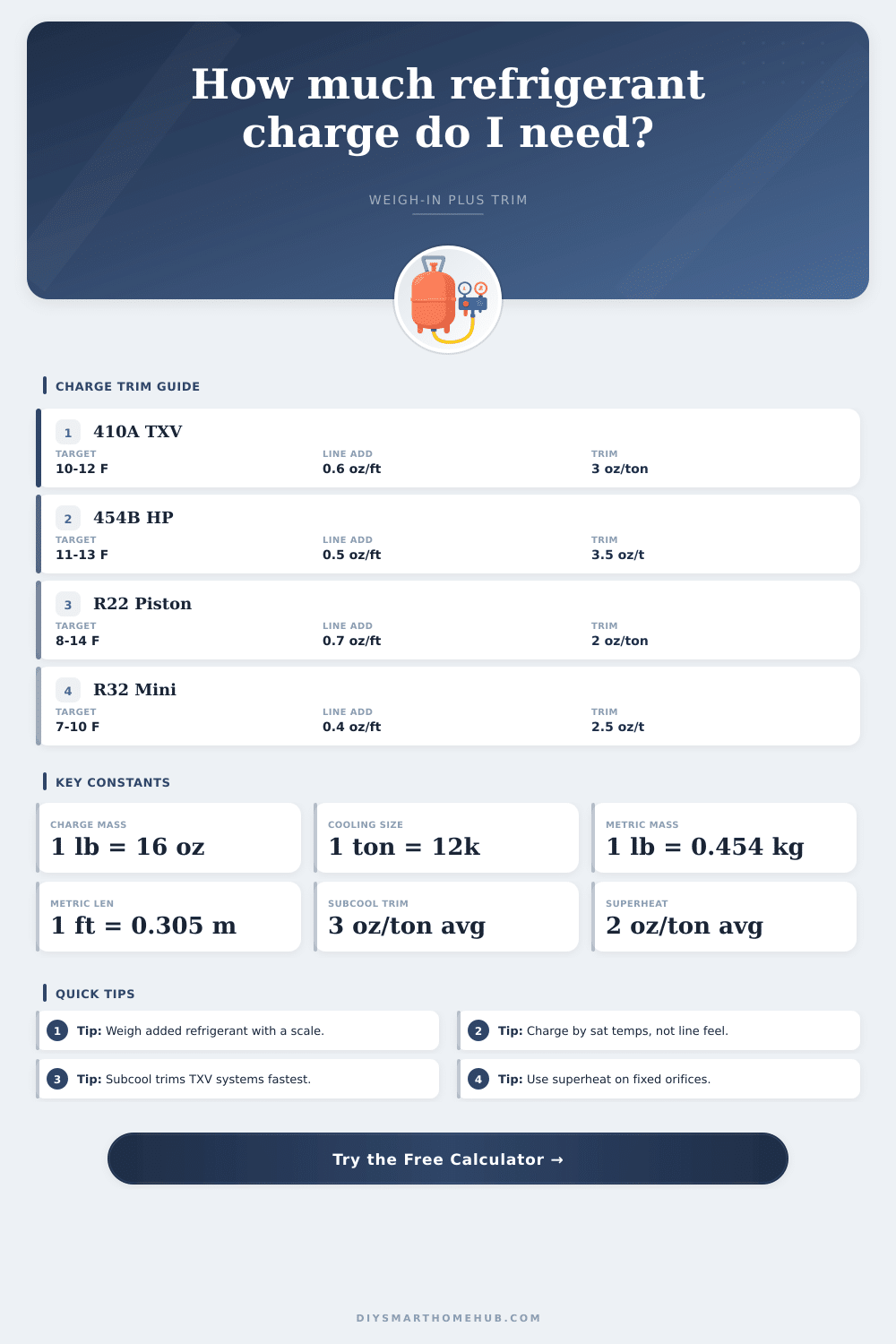
| Split AC with TXV | Subcooling | 10-12 F | 3.0 oz per ton per F |
| Heat Pump TXV | Subcooling | 11-13 F | 3.5 oz per ton per F |
| Fixed Orifice Split | Superheat | 8-14 F | 2.0 oz per ton per F |
| Mini-Split Weigh-In | Subcooling | 7-10 F | 2.5 oz per ton per F |
📝Refrigerant Family Reference
| Refrigerant | Common Use | Liquid Density | Charge Notes |
|---|---|---|---|
| R-410A | Modern split AC | 66.7 lb/ft3 | Common residential TXV baseline. |
| R-32 | Ductless inverter | 53.2 lb/ft3 | Lower mass per foot than 410A. |
| R-454B | New split systems | 56.1 lb/ft3 | 410A-style workflow with less mass. |
| R-22 / R-407C | Legacy or retrofit | 74.6 / 71.4 lb/ft3 | Often trimmed by superheat or retrofit chart. |
🏠Common Residential Charge Scenarios
| Scenario | Refrigerant | Line Length | Baseline Charge |
|---|---|---|---|
| Apartment TXV | R-410A | 25 ft | 5.6 lb |
| Suburban Heat Pump | R-410A | 35 ft | 8.9 lb |
| Bedroom Mini-Split | R-32 | 18 ft | 2.8 lb |
| Open Plan R-454B | R-454B | 40 ft | 10.8 lb |
Weigh-in charge is the clean starting point when the line set was opened or replaced. Use actual scale weight for cylinders, then use subcool or superheat only for the final trim.
Use gauge saturation temperatures, not suction or liquid pressure alone. The trim side of the calculation only works when saturation and line temperature readings are taken at the same operating condition.
To charge a heat pump corectly, one must calculate the amount of refrigerant that is required for the heat pump installation. Because the refrigerant charge must be precise, too much refrigerant can reduce the efficiency of the heat pump and lead to damage to the compressor. Too little refrigerant can also pose a problems for the heat pump as it will starve the compressor of the refrigerant needed to perform it’s function.
To determine the amount of refrigerant that should be added, one begins with determining the amount of refrigerant that was originally included in the unit, or the baseline charge for the heat pump. The manufacturer of the heat pump specifies the baseline refrigerant charge, and specifies it based on 15 feet of copper tubing being used in the heat pump. If the line lengths of the heat pump installation are any longer than the baseline length, refrigerant must be added to the system to ensure the copper tubing is filled with refrigerant.
How to Charge a Heat Pump Correctly
When determining the refrigerant charge, an individual must focus upon the liquid line. The liquid line is used to convey liquid refrigerant to the condenser of the heat pump, while the suction line allow the vaporized refrigerant to exit the system. Because the weight of vapor refrigerant is much more less than the weight of the liquid refrigerant, only the weight of the refrigerant in the liquid line must be accounted for.
Additionally, if the suction lines or refrigerant lines have vertical rises in their lengths, liquid refrigerant will collect in these high spots in the system. Therefore, an additional amount of refrigerant must be added to the system to compensate for this refrigerant that collects in these high spots. To determine if the refrigerant charge is correct, an individual must measure the amount of subcooling or superheat of the system.
The amount of subcooling exists within the TXV of the system, and is the difference between the saturation temperature of the refrigerant at the condenser and the measured actual temperature of the refrigerant within the liquid line. For most heat pumps that use an R-410A refrigerant, the subcooling should be between 10 and 12 degrees Fahrenheit. If the refrigerant system uses a fixed orifice, the measured parameter will be the amount of superheat.
Superheat is the difference between the temperature of the suction line and the saturation temperature of the refrigerant within the evaporator. For heat pumps that use a fixed orifice, the superheat should be between 8 and 14 degrees Fahrenheit. Each parameter can vary depending upon the temperature of the air within the system.
For instance, hotter air outside the heat pump will increase the condensing pressure of the refrigerant. Muggy air within the heat pump can increase the load on the evaporator. Additionally, if the air filters within the system are dirty or the ducts within the structure are too small to allow for sufficient movement of air through the structure, the refrigerant readings will be inaccurate.
Dirty air filters and insufficient air movement will cause inaccurate refrigerant system readings. Additionally, before setting the refrigerant charge, an individual must ensure that the airflow within the heat pump is correct. To calculate the refrigerant charge, first determine the weight of the refrigerant that should be included within the additional tubing past the baseline 15 feet.
For instance, a 3/8-inch refrigerant line can hold 0.6 ounces of R-410A refrigerant per foot of tubing. Therefore, if the manufacturer’s baseline refrigerant charge included 15 feet of tubing, but the installation site includes 35 feet of tubing, 20 feet of additional refrigerant must be accounted for. This calculation does not include allowances for refrigerant that collect in high spots within the refrigerant lines; refrigerant must also be added for these vertical rises in the lines.
Additionally, if the refrigerant lines branch into additional lines beyond those indicated by the manufacturer, refrigerant must also be added to account for these additional lines. Furthermore, one must measure the saturation pressure of the refrigerant in terms of the temperature of the refrigerant; saturation pressures can be converted into temperatures, but raw gauge pressure measurements of refrigerant will change based off the outside air temperature. To even begin to charge the refrigerant, an individual adds refrigerant to the heat pump in increments of three ounces per ton until the saturation temperature or superheat reaches the parameters that were calculated for the system.
An individual should avoid certain steps to ensure that the refrigerant charge is correct. For instance, an individual must not attempt to charge the refrigerant by feeling the temperatures of the refrigerant lines. The temperatures of the lines will not convey the saturation temperature of the refrigerant.
An individual should also not attempt to add refrigerant to the system without using a scale to measure the amount of refrigerant being added; adding refrigerant without using a scale will lead to an inaccurate refrigerant charge. Additionally, prior to finalizing the refrigerant charge, an individual should also ensure that the airflow of the refrigerant system is correct; lack of airflow within the system will lead to inaccurate refrigerant system readings. Finally, the individual should measure the saturation temperature of the refrigerant against the temperature of the refrigerant lines indicated on the manufacturers nameplate; the baseline refrigerant charge may have been calculated based upon different refrigerant lines than are installed at the site by the builder.
By performing the calculations and using a refrigerant scale to measure refrigerant being added to the system, an individual can ensure that the refrigerant charge within the heat pump is correct; a correctly-charged heat pump will have its system capacity maximize, as well as extend the life of its compressor.