🍳 Range Hood Duct Size Calculator
Calculate the minimum duct size for your range hood exhaust based on CFM rating and duct run length
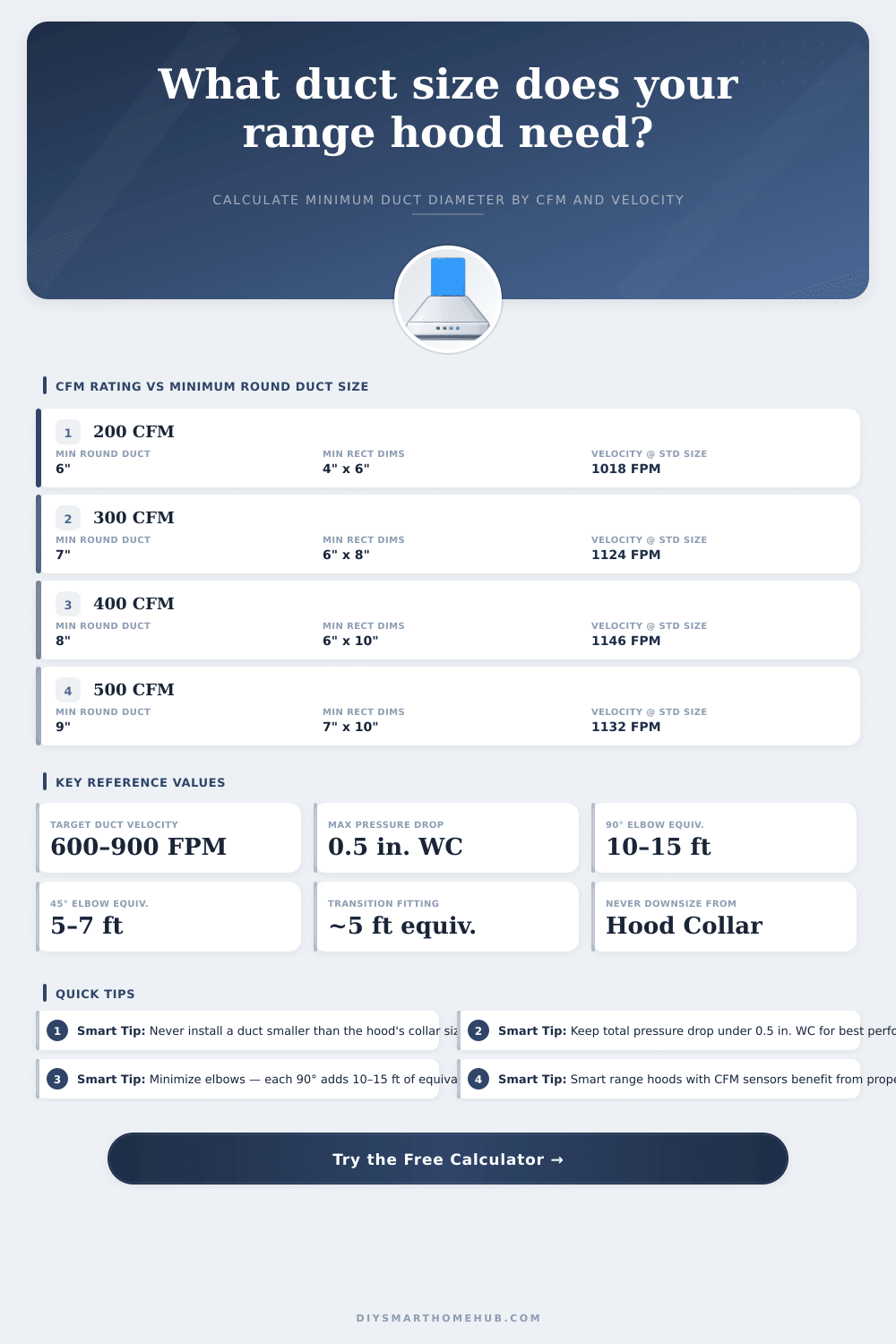
| Hood CFM | Min Round Duct | Min Rect Dims | Duct Area (in²) | Velocity @ Std Size |
|---|---|---|---|---|
| 200 CFM | 6" | 4" × 6" | 28.3 in² | 1,018 FPM |
| 250 CFM | 7" | 5" × 7" | 38.5 in² | 935 FPM |
| 300 CFM | 7" | 6" × 8" | 38.5 in² | 1,124 FPM |
| 400 CFM | 8" | 6" × 10" | 50.3 in² | 1,146 FPM |
| 500 CFM | 9" | 7" × 10" | 63.6 in² | 1,132 FPM |
| 600 CFM | 10" | 8" × 10" | 78.5 in² | 1,100 FPM |
| 800 CFM | 12" | 10" × 12" | 113.1 in² | 1,019 FPM |
| 1000 CFM | 12" | 10" × 14" | 113.1 in² | 1,274 FPM |
| 1200 CFM | 14" | 12" × 14" | 153.9 in² | 1,124 FPM |
| Fitting Type | Equivalent Length (ft) | Impact on Pressure Drop |
|---|---|---|
| 90° Round Elbow (smooth) | 10 ft | Moderate |
| 90° Round Elbow (standard) | 15 ft | High |
| 45° Round Elbow | 5 ft | Low |
| 90° Rectangular Elbow | 12 ft | Moderate–High |
| 45° Rectangular Elbow | 6 ft | Low–Moderate |
| Round-to-Rect Transition | 5 ft | Low–Moderate |
| Rect-to-Round Transition | 5 ft | Low–Moderate |
| Roof Cap / Damper | 30 ft | Very High |
| Wall Cap / Damper | 20 ft | High |
| Inline Grease Filter | 15 ft | High |
A range hood duct is a tube that connects the range hood to the outside of the house. It plays a key role in the ventilation system of the kitchen. Those tubes remove captured smoke, smells, humidity and heat from the stove before they spread through the whole house.
By venting air out, ducted hoods not only remove heat but also help to clean the home of dirty gases
Use a Smooth Metal Duct for Your Range Hood
You can find two main kinds of range hoods: ducted and ductless. Ducted hoods, that you occasionally call external venting, use pipes to push the smoke outside the house. Ductless hoods operate similarly, but instead of pushing the air out, they pass it through a filter and put it back in the room.
Because they do not require pipes, such hoods are cheaper and easier to install. They are a practical choice if you do not cook often during the day. Even so, some consider them almost useless because they gather grease and have hard to clean filters.
Hence, ducted hoods are a better choice if it is possible.
For the output, you must use metal duct. Between flexible and smooth metal, smooth duct is better. The ridges in flexible tubes create turbulence and slow the air.
Never use plastic tube or four-inch dryer duct for installation of a range hood. The best choices are aluminum or stainless steel; these are fire-resistant, handle temperatures until 800 degrees, and are easy to install and clean.
The size of the duct is very important. Too small a tube blocks the flow of air, which reduces the efficiency and makes more noise. On the other hand, too big a duct may not remove the dirt effectively.
For hoods with 400 CFM, four inches is enough. If the rate is 600 CFM, you require at least six inches. CFM means “cubic feet per minute,” which measures the volume of moved air.
Moreover, a wider duct allows the air to move more silently.
Keep the duct run as short and straight as possible. Every corner of 90 degrees adds three to five feet to the run. If the hood pushes more air than what enters the house, it can create negative pressure, which causes problems with the HVAC system.
The vent can pass through a wall or through the ceiling and roof, but never leave it only in the attic. Depending on the model, the blower can be inside the hood or up on the roof.