Range Hood CFM Calculator
Find the right ventilation power for your kitchen — by BTU output or room size
Settings
Quick Presets
BTU Method Inputs
Kitchen Volume Method Inputs
Your Range Hood Results
Stove Type Spec Grid
| Stove Type | Typical BTU | Multiplier | Rec. CFM |
|---|---|---|---|
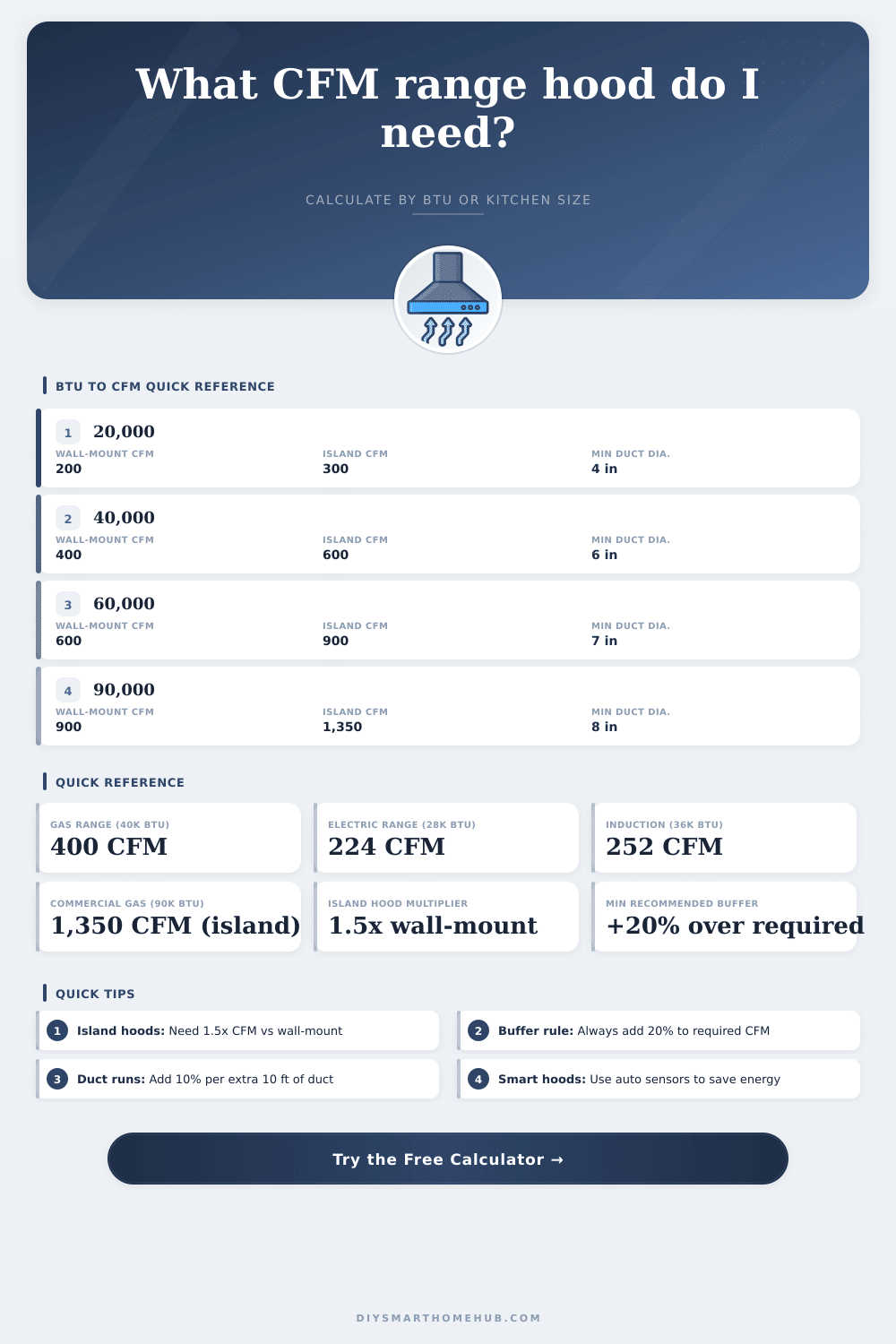
| Gas 4-burner | 40,000 | 1.0 | 400+ |
| Gas 5-burner | 55,000 | 1.0 | 550+ |
| Electric coil | 28,000 | 0.8 | 224+ |
| Electric smooth | 24,000 | 0.8 | 192+ |
| Induction 4-burner | 32,000 | 0.7 | 224+ |
| Induction 5-burner | 36,000 | 0.7 | 252+ |
| Commercial gas 6-burner | 90,000 | 1.5 | 1,350+ |
| Dual fuel range | 50,000 | 1.0 | 500+ |
Kitchen Size Guide
| Kitchen Area | ACH | Est. CFM | Hood Width |
|---|---|---|---|
| Under 100 sq ft | 15 | 150-225 | 24-30 in |
| 100-150 sq ft | 15 | 225-337 | 30-36 in |
| 150-200 sq ft | 15 | 337-450 | 36-42 in |
| 200-300 sq ft | 15 | 450-675 | 42-48 in |
| Open plan 300+ sq ft | 15 | 675+ | 48 in+ |
BTU-to-CFM Reference Table
| Total BTU Range | Wall-Mount CFM | Island CFM | Under-Cabinet CFM | Min Duct Dia. |
|---|---|---|---|---|
| Under 20,000 | 200 | 300 | 200 | 4 in (100 mm) |
| 20,000 - 30,000 | 300 | 450 | 300 | 5 in (125 mm) |
| 30,000 - 45,000 | 400 | 600 | 400 | 6 in (150 mm) |
| 45,000 - 60,000 | 600 | 900 | 600 | 7 in (175 mm) |
| 60,000 - 80,000 | 700 | 1,050 | 700 | 8 in (200 mm) |
| 80,000 - 100,000 | 900 | 1,350 | 900 | 8 in (200 mm) |
| 100,000+ | 1,000+ | 1,500+ | 1,000+ | 10 in (250 mm) |
Key CFM Factors at a Glance
Smart range hoods with humidity and CO2 sensors can automatically ramp fan speed when cooking starts and return to standby when done. Connect them to your home automation hub to trigger exhaust fans, open makeup air dampers, and even sync with smart ovens for a fully automated kitchen ventilation routine.
Every 10 ft of duct run beyond the first 10 ft adds resistance requiring roughly 10% more CFM. For hoods above 400 CFM, consider adding a makeup air system to replace exhausted air and maintain neutral kitchen pressure. Smart makeup air dampers can be wired to your hood relay and controlled via home automation for hands-free operation.
CFM means cubic feet per minute. That measures how much air the range hood can remove from the space during a set time Makers always give advice about the necessary ventilation, and they measure the hoods according to the amount of air they extract, usually by CFM.
Most home hoods usually range between 200 and 600 CFM. For simple cooking, like warming food or fast frying, 250 to 400 CFM is enough. Naturally, the cooking style and your habits affect how much air you require while you prepare food.
How much CFM do you need for your range hood
When the hood is attached to the wall or under a cabinet, the general rule is around 100 CFM for every linear foot of the cooktop surface. The most common cooktops measure 30 inches (or 2.5 feet) wide. So, to reach the suggested values, a 30-inch range requires a hood with at least 250 CFM.
Island hoods require about 150 CFM per linear foot.
Gas stoves produce more heat and steam, hence you require higher CFM. You can add up the BTU output of all burners and divide that by 100. For instance, a stove with 50,000 BTU requires a hood with at least 500 CFM.
The Home Ventilating Institute suggests that calculation to find the minimum guideline. Modern pro-style stoves are much hotter than old models, so they require higher capcity. When you doubt, choose higher CFM for gas stoves.
It is important to know that when the CFM goes over 400, you need fresh air. HVAC specialists commonly fight these high values, because systems for fresh air can be hard to install. There is no simple calculation for that, and you also must consider the loss of air at curves and links of the pipe.
Some hoods have a maximum CFM value, but the actual effect is often much lower because of the shape of the pipe. A 4-inch pipe works only for around 100 CFM, and that only if it is metal, not from bending plastic. Most manuals suggest using a 6-inch pipe.
It is unrealistic to believe that you can reach 600 CFM through a too small tube.
Around 1200 CFM is enough for almost everything, although smoke alarms can still sound if you fry on several burners and do not set the hood on the maximum immediately. Some say that 1300 CFM is too much even for huge stoves, because warm air naturally goes upward, which helps the hood. Hence, higher CFM is not always better in every situation.