Radiant Floor Heat Loss Calculator
Estimate room-by-room design heat loss, floor output per square foot, required water temperature, and tubing layout for slab, above-floor panel, or staple-up radiant zones before you finalize a hydronic plan.
📌Presets and Units
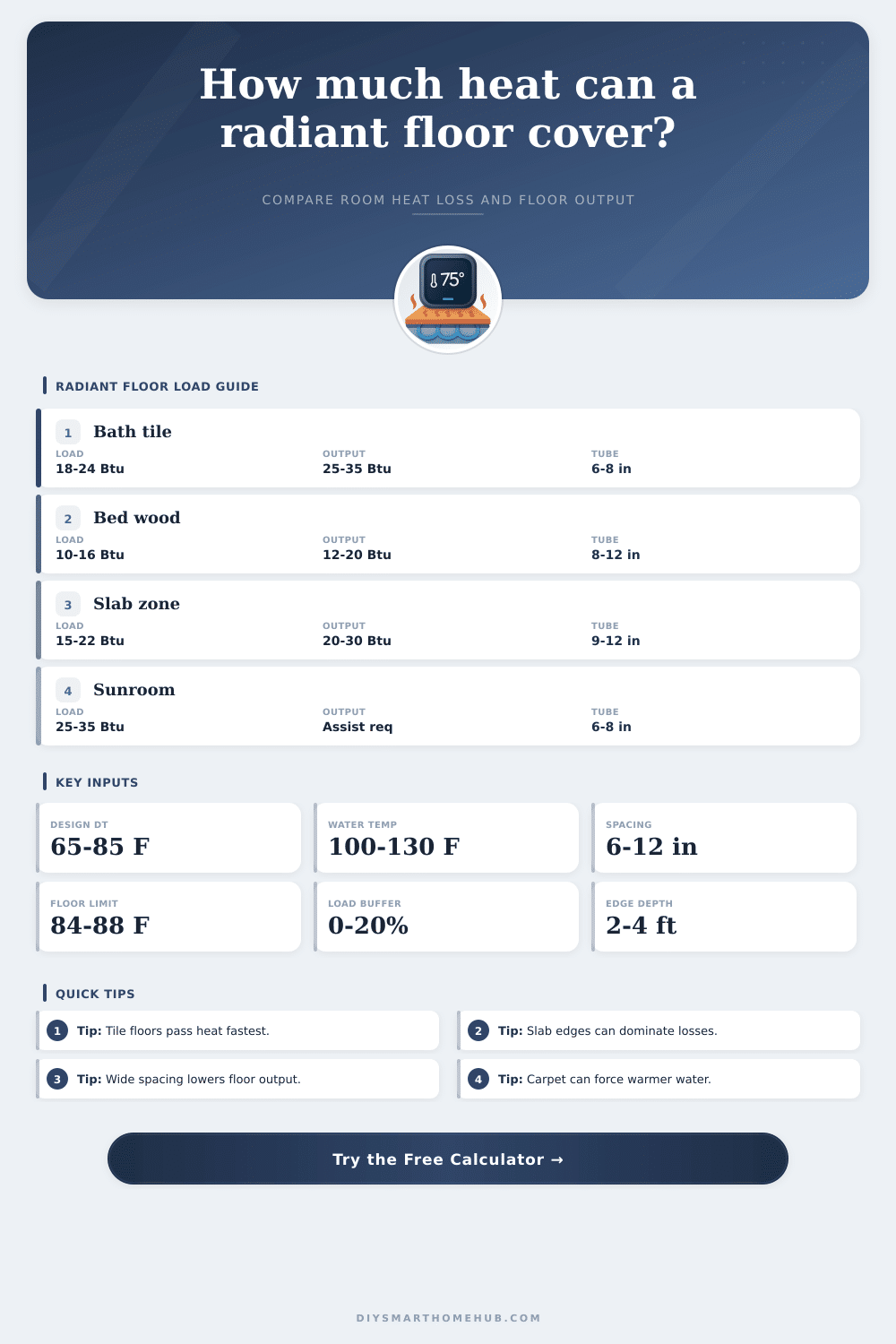
Preset note: Primary Bath Tile starts with a compact tile room, 6 inch spacing, and an embedded slab where radiant output is usually strong relative to the room load.
🏠Room Geometry and Design Conditions
🧱Envelope and Boundary Inputs
💧Radiant Floor Design Inputs
📊Radiant Floor Heat Loss Results
🧮Current Design Drivers
The output estimate assumes steady-state radiant behavior at the selected water temperature. Fast pickup, slab lag, and manifold balancing are outside this screening model.
📑Reference Tables
| Floor Boundary | Area U | Edge Loss | Use Case |
|---|
| Floor Covering | R Factor | Max Out | Best Fit |
|---|
| Assembly | Transfer | Drop | Profile |
|---|
| Preset | Area | Load | Verdict |
|---|
💡Design Notes
Heat loss decides whether spacing can relax
If the room load stays under about 12 to 15 BTU per square foot, wider spacing and lower water temperature often work. Above that range, edge losses, glass area, and floor finish begin to dominate the design.
Floor finish can matter as much as tubing
Tile and polished concrete pass heat with relatively low surface resistance, while carpet and dense pads can cap output even if the tubing pattern and water temperature look aggressive.
Radiant heating is the feeling of heat from warm stovetop plate through the whole room. If it lies in the floor, you commonly call it radiant floor heating or simply floor heating. There are three kinds of radiant floor heat: radiant air floors, where air carries the warming, electric radiant floors and hydronic radiant floors with warm water.
Those surface systems give over heat by means of infrared radiation and conduction, instead of by means of warming air.
How Radiant Floor Heating Works
Radiant floor heating system warms the room by means of direct warming of the floor, not of the air inside it. It uses thermal radiation and electromagnetic waves to warm people and objects directly from below. Traditional heaters require pipes to warm the air, but floor heating works otherwise.
The heat spreads over large area, so it arrives at relatively low temperature and makes the warming equal. It warms people directly. In winter radiant floors are energy efficient and leave people feel comfortable even with lower air temperatures, because you widely find it warm when the feet are warm.
One downside is that radiant floors react very slowly because of their thermal mass. For example, a temperature change can happen after three days. Another problem is that existing floor must be removed, so that new grid installs under it.
Even so, lightweight heating elements can set to subfloor by means of clamps or nails and cut to length on the job site. That requires almost no floor buildup and works well for remodeling and renovation. For any floor heating or radiant warm system, you must use proper thermal insulation to direct the heat upward in the living space.
Electrical radiant floor heating have certain costs. A typical electrical floor heating element uses 15 watts each square foot. In a small 35-square foot bathroom, running 8 hours a day, the system uses 4.2 kWh a day.
Installing electrical heated mats cost between 10 and 15 dollars each square foot. Hydronic systems circulate liquid resource, as warm water, under the floor. They can use closed loop boiler on natural gas.
There are also systems with geothermal pumps or air to water heat pumps for radiant floor heating.