Propane Temperature Correction Calculator
Convert observed propane gallons at any liquid temperature into standard volume, total mass, equivalent fill, hot-day expansion, and appliance runtime so tank readings and deliveries stay comparable year-round.
📌Preset Scenarios
Corrected Propane Summary
The calculator compares your field condition to the selected standard temperature and keeps the underlying propane mass constant while volume shifts.
📊Temperature and Blend Reference
Liquid density anchor
HD-5 propane near 60 F is a common baseline for corrected gallon comparisons.
Observed to base volume
A factor above 1 means cold gallons correct upward; below 1 means hot gallons correct downward.
Hot-day swell check
Even when a tank is acceptable at fill time, warmer liquid can erase headspace later.
Energy basis
Runtime is calculated from corrected mass, reserve, and the appliance duty-adjusted average load.
🌡Liquid Density vs Temperature
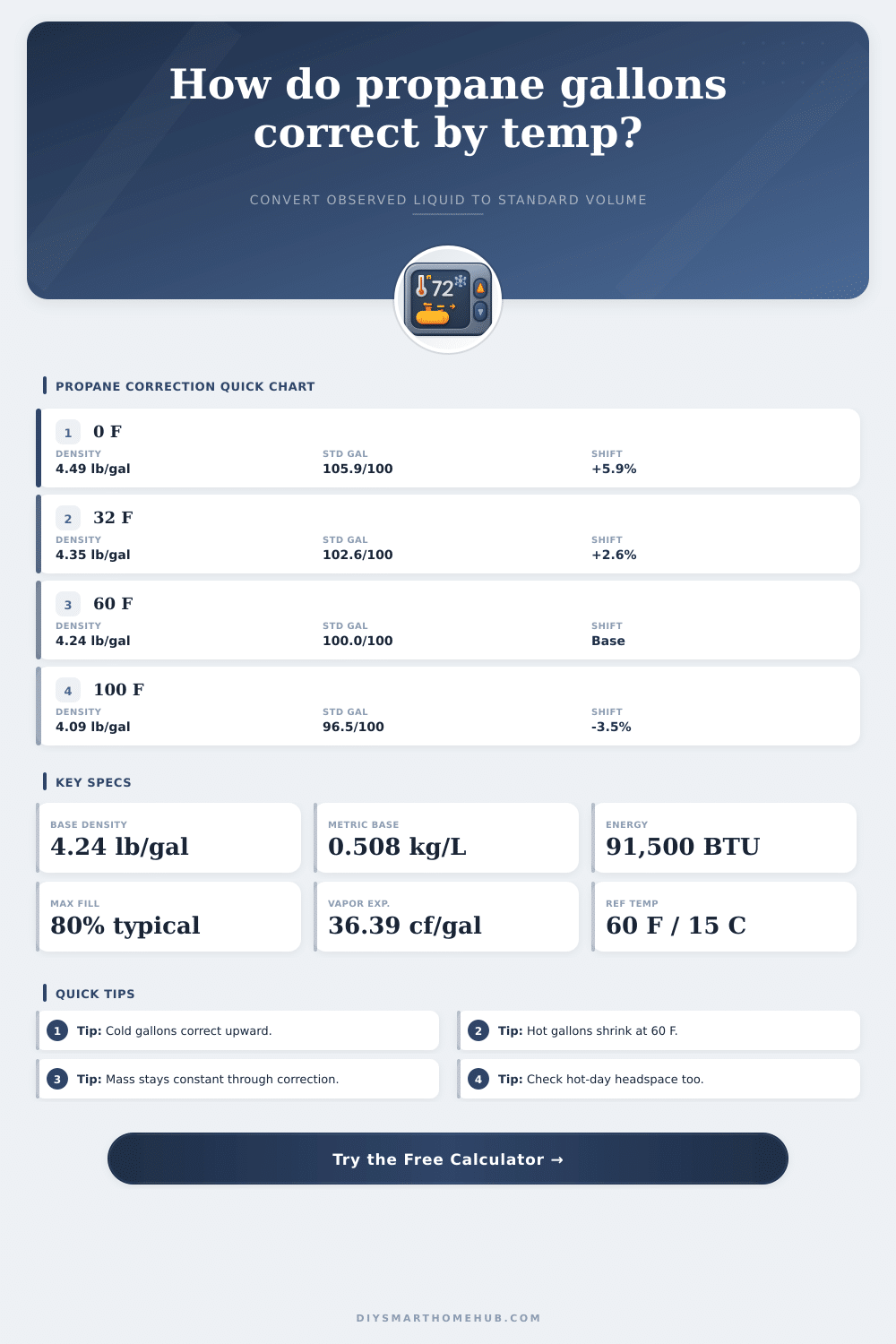
Each row shows how 100 observed gallons convert when normalized back to 60 F using the density curve built into this calculator.
| Temp | Density | kg/L | Std gal from 100 | Shift vs 60 F |
|---|---|---|---|---|
| -20 F | 4.54 lb/gal | 0.544 | 107.1 gal | +7.1% |
| 0 F | 4.49 lb/gal | 0.538 | 105.9 gal | +5.9% |
| 32 F | 4.35 lb/gal | 0.521 | 102.6 gal | +2.6% |
| 60 F | 4.24 lb/gal | 0.508 | 100.0 gal | Base |
| 80 F | 4.16 lb/gal | 0.498 | 98.1 gal | -1.9% |
| 100 F | 4.09 lb/gal | 0.490 | 96.5 gal | -3.5% |
| 120 F | 4.01 lb/gal | 0.481 | 94.6 gal | -5.4% |
⛽Tank Fill and Correction Anchors
This table compares common tank capacities with safe 80 percent fill and what 50 percent observed fill becomes after cold or hot correction.
| Tank | Water cap | 80% fill | 50% @ 20 F | 50% @ 100 F |
|---|---|---|---|---|
| 20 lb cyl | 5.9 gal | 4.7 gal | 3.06 std gal | 2.84 std gal |
| 100 lb cyl | 29.5 gal | 23.6 gal | 15.29 std gal | 14.19 std gal |
| 120 gal tank | 120 gal | 96 gal | 62.2 std gal | 57.7 std gal |
| 250 gal tank | 250 gal | 200 gal | 129.6 std gal | 120.2 std gal |
| 500 gal tank | 500 gal | 400 gal | 259.1 std gal | 240.4 std gal |
| 1000 gal tank | 1000 gal | 800 gal | 518.3 std gal | 480.8 std gal |
⏱Runtime and Planning Reference
The same corrected mass can support very different runtimes depending on burn rate and duty cycle. These examples assume HD-5 propane and a 15 percent reserve.
| Scenario | Load | Duty | Standard gal | Runtime | Typical use |
|---|---|---|---|---|---|
| Patio heater bottle | 40,000 BTU/h | 100% | 4.7 gal | 9.2 hr | Continuous outdoor heat |
| Grill cylinder | 25,000 BTU/h | 70% | 4.7 gal | 20.9 hr | Intermittent burner cycling |
| Direct vent heater | 30,000 BTU/h | 50% | 23.6 gal | 146 hr | Small home backup heat |
| Standby generator | 90,000 BTU/h | 80% | 23.6 gal | 30.4 hr | Extended outage operation |
| Whole-house furnace | 120,000 BTU/h | 40% | 200 gal | 653 hr | Seasonal reserve planning |
| Construction heater | 150,000 BTU/h | 100% | 100 gal | 52.0 hr | Cold weather site heat |
💡Field Notes
Propane in a shaded buried tank can lag ambient conditions for hours. If the tank was filled overnight and checked in afternoon sun, corrected gallons can differ from the air temperature guess.
A tank that looks acceptable when the fuel is cold may still crowd its safe limit after the liquid warms. The hot-day expansion output is there to flag that before transport or storage.
Propane volume change with temperature because propane will expand or contract based on the temperature of the propane itself. While it may seem like there is less propane in your tank in the winter than in the summer, the mass of propane in your tank is actually the same year-round. Propane will change based on the temperature within the propane tank, which is why it may seem like there is more or less propane in your tank than is actualy present within the tank.
At low temperatures, propane will be more densly than at high temperatures. Because propane is more dense at low temperatures, it will occupy less space within the propane tank. For instance, 18 gallon of propane at 10 degrees F will contain more density than the same amount of propane at 60 degrees F. As a result, those 18 gallons at 10 degrees F will contain the same mass as 19 gallons of propane at 60 degrees F. Because 60 degrees F is the standard temperature for propane sales, it is important to use this temperature for any calculations related to propane deliveries.
How Temperature Changes Propane Volume
Without correcting for the temperature of the propane, an individual may believe they are receiving less propane than they are actually receiving, as the mass of the propane is the same. Many individuals notice these differences in propane tanks that contain less than 100 gallons of propane, such as 20-pound propane tank for grills. These propane tanks contain gauges that measure the liquid level of the propane, but do not measure the density of the propane within the tank.
For example, a grill tank may read 80% of the way filled with propane when the temperature outside the tank is 32 degrees F. However, because the propane within the tank is dense, the same amount of propane by mass would be measured at a lower percentage within the tank at higher temperatures. As the propane warms, it expand, and the gauge level within the tank will increase without adding propane to the tank. The density of the propane within the tank is what determines how much propane of mass exist within the propane tank.
Propane contains more mass at 60 degrees F than at freezing temperatures. At 60 degrees F, pure HD-5 propane contains 4.24 pounds of propane per gallon, but at freezing temperatures it weighs 4.35 pounds of propane per gallon. As a result, a gallon of propane within the tank at freezing temperatures contain more mass than the same gallon of propane at 60 degrees F. Standard gallons of propane can be calculated by taking the measured volume (in gallons) of propane within the tank multiplied by the field density of the propane (how dense the propane is at the current temperature) divided by the base density of propane (4.24 lb/gal at 60 degrees F).
As tank owners, it is important to consider the density of the propane in relation to propane tank fill limit.
For instance, the largest propane tanks contains 500 gallons of propane, and have a gauge that measures the percentage of the tank that is filled with propane. The percentage on the gauge is only an observed percentage of the tank fill level. In order to ensure that the tank does not become overfilled with propane, it is important to correct for the density differences in the propane.
If too much propane is added to the tank when the propane is cold, the propane will expand to fill more of the tank as the propane warms. In this case, the tank may bulge. Additionally, 15% of the propane tank should be reserved for emergency.
If this 15% is subtracted from the total tank volume, it will lead to a more realistic estimate of the total number of hour the tank will run an appliance. The runtime of propane tanks is calculated by the number of usable BTUs of energy that are contained within the tanks. Propane contains 21,500 BTUs of energy per pound.
The number of hours that a propane tank will run an appliance can be calculated by taking the total mass of propane within the tank and dividing the total BTUs of energy that the tank contains by the BTU requirement of the appliance. For instance, an electric furnace may require 45,000 BTUs of energy per hour of operation, but only be able to perform at a 65% duty cycle. In this instance, the furnace would use 29,250 BTUs of energy per hour (45,000 x.65).
If the propane tank has 100 pounds of propane, it will last for 7.3 hours (21,500,000 BTUs / 29,250 BTUs per hour). By using the incorrect amount of temperature correction for the propane within the tank, this example will show error in the calculated runtime of the propane tank. Common errors in relation to propane include using air temperature rather than the temperature of the liquid propane within the tank.
The two temperatures can be different from one another. Another common error is using propane tank capacity instead of the water capacity measurements of the tank. Finally, it is common for individuals to make the error of overfilling the tank on hot days when the propane is liquid.
If propane is added to the tank when it is hot, it will expand, and more propane will be added to the tank as the propane cools. Propane suppliers utilize these different calculations for propane temperature in order to ensure that customers are billed fairly for the propane that they purchase. Propane suppliers bill customers for the mass of the propane in their tanks.
However, they measure the number of gallons of propane that is contained in the tank. By billing customers for propane based on the standard temperature of 60 degrees F, customers are paying for the mass of the propane, rather than the volume of the propane in relation to the temperature of the tank. Additionally, if different types of propane are used (such as propane-butane mixtures), the density of the propane will change.
These different types of propane will require different density correction for the calculations related to that propane tank. These calculations can be used for planning for different scenario in which propane may be used. For example, direct volume measurements can be used for small propane tanks, such as propane cylinders for grills.
For larger propane tanks, the percentages of the tanks can be used. Additionally, each appliance has a duty factor for propane. For instance, a steady torch will have a 100% duty factor of propane use, while a home heater will have a lower duty factor for propane use.
By understanding the density of propane and how it relates to the temperature of the propane, an individual will be able to accurately determine the amount of propane that remain in their tank.