Propane Gallons to Pounds Calculator
Convert exact liquid volume or tank fill levels into pounds, kilograms, BTUs, vapor volume, and runtime so grill swaps, generator runs, and delivery checks are easier to verify.
⚙Preset Scenarios
📋Calculator Inputs
📊Results
🧮Reference Specs
🌡Density Profile Table
| Profile | Approx Temp | lb/gal | kg/L |
|---|---|---|---|
| Cold delivery | 32 F | 4.39 | 0.526 |
| Cool shoulder season | 45 F | 4.31 | 0.517 |
| Standard reference | 60 F | 4.24 | 0.508 |
| Warm tank | 77 F | 4.11 | 0.493 |
| Hot summer tank | 95 F | 4.02 | 0.482 |
🛢Common Tank and Cylinder Weights
| Container | Liquid gal | Propane lb | Metric kg |
|---|---|---|---|
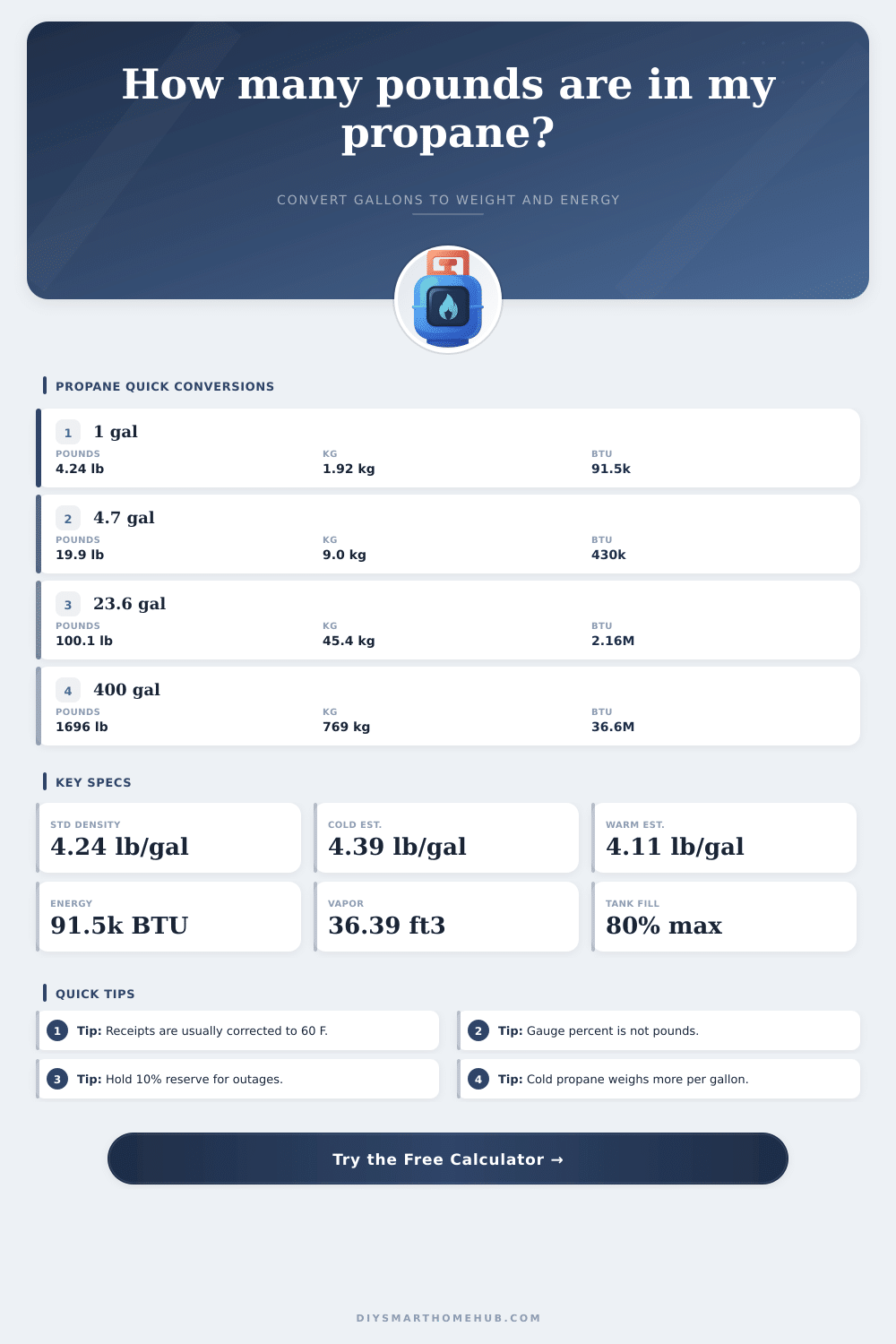
| 20 lb grill cylinder | 4.7 gal | 19.9 lb | 9.0 kg |
| 30 lb RV cylinder | 7.1 gal | 30.1 lb | 13.7 kg |
| 100 lb upright cylinder | 23.6 gal | 100.1 lb | 45.4 kg |
| 500 gal home tank | 400 gal | 1,696 lb | 769 kg |
📈Dynamic Conversion Chart
| Liquid volume | Pounds | Kilograms | Total BTU |
|---|---|---|---|
| 1 gal | 4.24 lb | 1.92 kg | 91,547 BTU |
🔥Runtime Benchmarks at 40,000 BTU/h
| Fuel volume | Usable fuel | Runtime | Typical use |
|---|---|---|---|
| 4.7 gal | 4.23 gal | 9.7 hr | Grill or small heater planning |
| 23.6 gal | 21.24 gal | 48.6 hr | Weekend outage backup |
| 96 gal | 86.4 gal | 197 hr | Detached shop or cabin |
| 400 gal | 360 gal | 822 hr | Whole-house standby fuel |
Bulk deliveries are commonly temperature-corrected to a 60 F reference. A tank gauge tells you approximate fill percentage, not direct pounds, so converting the liquid volume first keeps the estimate cleaner.
If you are weighing a cylinder, add tare weight to the propane pounds shown here. Keeping a 10% to 20% reserve helps with outage planning and avoids assuming every last gallon is available.
The density of liquid propane are a variable factor because the weight of liquid propane changes based on the temperature of the liquid propane. Due to the changing density of liquid propane based upon the temperature changes, tanks of liquid propane will feel heavier when they is filled during the winter months and will feel lighter during the summer months. Unlike water, which weigh 8.34 pounds per gallon regardless of most temperature changes, the weight of liquid propane is approximately 4.24 pounds per gallon at a temperature of 60 degrees Fahrenheit.
At temperatures that are below 60 degrees Fahrenheit, however, the propane will weigh more per gallon. At temperatures that are above 60 degrees Fahrenheit, the propane will weigh less per gallon. Because of these changes in weight based upon temperature, it is more important to consider the number of pound of propane that is contained within each tank, rather than the number of gallons of propane that are contained within those tanks.
How Temperature Changes the Weight of Propane
Appliances like propane grill and propane heaters dont burn the volume of liquid propane contained within the tanks, but rather burn the energy that is contained within the propane’s mass. A standard 20-pound tank is typically filled to 80% of its tank capacity. A 20-pound tank that is filled to 80% of its tank capacity contains approximately 4.7 gallons of liquid propane.
At 60 degrees Fahrenheit, where propane weigh 4.24 pounds per gallon, these 4.7 gallons will weigh approximately 20 pounds. If the cook cooled the propane tank to temperatures that are below 60 degrees Fahrenheit prior to filling the tank with propane, however, the propane will weigh more per gallon. More propane will be available to burn that propane with the appliance, providing longer cooking time.
If, however, the propane is warm due to summer temperatures, less propane will be available per gallon, and the propane will provide less cooking time. Thus, understanding the density of the propane will allow a cook to ensure that each propane tank contain enough propane to perform the desired cooking tasks. Tank gauges will display a measurement of the amount of propane contained within the tank.
The gauge measurements, however, are based upon the height of the liquid propane within the tank, not the weight of that propane. Thus, the gauge will indicate the percentage of the tanks volume that is filled with propane, but it will not account for the density of the liquid propane within the tank. For instance, a tank that is sized to contain 500 gallons of water will only contain 400 gallons of propane if it is filled to 80% of its capacity.
Furthermore, the gauge needles within the tank may change based upon the temperature of the propane. Thus, it is recommended that there always be at least a 10-20% reserve of propane within the tank for use during periods of power outages or during the winter season. The runtime of the different propane-heating appliances will depend upon the number of BTUs that the appliance require to perform its tasks and the weight of the liquid propane available.
If the BTUs of the appliances and the pounds of propane is known, it is possible to forecast how many hour the appliance will run. For instance, an appliance that requires 40,000 BTUs of heat will run for approximately 10 hours on a 20-pound tank of propane if a reserve of propane is maintained within the tank. Furthermore, one gallon of propane creates 36 cubic feet of vapor at standard pressure.
Cold weather may reduce the rate of vaporization of the propane, however, which may also reduce the runtime of the appliances that utilize that propane. If you are changing a propane tank at a propane station, the tank may not be full of propane. In this case, you can determine the weight of the tank by reading the tare weight that is printed on the tanks collar.
This tare weight is the weight of the empty metal propane tank. The weight of the propane can be determined by adding the tare weight of the tank and the weight of the propane. Furthermore, bulk deliveries of propane may be confusing for station managers and cooks.
If a supplier purchases bulk propane, the delivery receipt may indicate the number of gallon of propane that were delivered. The weight of that propane, however, will depend upon the temperature at the time that the propane was delivered. Most propane suppliers will list the weight of propane on the delivery receipt based upon a temperature of 60 degrees Fahrenheit to standardize the weight of the propane that is delivered to the station each time.
Propane contains 21,600 BTUs of energy per pound of propane, which is similar to the energy content of natural gas. The weight of propane can be converted into units of energy in kilowatt-hours. For instance, 100 pounds of propane will contain 28 kilowatt-hours of energy.
Because liquid propane is denser than other fuels, more heat can be extracted from each gallon of propane than from other fuels of similar capacities. Thus, the use of propane as a fuel for standby generators and heaters are efficient. In addition to knowing the propane tanks weights, it is also possible to weigh small propane cylinder on a scale.
By subtracting the tare weight of the tank from the total weight of the propane and tank, the weight of the propane is easily found. Furthermore, the meters on propane tanks will display the number of gallons of propane that have been used. The readings of these meters can be taken prior to and after the delivery of propane.
These methods of determining the weight of propane and the number of gallons of propane that are contained within a tank will allow for cooks to account for the density and the temperature of the liquid propane.