Propane Furnace Size Calculator
Estimate design heat loss, pick a nominal propane furnace size, and compare airflow, AFUE, propane demand, and tank runtime for additions, retrofits, and whole-home comfort plans.
📌Quick Presets
⚙Project Inputs
Calculated Furnace Match
Enter the project details above to compare design heat loss, furnace size, airflow, and propane use.
📊AFUE and Furnace Tier Grid
Single-Stage
Two-Stage
Condensing
Modulating
📘Climate Load Benchmarks
| Design Band | Tight Home | Average Home | Poor Envelope |
|---|---|---|---|
| 25–35°F delta | 18–24 BTU/sq ft | 24–30 BTU/sq ft | 30–38 BTU/sq ft |
| 35–45°F delta | 22–30 BTU/sq ft | 30–38 BTU/sq ft | 38–48 BTU/sq ft |
| 45–55°F delta | 28–36 BTU/sq ft | 36–46 BTU/sq ft | 46–58 BTU/sq ft |
| 55–65°F delta | 34–44 BTU/sq ft | 44–56 BTU/sq ft | 56–70 BTU/sq ft |
🛠Furnace Profile Comparison
| Profile | AFUE | Rise Band | Static Target | Best Fit |
|---|---|---|---|---|
| 80% Single-Stage | 80% | 45–65°F | 0.50 in. w.c. | Older trunk and branch ducts |
| 92% Two-Stage | 92% | 35–60°F | 0.50 in. w.c. | Mixed family room loads |
| 95% Condensing | 95% | 35–55°F | 0.50 in. w.c. | Tighter envelopes and retrofits |
| 97% Modulating | 97% | 30–50°F | 0.60 in. w.c. | Low-load comfort zoning |
| 80% Downflow | 80% | 40–70°F | 0.50 in. w.c. | Closet or slab layouts |
| 82% Mobile Home | 82% | 40–70°F | 0.30 in. w.c. | Narrow manufactured ducts |
| 84% Lowboy Retrofit | 84% | 40–65°F | 0.50 in. w.c. | Short basement headroom |
🏠Common Home Checks
| Scenario | Area | Heat Loss | Nominal Input | Peak Burn |
|---|---|---|---|---|
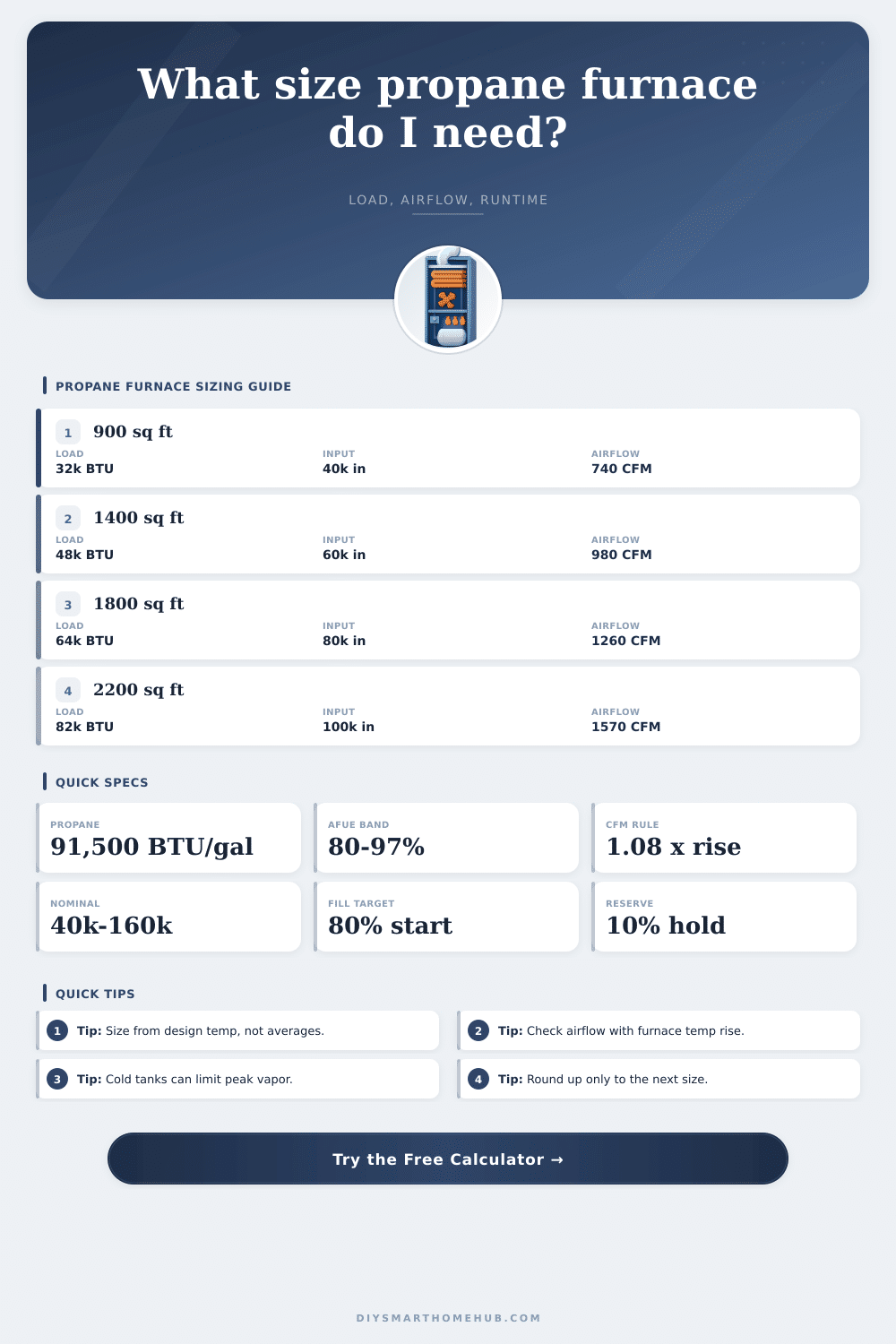
| Tight Addition | 168 sq ft | 8k–12k BTU/h | 40k input | 0.44 gal/h |
| Average Ranch | 1400 sq ft | 42k–52k BTU/h | 60k input | 0.66 gal/h |
| Split Level | 1800 sq ft | 58k–70k BTU/h | 80k input | 0.87 gal/h |
| Whole House | 2200 sq ft | 76k–88k BTU/h | 100k input | 1.09 gal/h |
⛽Propane Runtime Reference
| Supply | Usable Gallons | 60k Input | 80k Input | 100k Input |
|---|---|---|---|---|
| 40 lb Cylinder | 6.6 gal | 10.1 hr | 7.5 hr | 6.0 hr |
| 100 lb Cylinder | 16.5 gal | 25.2 hr | 18.9 hr | 15.1 hr |
| 120 gal Tank | 84.0 gal | 128.1 hr | 96.1 hr | 76.8 hr |
| 250 gal Tank | 175.0 gal | 266.9 hr | 200.1 hr | 160.1 hr |
Tip: Match blower airflow to the chosen temperature rise. If the calculated airflow is well outside the furnace profile band, revisit duct losses or switch to a better AFUE and staging profile.
Tip: Small cylinders can satisfy total gallons yet still miss peak winter vapor demand. Compare design input against cold-weather tank capacity before relying on 40 lb or 100 lb storage.
Selecting a propane furnaces requires you to calculate the heat loss of a home. Furthermore, once you have calculated the heat loss of your homes, you must select a propane furnace with an appropriate capacity for that amount of heat loss. Should the propane furnace be too small for the home, the propane furnace will not be able to provide enough heat to the home to keep the residents warm.
Should the propane furnace be too large for the home, the propane furnace will cycle on and off too often, leading to teh propane furnace wear out too quickly. To calculate the heat load of a homes, you must determine the amount of heat that the home lose each hour. The outdoor temperature outside the home and the insulation levels within the home determine the heat load of the home.
How to Choose the Right Size Propane Furnace
Homes with high levels of insulation will lose less heat than homes that are not as well insulated. For example, a home that use spray foam insulation and has double pane windows will have a lower heat load than an older home that has only single pane windows. Additionally, if air can leak through doors, windows, and electrical outlets in the home, the heat load will be more higher.
Additionally, if the ducts that distribute the heat to the various area of the home are located in the cold attic or crawlspaces of the home, the home can lose 10% to 20% of the heat that is created by the propane furnace before the heat reaches the living areas of the home. One of the factor that will influence the heat load of a home is the design temperature of the home. The design temperature is the difference between the indoor temperature of the home and the outdoor temperature outside of the home.
If the difference between the indoor and outdoor temperature is 60 degrees, the heat loss of the home will be greater than if the difference between those two temperatures is only 40 degrees. A bit of safety is also incorporated into the calculation of the heat load. Adding a percentage of heat loss that are returned as a safety buffer can account for instance where the outdoor temperature drop below the design temperature of the home.
A percentage of 10% is often used as the safety buffer in these calculation. The efficiency of the propane furnace will influence the amount of propane that the furnace consumes to heat the home. The Annual Fuel Utilization Efficiency or AFUE of the furnace represents the efficiency of the propane furnace.
An 80% efficient propane furnace will lose 20% of the heat that is created by the burning of propane in the furnace. However, a 95% efficient condensing propane furnace will lose less heat through the exhaust of the furnace, meaning that more of the heat that is created are distributed into the home. Thus, a higher efficiency propane furnace will consume less propane to heat the same size home as a lower efficiency furnace.
Additionally, another alternative is to purchase a modulating propane furnace. These type of furnaces are able to modulate to the heat load of the home. Another important component of providing heat to a home with propane is the supply of propane.
The supply of propane must be sufficient to supply the propane furnace with propane. A large propane tank will be able to supply a propane furnace with propane for a longer period of time than a small propane cylinder. Additionally, in cold weather, the small propane cylinder may struggle to provide enough propane to supply the propane furnace with the propane that it require to reach operating temperatures.
This is due to the fact that colder temperature will reduce the vaporization of propane in the small propane tank. If too much propane is required to heat the home in cold weather, the propane tank may not have enough vapor margin to supply enough propane to the propane furnace to maintain the temperatures in the home during the coldest period of the winter. One of the most common mistake in installing a propane furnace is to calculate the required capacity of the furnace based off the square footage of the home.
The square footage of the home does not take into account the efficiency of the insulation of the home. For example, a home that has a square footage of 1,400 square feet and proper sealing will lose less heat than a home with 1,400 square feet of space but with poor insulation. Instead, a 1,400 square foot home with good insulation may only require a 48,000 BTU propane furnace, but the same size home with poor insulation may require an 80,000 BTU propane furnace.
Additionally, the height of the ceilings in the home can impact the amount of propane that is required to heat the home to the desired temperatures. Higher ceilings will require more propane to heat the same area as a home with lower ceilings. Finally, to determine the proper size of a propane furnace for a home, you should balance the heat load of the home against the supply of propane and the efficiency of the propane furnace.
The airflow and the temperature rise that is created by the furnace should be checked to ensure that the airflow of the furnace is correct for the size of the ducts that distribute the heat to the home. Additionally, if the propane furnace is sized appropriately for the home, the temperatures in the home will remain even, and the propane furnace will consume an even amount of propane throughout the winter months.