Propane Cubic Feet to Gallons Calculator
Convert propane vapor volume into liquid gallons, BTUs, runtime, and ending tank fill so a measured gas volume can be checked against cylinder size, standby loads, or appliance demand.
📌Preset Scenarios
⚙Calculator Inputs
Converted Fuel Snapshot
Run a calculation to compare vapor volume, liquid gallons, energy content, and how much of the selected tank the withdrawal consumes.
💡Conversion Constants
Standard Vapor
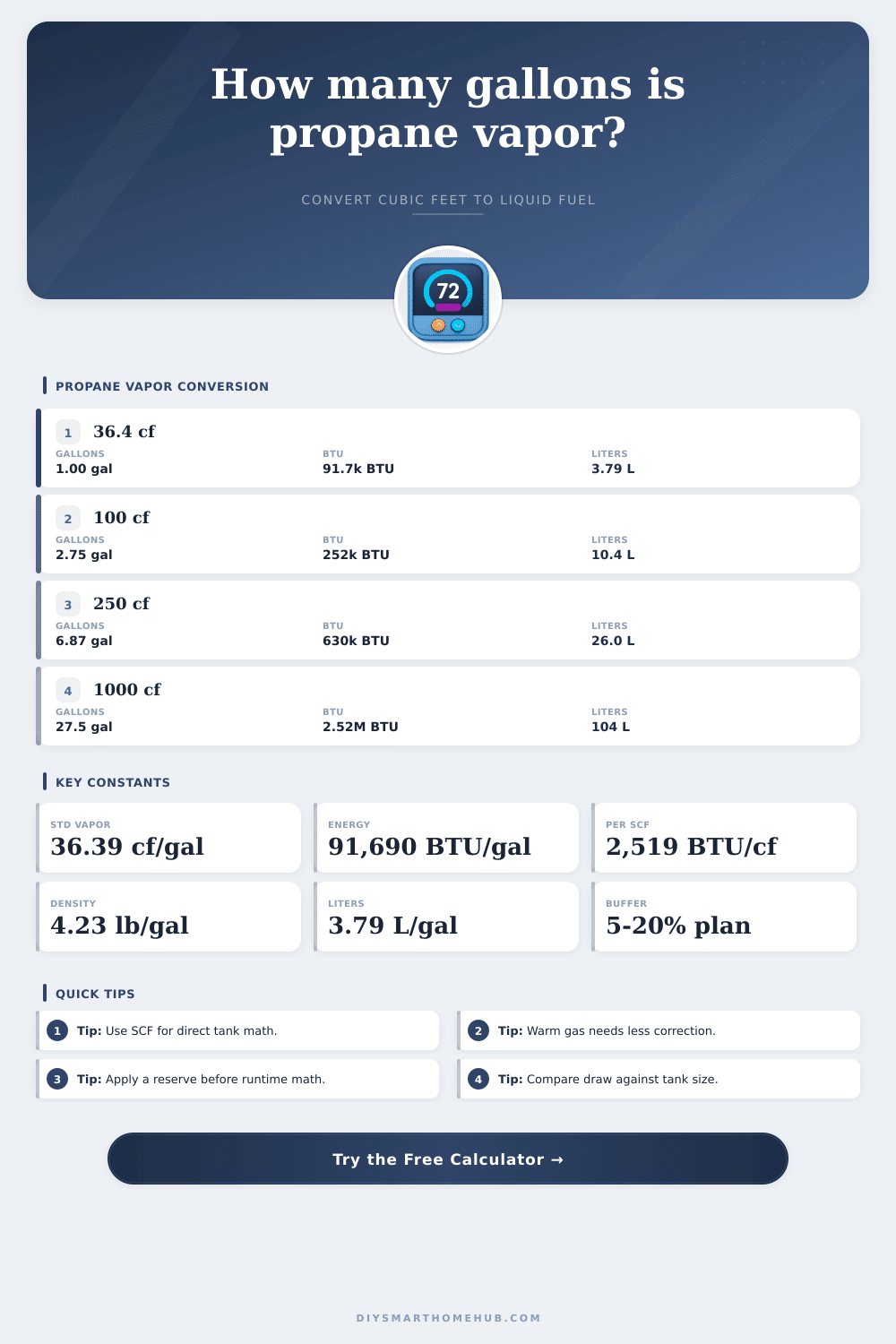
One liquid gallon of propane expands to about 36.39 standard cubic feet at 60°F and atmospheric pressure.
Liquid Energy
The calculator uses the common heating value for liquid propane when converting gallons into total heat content.
Gas Energy
Dividing by the standard vapor factor yields the BTU content for each standard cubic foot of propane vapor.
Density
This converts liquid gallons into propane mass, which is useful when checking cylinder exchange, handling, or fuel weight.
Metric Fuel
Every converted gallon is also shown in liters so cylinder fill and storage planning can be read either way.
Metric Gas
Standard cubic feet are converted to standard cubic meters, which helps align with industrial gas readings and logs.
Tank Reserve
Runtime and draw checks become more realistic when a reserve is held back instead of planning all the way to empty.
Planning Buffer
Applying a small buffer helps measured gas volume stand in for real use cases that include startup, weather, and cycle losses.
📊Quick Conversion Table
These entries use standard cubic feet at 60°F and 14.7 psia, then convert directly into liquid gallons, liters, and heat content.
| Standard cubic feet | Liquid gallons | Liters | BTU content | Typical use |
|---|---|---|---|---|
| 25 SCF | 0.69 gal | 2.6 L | 62,990 BTU | Short grill or cooktop session |
| 100 SCF | 2.75 gal | 10.4 L | 251,963 BTU | One strong patio heater block |
| 250 SCF | 6.87 gal | 26.0 L | 629,907 BTU | Generator exercise window |
| 500 SCF | 13.74 gal | 52.0 L | 1,259,814 BTU | High-demand appliance day |
| 1000 SCF | 27.48 gal | 104.0 L | 2,519,628 BTU | Small tank top-off equivalent |
🛢Tank and Cylinder Equivalents
Liquid capacity below reflects typical usable propane at normal fill rather than total water capacity, which keeps the vapor-to-liquid conversion easier to compare.
| Container | Liquid gallons | Standard cubic feet | BTU content | Best fit |
|---|---|---|---|---|
| 20 lb cylinder | 4.7 gal | 171 SCF | 430,943 BTU | Grills and light portable heat |
| 30 lb cylinder | 7.1 gal | 258 SCF | 650,999 BTU | RV and moderate heater duty |
| 100 lb cylinder | 23.6 gal | 859 SCF | 2,163,884 BTU | Detached shops and backup runs |
| 120 gal ASME | 96 gal | 3,493 SCF | 8,802,240 BTU | Small whole-home support |
| 250 gal ASME | 200 gal | 7,278 SCF | 18,338,000 BTU | Furnace plus water heat |
| 500 gal ASME | 400 gal | 14,556 SCF | 36,676,000 BTU | Longer reserve and colder loads |
🔥Appliance Draw Reference
Gallons per hour and standard cubic feet per hour assume the appliance runs continuously at the listed input rate.
| Appliance | Input rate | Gal per hour | SCF per hour | 20 lb cylinder runtime |
|---|---|---|---|---|
| Grill burner bank | 40,000 BTU/h | 0.44 gal/h | 15.9 SCF/h | 10.8 hours |
| Patio heater | 46,000 BTU/h | 0.50 gal/h | 18.2 SCF/h | 9.4 hours |
| Garage heater | 75,000 BTU/h | 0.82 gal/h | 29.8 SCF/h | 5.7 hours |
| Tankless water heater | 180,000 BTU/h | 1.96 gal/h | 71.4 SCF/h | 2.4 hours |
| Standby generator | 250,000 BTU/h | 2.73 gal/h | 99.2 SCF/h | 1.7 hours |
| Whole-home furnace | 100,000 BTU/h | 1.09 gal/h | 39.7 SCF/h | 4.3 hours |
📋Preset Scenario Snapshot
These examples show how the included presets translate measured or standard vapor volume into liquid gallons and approximate runtime at the preset load.
| Scenario | Input volume | Corrected SCF | Liquid gallons | Runtime basis |
|---|
If the vapor sits above atmospheric pressure, the same physical cubic feet represent more standard cubic feet, so the corrected gallons and BTUs rise quickly.
A conversion that looks small against the whole tank can still push a lightly filled cylinder below the refill point once the planning buffer is added.
Propane exist in both liquid and vapor forms. It is necessary to understand the differnce between liquid propane and vapor propane in order to calculate the usage of propane fuel correct. The volume of propane in the tank exists in a form of vapor propane.
One gallon of liquid propane will expand to 36 cubic feet of vapor propane. Because propane can expand into a vapor form, a small amount of liquid propane can represent a large amount of vapor propane. The unit of standard cubic feet (SCF) are used to maintain consistency in propane measurements.
How Liquid and Vapor Propane Work and How Much You Need
Appliances will display the consumption of propane in standard cubic feet. Standard cubic feet is measured at a constant temperature of 60 degrees Fahrenheit and at sea level. The volume of propane in the tank may change due to fluctuations in temperature and pressure.
Warmth in the gas will make it expand, meaning it will hold fewer molecules of propane within a given space. Higher pressure will force more propane molecule into each cubic foot of space. The measurements of vapor propane will need to be corrected for these factors to determine how much liquid propane is being used.
Appliances will run for a certain amount of time, but the duty cycle of the appliance will determine how long the propane will last. The duty cycle is the percentage of time an appliance run. For instance, if an appliance has a duty cycle of 65 percent, it will be on for 65 percent of the time and off for the remainder of the time.
If the propane is measured while the appliance is on, it is possible to measure an amount of propane that will not last the appliance for it’s duty cycle. The duty cycle will factor into the calculation of the length of time that a propane tank will last. Additionally, there should always be a reserve of propane in the tank for when the appliances is not in use.
This propane reserve will ensure that the propane tank does not run out of propane while using the appliances. The size of the tank impact the amount of propane reserves that is needed. A 500-gallon ASME tank can hold a large amount of propane and is used for appliances that need a large amount of propane over long periods of time, such as home furnaces.
A 20-pound propane cylinder hold much less propane than the ASME tank. A 20-pound portable cylinder will hold only 4.7 gallon of liquid propane. Because there is less propane in a 20-pound propane cylinder, it isnt appropriate for use with appliances with high demand for propane, such as tankless water heaters.
The size of the propane tank will determine what appliances can be fueled by the tank and the amount of propane reserve that is need. Temperature will also have an impact on the propane levels in the tank. In the summer months, the propane will be hotter and expand.
This will make the density of the propane thin. In the winter months, the propane will be colder and contract. This will make the density of the propane thick.
Due to the effect of temperature on the density of propane, the temperature will have an impact on the amount of liquid propane needed to fill the tank to the required level of vapor propane. Additionally, the duty cycle of the appliances will factor into the calculation of the amount of propane that is needed. For instance, if an appliance such as a generator is to operate at full load, more propane will be used to meet the demands of the appliances.
If the load is not factored into the determination of propane needs, there will be an underestimation of the amount of propane that the appliance will use. The calculations can be used to determine the amount of propane needed for different appliances. For instance, if an RV cooktop will be used, the required amount of vapor propane can be planned out for the cooktop taking the time to simmer and boil the water on the cooktop.
If a forklift is to be fuel, the actual volume of propane will need to be monitored at a specific pressure. Finally, if propane is to be used in a greenhouse to heat the plants, the amount of vapor propane can be planned for using frost guards on the plants. Additionally, there should always be a reserve of propane in the greenhouse to ensure that the plants are not exposed to temperatures that could kill them due to a depletion of propane in the propane tank.
In order to calculate the amount of propane needed, it is necessary to match the draw of propane to the different profiles of the appliances. Grills may burn propane at a consistent rate, but a heater may use propane at a faster rate. Tankless water heaters will use propane in short bursts, so the draw of propane for a tankless water heater will be different than a furnace that heats the entire home.
Matching the draw of propane to the profile of the appliances ensures that the amount of propane that is estimated to be used is accurate. Additionally, the amount of propane that is left in the tank should be compared to the 10 and 20 percent reserve of propane. If there is a lack of propane between the calculated amount and the reserve, it is necessary to add propane to the propane tank as soon as possible.
It is necessary to leave room for propane reserve in the propane tank. This propane will ensure safety for the propane tank and the appliances that use propane. A 5 percent reserve will ensure that there is propane should the appliances experience a surge in the amount of propane that is required.
However, a 20 percent reserve will ensure that the propane tank will have enough propane to meet demands in deep cold weather. In deep cold weather, the liquid propane will boil more slow. Should propane be skipped over and no reserve is left in the tank, it is possible that the propane will run out unexpectedly.
Finally, the propane tanks readings will impact the calculations. The gauge pressure of propane that is above atmospheric pressure will result in higher measurements of standard cubic feet after the propane measurements are corrected. The additional pressure will force more liquid propane into each cubic foot of propane.
Thus, the additional pressure that is exert on the propane tank will also increase the number of liquid gallons and the total energy of the propane.