Propane Conversion Calculator
Convert propane between liquid volume, weight, energy content, and appliance runtime so the gallons in a cylinder or tank line up with the backup load you actually need to cover.
📍Preset Conversion Scenarios
Each preset changes the source unit, tank context, appliance draw, daily schedule, and reserve holdback so you can compare common propane planning questions before entering a custom case.
📏Propane Source and Load Inputs
Converted Propane Summary
Choose a source amount and appliance to see conversions, energy content, and planned runtime.
📊Propane Conversion Anchor Grid
📑Reference Tables
Conversion Factors
| Known unit | Equals 1 gal | Energy | Use note |
|---|---|---|---|
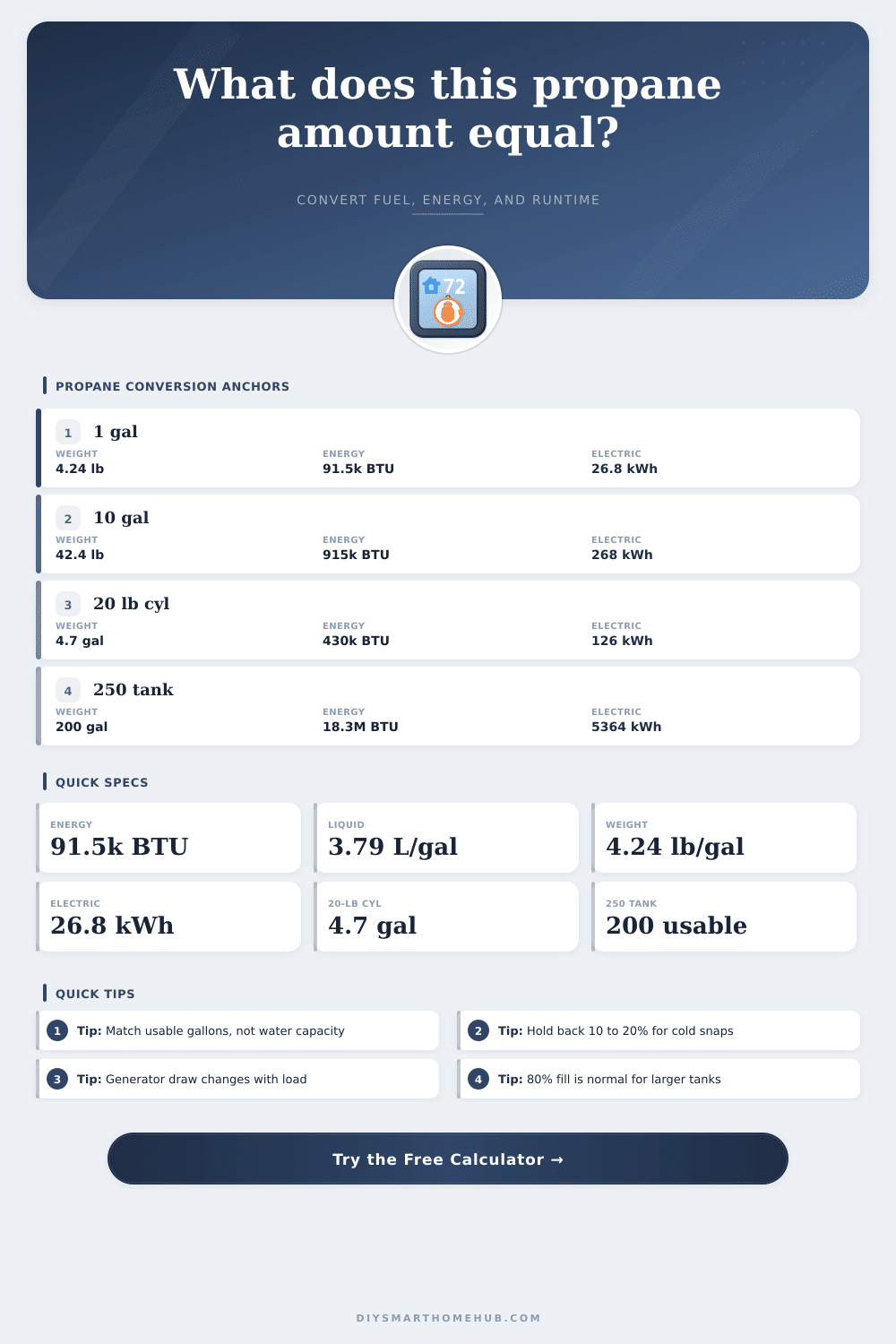
| Gallons | 3.79 L | 91,502 BTU | Best for tank receipts and bulk deliveries |
| Pounds | 4.24 lb | 21,580 BTU per lb | Best for cylinder scale readings |
| Kilograms | 1.92 kg | 47,580 BTU per kg | Useful for metric refill tags |
| kWh equivalent | 26.8 kWh | 3,412 BTU per kWh | Useful when comparing propane to battery energy |
Tank Capacity Guide
| Container | Usable gal | Liters | Typical use |
|---|
Appliance Draw Comparison
| Appliance | Full draw | BTU per hour | 8h burn | Best paired tank |
|---|
Preset Runtime Benchmarks
| Scenario | Known source | Planned gallons | Runtime | Daily autonomy |
|---|
💡Planning Notes
Percent gauges make sense only after you map them to the usable propane volume you treat as full. A 250-gallon tank planning number is usually 200 gallons, not 250 liquid gallons.
Most furnaces, tankless heaters, and generators cycle below maximum input much of the time. The average firing selector helps keep short spikes from overstating daily propane demand.
Propane changes in volume and weight with the change in temperature; hence, it is necessary to understand how propane behave when determining how long propane will last. Propane is a liquid that expands and contracts and has a specific weight that is not the same than the weight of water. Many people makes mistakes with propane tanks by assuming that the propane tank is filled to capacity with propane, whereas the propane will only fill to a certain amount within the tank.
Accounting for the density of propane and the fact that propane will expands will allow people to determine the true volume of propane within the propane tank. Propane tanks will never be filled to the one hundred percent capacity of the tank. Propane will expand with the rise in temperature within the tank.
How Long Will Your Propane Last
People will fill propane tanks to only eighty percent of the tank capacity to allow for the expanding propane to allow for propane to expand and to prevent the creation of too much pressures within the tank. For example, a 250-gallon propane tank will only hold 200 gallon of propane. The remaining 50 gallons are for the expansion of the propane.
By accounting for the expansion of propane in the tank, people will be able to understand how many gallon of propane will be available for use. Appliances will use propane at varyingly rates. For example, a furnace may not be continuously on throughout the house and will cycle on and off to heat the home.
The same can be said for a generator that will require varying amount of propane to operate at varying levels of power. Calculating the average usage of propane for these appliances will allow people to determine the total amount of time that the propane will last. It is also recommended to leave some propane in the tank to account for the propane requirements of the appliances during the colder periods of the year.
One gallon of propane contains 91,500 British thermal unit (BTUs) of energy. This value represents the total energy that propane will release when burned and is important in various comparisons of propane to other form of energy. Using the BTU rating of appliances, you can calculate the volume of propane to determine how many hour the appliance will run.
Additionally, BTUs can also be expressed in kilowatt-hours to compare the energy content of propane to that of an electric battery. Propane is a high energy source for many of its various use. There are various size and types of propane containers.
Small propane tanks are used for appliances that must be mobile, such as a grill. Large propane tanks are used for heating of entire home or to run a generator. A 20-pound propane tank will contain a different amount of propane than a 250-gallon tank.
Each propane container will have its own conversion to determine the total amount of propane that the container will contain. For instance, a 20-pound propane tank will contain approximately 4.7 gallons of propane since propane weigh 4.24 pounds per gallon. Many people make error when calculating the length of time that their propane will last.
People often do not account for the impact that cold weather will have on propane. When the weather is colder, the propane within the tanks will contract. Additionally, the drop in temperature will also lead to the propane tanks pressure dropping.
When the propane pressure in the tank drops, the appliances that are connect to the tank will not function as they should. It is important for individuals to account for the potential of cold weather and account for this in the calculation of how much propane they need to survive the winter storm. Additionally, people need to consider the burn rate of their propane appliance.
Finally, there are various conversion tools that will make it more easier for people to calculate the length of time that their propane will last. These tools will allow for the size of the propane tank and the propane gauge of the tank to be entered to determine the usable gallons of propane in the tank. Additionally, the BTU ratings of the appliances can also be entered into these tools to determine the length of time that the propane will last.
By using these type of calculations, the propane gauge can be changed from a relative number into a specific unit of time that the propane will last.