Propane Burn Time Calculator
Estimate how long a propane cylinder or bulk tank can support a heating zone, how fast fuel is consumed, and whether cold-weather vapor delivery keeps up with the burner.
📌Quick Presets
⚙Burn Time Inputs
Burn Time Summary
Choose a preset or enter your zone details to estimate runtime, fuel draw, and cold-weather vapor headroom.
📊Appliance and Supply Spec Grid
Condensing Furnace
Best for whole-home heating where long burn time matters and lower propane draw helps stretch tank runtime.
Standard Furnace
Typical retrofit benchmark with higher input demand than condensing systems for the same delivered heat.
Unit Heater
Fast recovery for workshops and bays, but short cycling and door openings can raise real propane use.
Hydronic Zone
Even comfort and reduced air movement often lower average duty cycle compared with forced-air spot heating.
20 lb Bottle
Portable supply for patio and emergency room heaters, but cold weather sharply limits vapor delivery.
100 lb Bottle
Common backup supply for cabins, sheds, and greenhouses where longer runtime is needed without a bulk tank.
Mid-Size Tank
Good fit for detached structures or seasonal zones that need better vapor stability than portable cylinders.
Whole-Home Tank
The safest runtime choice for high continuous loads, deep cold snaps, and multi-zone backup planning.
📑Burn Rate Reference Table
| Burner Input | Gallons Per Hour | Pounds Per Hour | 20 lb Runtime at 70% |
|---|---|---|---|
| 10,000 BTU/h | 0.11 gal/h | 0.46 lb/h | 30 hours |
| 20,000 BTU/h | 0.22 gal/h | 0.93 lb/h | 15 hours |
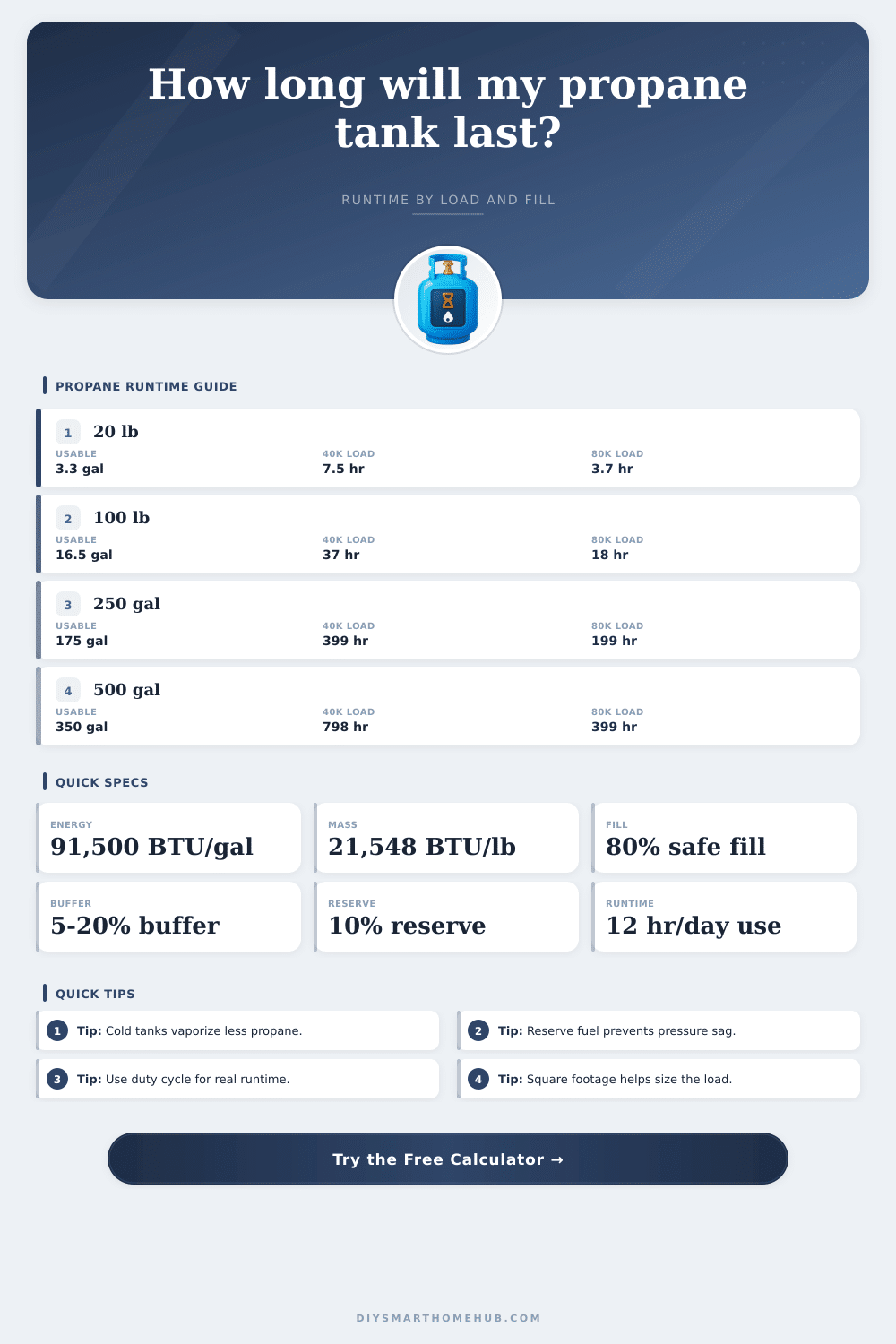
| 40,000 BTU/h | 0.44 gal/h | 1.86 lb/h | 7.5 hours |
| 80,000 BTU/h | 0.87 gal/h | 3.71 lb/h | 3.7 hours |
Runtime examples assume a 20 lb cylinder with 70% usable fuel after reserve. Actual hours drop faster when ambient temperature lowers cylinder vaporization rate.
🌡Cold Weather Vapor Capacity Table
| Supply Size | 60°F | 32°F | 0°F | -20°F |
|---|---|---|---|---|
| 20 lb Cylinder | 72k BTU/h | 42k BTU/h | 18k BTU/h | 8k BTU/h |
| 100 lb Cylinder | 215k BTU/h | 122k BTU/h | 55k BTU/h | 28k BTU/h |
| 250 gal Tank | 580k BTU/h | 360k BTU/h | 170k BTU/h | 95k BTU/h |
| 500 gal Tank | 940k BTU/h | 610k BTU/h | 300k BTU/h | 170k BTU/h |
Approximate vaporization values assume one tank and no manifolded cylinders. Higher fill levels help, while wind and frost reduce actual delivery.
📝Heating Profile Comparison Table
| Use Case | Seasonal Efficiency | Load Intensity | Best Runtime Use |
|---|---|---|---|
| Patio Heater | 99% | Very High | Short outdoor bursts |
| RV Furnace | 78% | Medium | Portable overnight heat |
| Direct Vent Room Heater | 82% | Medium | One room backup heat |
| Condensing Furnace | 95% | Balanced | Whole-home runtime |
| Garage Unit Heater | 80% | High | Fast warm-up zones |
| Hydronic Radiant Zone | 90% | Low | Steady comfort hold |
🏠Common Runtime Scenarios Table
| Scenario | Area | Typical Load | 100 lb Runtime |
|---|---|---|---|
| Bedroom Backup | 168 sq ft | 11k BTU/h | 128 hours |
| Sunroom Evening | 288 sq ft | 19k BTU/h | 74 hours |
| Garage Bay | 480 sq ft | 34k BTU/h | 41 hours |
| Workshop Weekend | 864 sq ft | 56k BTU/h | 25 hours |
Reserve matters twice: it preserves regulator stability and also leaves margin for a colder-than-planned night when duty cycle rises above your average assumption.
If runtime looks generous but the vapor status is tight, your tank still may not feed the burner during deep cold. Move up in cylinder count or tank size.
Propane is an fuel that provides heat. Propane is a fuel that can be used for heating in many different environments. There are a few different factors that you must consider when you plan for propane usage.
The first is how propane vaporize. Unlike liquid gasoline, propane vaporizes from the bottom of the propane tank to the burner. If the temperature of the environment drop, the propane within the tank will vaporize at a slower rate.
How to Plan for Propane Use
This slower rate of vaporization mean that there is less pressure available to the burner. Small propane cylinders may provide enough propane to heat a patio heater for a mild night outside, but the small propane cylinder may not provide enough vapor to heat that same propane heater during a deep freeze. The large bulk propane tanks has more surface area than small propane tanks, so they will boil off more propane even at zero degrees outside.
The second factor to consider is the heating load of the space that must be heated. The size of the space, the temperature within that space, and the insulation of that space determine the heating load of a space. For example, a garage with high ceilings and doors that tend to leak the air within that garage will have a more high heating load than a garage with low ceilings and tight doors.
Using insulation within a structure will reduce the heating load that must be provided by an appliance. The shape of the space to be heated also plays a role in the heating load of that space. A person can calculate the heating load of a space so that a person can purchase the correct size propane tank and the correct type of appliance.
The third factor is the efficiency of the appliance. Appliances, such as patio heaters, are highly efficient at providing radiant heat to those within the beam of those heaters. However, the patio heater will use a large amount of propane if the heater is set to a high setting.
Condensing furnaces are some of the most efficient appliances because they extract heat from the exhaust gases of the furnace. Appliances that are more efficient will use less propane to heat a space to a given temperature. Additionally, the runtime of propane appliance will be longer with an appliance that has a higher efficiency rating.
The fourth factor to consider is the duty cycle of the appliance. The duty cycle is the percentage of time that the appliance will be running. If an appliance has a duty cycle of 55 percent, the appliance will only run 55 percent of the time.
Therefore, the propane will last longer with that appliance than one with a 100 percent duty cycle. The fifth factor is the size and type of propane tank that will be used. A 20-pound propane cylinder can hold 4.7 gallons of propane.
However, a 20-pound propane tank may not vaporize effective in cold weather. A 100-pound propane tank can hold more propane than a 20-pound tank, so it will be better for heating a 1000 sq. Ft. Workshop.
A 500 gallon bulk tank can hold the most amount of propane of the propane tanks mentioned. Additionally, the 500 gallon bulk tank can deliver 300,000 BTUs per hour, even in deep cold weather. A propane tank that is filled to 80 percent of its capacity will contain more propane than a propane tank that is filled to only 50 percent of its capacity.
However, it is recommended to always leave some propane in a tank, to allow for the propane system to maintain even pressure within its system and to prevent it from icing up. To plan for propane usage, determine how many hours per day that the space will be heated. Heating a space for 12 hours per day will use less propane than heating that same space for 24 hours per day.
The temperature that is set on the thermostat will impact the amount of propane that the propane appliance will consume. The higher the temperature setting, the more propane will be used to reach that higher temperature. If there is air leakage in the space that is being heated, more propane will be required to heat that space.
Air leakage causes heat to leave the space, and cold air to enter that space. Finally, you should consider the temperature of the local winter climate when estimating the amount of propane that will be used. Using the low temperatures of the winter climate will determine the heating load for the propane appliance, since that is the extreme in which the appliance will be required to function.
Many people make mistake when estimating the runtime of their propane appliances. One mistake is to use the maximum BTU rating of the appliances to calculate the runtime of that appliance. However, people often forget that the vaporization of propane limits the amount of heat that the appliance will provide in colder climates.
People also tend to make the mistake of forgetting to account for the reserve of propane that should be left in the tank. This mistake causes the pressure of the propane to drop, especially during a storm. Finally, many people do not account for the duty cycle of the appliance.
People often assume that the appliance will be running continuously, when in fact the duty cycle of that appliance indicates that it will not be running continuously. In order to properly plan for propane usage, you should of avoided these mistakes by calculating the heating load of the space to be heated, purchasing an efficient appliance, and purchasing a propane tank of the appropriate size to meet the needs of the space to be heated.