Watts Amps Volts Calculator
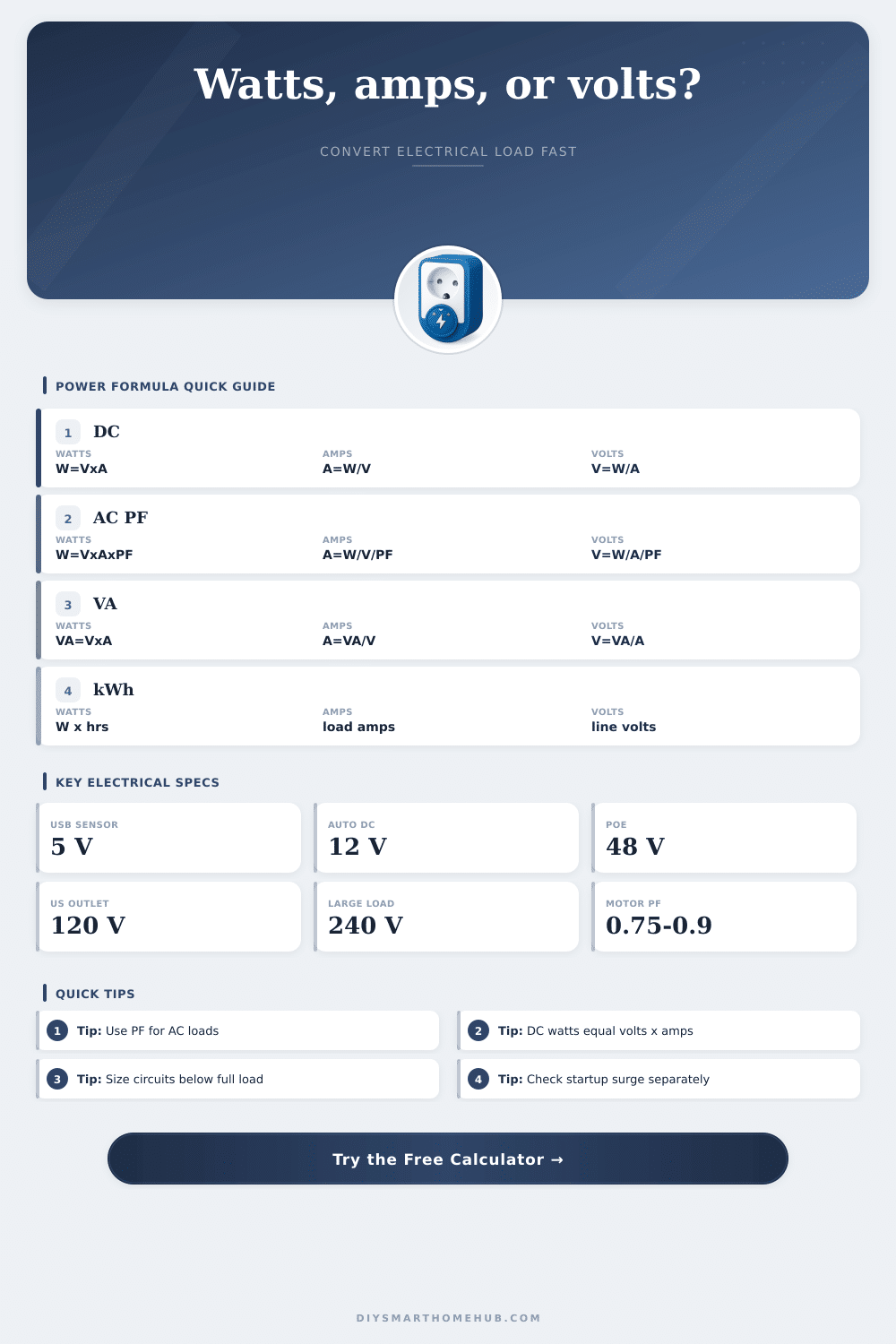
Convert between watts, amps, volts, VA, kWh, and power factor for DC, AC, and single-phase home loads with device-based presets.
1.Real Load Presets
2.Electrical Inputs
Calculation Breakdown
3.Device Spec Comparison
4.Formula Reference Table
| Use case | Watts formula | Amps formula | Voltage formula |
|---|---|---|---|
| DC load | W = V x A | A = W / V | V = W / A |
| AC single-phase real watts | W = V x A x PF | A = W / (V x PF) | V = W / (A x PF) |
| AC apparent power | VA = V x A | A = VA / V | V = VA / A |
| Daily energy | kWh = W x h / 1000 | Ah = A x h | Use same line volts |
5.Common Device Load Data
| Device | Typical watts | Voltage | Current estimate |
|---|---|---|---|
| USB smart sensor hub | 3 to 8 W | 5 V DC | 0.6 to 1.6 A |
| WiFi router or mesh node | 8 to 18 W | 12 V DC | 0.7 to 1.5 A |
| PoE security camera | 6 to 14 W | 48 V DC | 0.13 to 0.29 A |
| 12V LED strip, 5 m | 24 to 72 W | 12 V DC | 2 to 6 A |
| Home NAS, 2 to 4 bay | 25 to 70 W | 120 V AC | 0.25 to 0.75 A at PF 0.8 |
| Mini-split running load | 500 to 1800 W | 240 V AC | 2.6 to 10 A at PF 0.75 |
| EV charger branch load | 5760 to 9600 W | 240 V AC | 24 to 40 A |
| Baseboard heater | 1000 to 5000 W | 240 V AC | 4.2 to 20.8 A |
6.Voltage And Circuit Comparison
| Nominal voltage | Where it appears | 1 amp equals | Planning note |
|---|---|---|---|
| 5 V DC | USB adapters and small hubs | 5 W | Voltage drop matters on long low-voltage cable. |
| 12 V DC | LED strips, alarms, small battery systems | 12 W | Higher current means thicker wire for longer runs. |
| 24 V DC | Long LED runs, controls, actuators | 24 W | Half the current of 12V at the same watts. |
| 48 V DC | PoE switches, cameras, access points | 48 W | PoE standards also include port power limits. |
| 120 V AC | Standard US receptacles | 120 VA | Real watts depend on PF for non-resistive loads. |
| 240 V AC | EVSE, heaters, pumps, HVAC | 240 VA | Same watts use half the current of 120V. |
7.Power Factor And Surge Table
| Load type | Typical PF | Surge range | Calculator treatment |
|---|---|---|---|
| Pure DC load | 1.00 model | 1.0x to 1.2x | Uses W = V x A without PF loss. |
| Resistive heater | 0.98 to 1.00 | 1.0x | AC resistive mode forces PF to 1.00. |
| Power adapter or SMPS | 0.55 to 0.95 | 1.1x to 1.8x | PF changes line amps, not DC output watts. |
| Induction motor | 0.60 to 0.85 | 3x to 6x | Startup current is shown as a separate estimate. |
| Inverter compressor | 0.75 to 0.95 | 1.5x to 3x | Smoother than across-the-line motor starts. |
8.Scenario Comparison Grid
| Scenario | Input values | Formula result | Use it for |
|---|---|---|---|
| 5V sensor | 5 V x 0.9 A | 4.5 W | USB adapter sizing |
| 12V LED strip | 60 W / 12 V | 5 A | DC driver and wire planning |
| PoE camera | 11 W / 48 V | 0.23 A | Port power estimate |
| NAS AC load | 55 W / 120 V / 0.82 PF | 0.56 A | UPS and circuit loading |
| Mini-split | 1150 W / 240 V / 0.78 PF | 6.14 A | Running current model |
| EVSE | 240 V x 32 A | 7680 W | Continuous branch load |
Electricity travels through wires in your home, yet it is the power of electricity that allow your devices to function. Devices will have number associated with them, such as volts, amps, and watts. Volts represent the electrical pressure that are used to push the electricity through a circuit.
Amps represent the amount of electricity flowing through the wires. Watts represent the work that the device can performs using the electricity. Each of these values is related to the others through mathematical equation, so if one of the values change, the other two will have to change as well.
How Volts, Amps, and Watts Work
For instance, if the voltage changes, the amperage and wattage will have to change. The amps will help to indicate how much heat the wires will create and what the capacity will be of a circuit. Another measurement of electricity is the power factor, which impact the amount of current that a device uses if it is using alternating current.
Devices such as motors and compressors does not use electricity with perfect efficiency. As a result, these devices have a power factor that is less than one. The power factor will show the portion of the current that is performing work with the device versus the portion of the current that are not.
For instance, a motor might have a running wattage of 600 watts and run at 120 volts, which would mean that it use around five amps of current. However, because the motor has a power factor that is less than one, it could pull more than five amps from electrical line. An individual can use a calculator to account for the power factor of a device.
To calculate the amount of energy that a device uses each day, you can use the watts that the device uses while it is on. The watts are multiplied by the number of hours that the device is used during a day, and then you divide the resulting number by one thousand to determine the energy in kilowatt-hours. This number represent the effect of the device upon the monthly electricity bill for the household.
Additionally, this figure can be used to determine if the battery or generator in a home can provide enough power for the device. In Direct Current (DC) systems, the voltage that the device uses is also considered in the calculation. For instance, a device that use a specific wattage at twelve volts will draw twice as much current as a device that use the same wattage at twenty-four volts.
The amount of current that a device uses impact the thickness of the wire for that device and the amount of voltage drop that will occur in the system. In addition to the measurements that can be understood from the devices in a home, there are other factor to consider for the circuits in the home. One factor to consider is the headroom and startup surge for a circuit.
Devices should not be loaded to the circuit to its full rating. Twenty-five percent can be added to the calculated amount of current that a device will use. This provides a more accurate idea of the electricity that will pass through the breaker and wires.
Additionally, there are startup surges for devices that use motors and compressors. Motors and compressors use three to six times the current that they use while they are run. A calculator can help with determining the startup surges for each device.
The different devices in a home have electrical requirement that are different than other devices. For instance, a 240-volt baseboard heater can provide many watts at a lower current than devices that provide the same amount of heat at 120 volts. Electric vehicle (EV) chargers use 240 volts because the increased voltage allow for a lower current to provide the same amount of wattage.
Additionally, lower voltages for current mean that the wires can be thinner. Low voltages in DC systems, such as for LED lights, use 12 or 24 volts because they are safe to touch. Low voltages, however, requires more current for the same wattage.
Additionally, voltage drop is more noticeable in low voltage over longer distances. You can avoid this by utilizing thicker wires or higher voltage in the system. Finally, even though all of the numbers on the devices are a starting point for those calculations, there are additional factor to consider when applying these numbers.
For instance, the numbers may show the wattage of a given device, but the device could create an overload of the circuit. A calculator can help an individual to understand the relationship between the current, voltage, and watts of a device. Once an individual understands the relationship between these factors, an individual can make better decision regarding which devices should be powered by what circuit and breaker.
Its important to know how much power you’re using so you dont trip a breaker. You should of checked your electrical panel too.