Portable AC Power Consumption Calculator
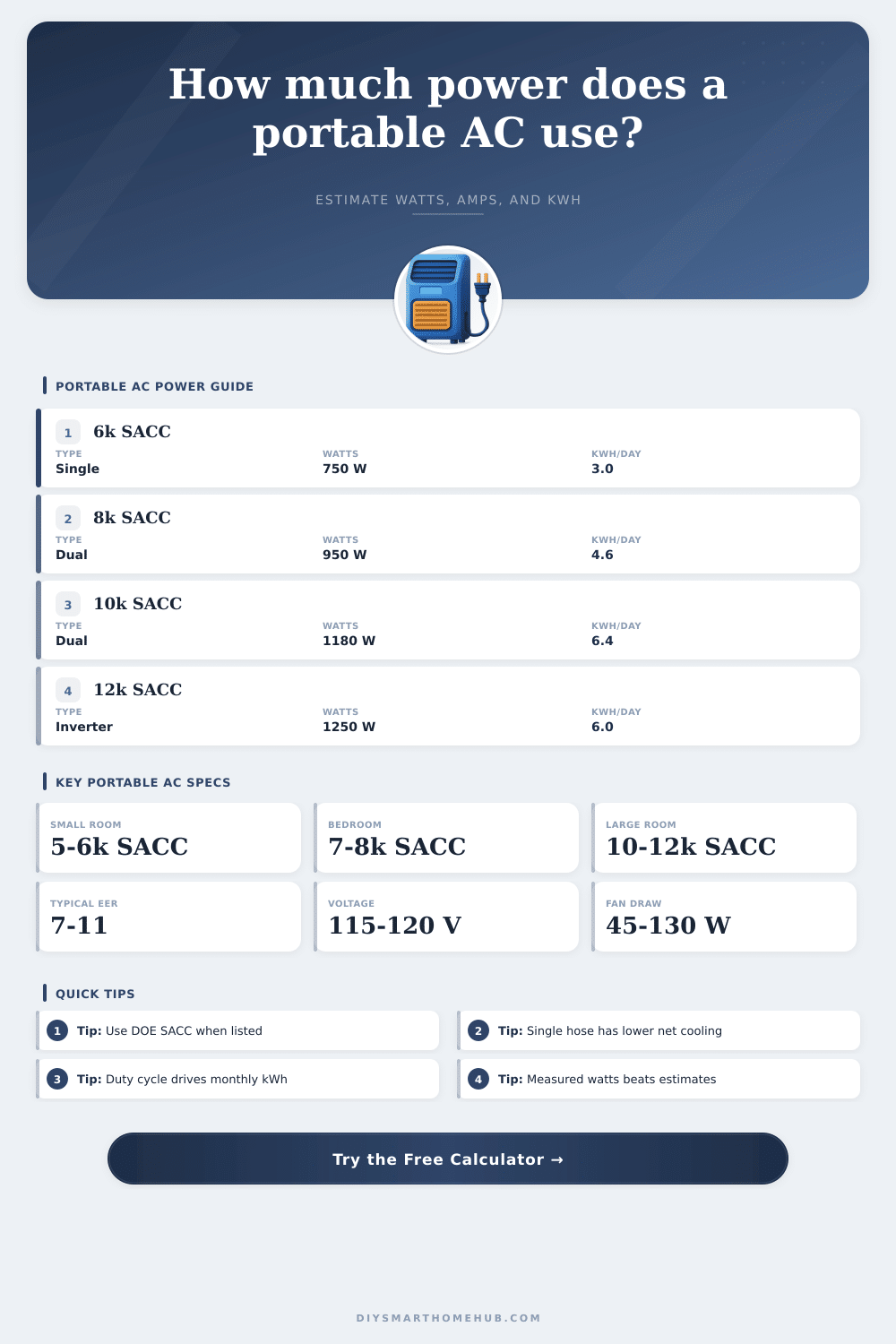
Estimate portable air conditioner running watts, daily kWh, monthly kWh, circuit amps, and usable cooling from DOE SACC, ASHRAE capacity, EER, measured watts, hose type, and runtime.
Portable AC Power Results
| Portable AC rating | Common DOE SACC range | Typical input watts | Room use case |
|---|---|---|---|
| 8,000 ASHRAE single hose | 5,000 to 5,500 BTU/h | 650 to 850 W | Small bedroom or office |
| 10,000 ASHRAE single hose | 6,000 to 7,000 BTU/h | 750 to 1,000 W | Bedroom or dorm room |
| 12,000 ASHRAE dual hose | 8,000 to 9,000 BTU/h | 850 to 1,150 W | Studio or medium room |
| 14,000 ASHRAE dual hose | 9,500 to 11,000 BTU/h | 1,100 to 1,450 W | Large room or open zone |
| 12,000 SACC inverter | 11,000 to 12,000 BTU/h | 900 to 1,350 W | Large room with modulation |
| Operating pattern | Cooling hours | Duty cycle | Best calculator input |
|---|---|---|---|
| Mild evening room | 4 to 6 h/day | 30% to 45% | Lower cooling hours and duty cycle |
| Normal bedroom | 7 to 10 h/day | 45% to 65% | Use overnight hours and moderate duty |
| Sunny apartment | 8 to 12 h/day | 65% to 85% | Increase duty for solar gain |
| Hot loft or garage | 8 to 14 h/day | 80% to 100% | Use full-load check if it never cycles |
| Inverter portable AC | 8 to 16 h/day | 35% to 70% | Use measured watts if available |
| Efficiency value | 6,000 SACC watts | 8,000 SACC watts | 10,000 SACC watts |
|---|---|---|---|
| EER or CEER 7.5 | 800 W | 1,067 W | 1,333 W |
| EER or CEER 8.5 | 706 W | 941 W | 1,176 W |
| EER or CEER 9.5 | 632 W | 842 W | 1,053 W |
| EER or CEER 10.5 | 571 W | 762 W | 952 W |
| Example portable AC scenario | Inputs used | Daily kWh | Monthly kWh |
|---|---|---|---|
| 5,000 SACC bedroom | 650 W, 6 h, 45% | 1.84 | 55 |
| 8,000 SACC office | EER 8.8, 8 h, 55% | 4.08 | 122 |
| 10,000 SACC living room | EER 8.5, 9 h, 65% | 7.05 | 212 |
| 12,000 SACC inverter | 1250 W, 10 h, 45% | 5.84 | 175 |
Portable air conditioners are cooling machine that many people buy because they dont require permanent installation and because they can fit into small corners in you’re home. However, portable air conditioners use a large amounts of electricity. The amount of electricity that a portable air conditioner use depends on the environment of the room that it is cooling and on how often that device’s compressor has to turn on to continue cooling the room.
In order to purchase the correct amount of cooling power for your room, you must understand the difference between the different BTU ratings for portable air conditioners. Most portable air conditioner model contain both an ASHRAE BTU rating and a SACC BTU rating. The ASHRAE BTU unit is a measurement of how many BTU units the portable air conditioner will dispense in a laboratory environment that does not leak air and that does not permit warm air to enter the room while the portable air conditioner is operating.
How Portable Air Conditioners Use Electricity
The SACC BTU unit is a measurement of the cooling power that the portable air conditioner will provide in a real room to which warm air may enter. If you purchase a portable air conditioner that is determined only by its ASHRAE BTU rating, the portable air conditioner might have insufficient cooling power for your room; such a portable air conditioner will require the compressor to run almost constant. The two major component of a portable air conditioner are the compressor and the fan.
The fan will run most of the time, but the compressor will only turn on when the temperature of the room exceed the target temperature that the portable air conditioner’s unit intends to cool. The measurement of how often the compressor for a portable air conditioner run is referred to as the duty cycle. This cycle is essential in determining the electrical cost of the portable air conditioner.
The electrical cost will be higher for a portable air conditioner that has a high duty cycle, such as models that are intended to operate in rooms that have many windows and no curtains. Conversely, portable air conditioners that are installed in well insulated rooms will have a low duty cycle. The design of the portable air conditioner will affect the amount of electricity that it uses.
Single hose portable air conditioners are common, but they tend to create a vacuum effect that pulls warm air into the room from other parts of the house. Dual hose models are more efficienter at removing heat from the room and because they pull outside air into the portable air conditioner. Inverter technology allows portable air conditioners to save money on electricity because these models allow the compressor to slowly reduce the amount of cooling output to the room, instead of turning the compressor on and off.
You must ensure that you dont place the electrical load of a portable air conditioner onto power strip or old extension cords. The high electrical load of portable air conditioners can cause breakers to trip or electrical plugs to melt. To determine whether a portable air conditioner can be plugged into your circuit, you must know the running current of the device.
Most electrical circuits has a maximum amount of current that can travel through them. A portable air conditioner that is running at full capacity can reach the maximum current level of the circuit. In order to calculate the cost of a portable air conditioner, you need to plan for contingencies.
One contingency is the planning buffer for hot weather. You may want to allow for some additional time in the calculations for portable air conditioners to cool rooms when the weather is particularly hot for that portion of the country during the summer season. It is better to overestimate the amount of electricity that the portable air conditioner will use by ten percent, rather than discover to your surprise that your electrical bill has become unusually high.
You may also forget to calculate the amount of electricity that the fan will use. Even though the fan does not use as much electricity as the compressor, the fan will still use a significant amount of electricity over the summer. In order to calculate the exact amount of electricity that is used by a portable air conditioner, you can use a plug-in watt meter.
This device will show you how much power the portable air conditioner is using at any given time. Furthermore, a plug-in watt meter will also capture the power surge that occurs when the compressor of the portable air conditioner starts to run. Using a plug-in watt meter will allow you to remove the guesswork of estimating the power that the portable air conditioner is using.
By understanding the SACC rating, the hose design, and the duty cycle of a portable air conditioner, you can manage the cost of the electrical power that your portable air conditioner will use during summer season.