Pool Heat Pump Calculator
Estimate pool volume, heat-up energy, daily heat loss, runtime, and recommended heat pump size by combining pool shape, average depth, weather, cover type, and the selected heat pump family.
📌Preset Pools
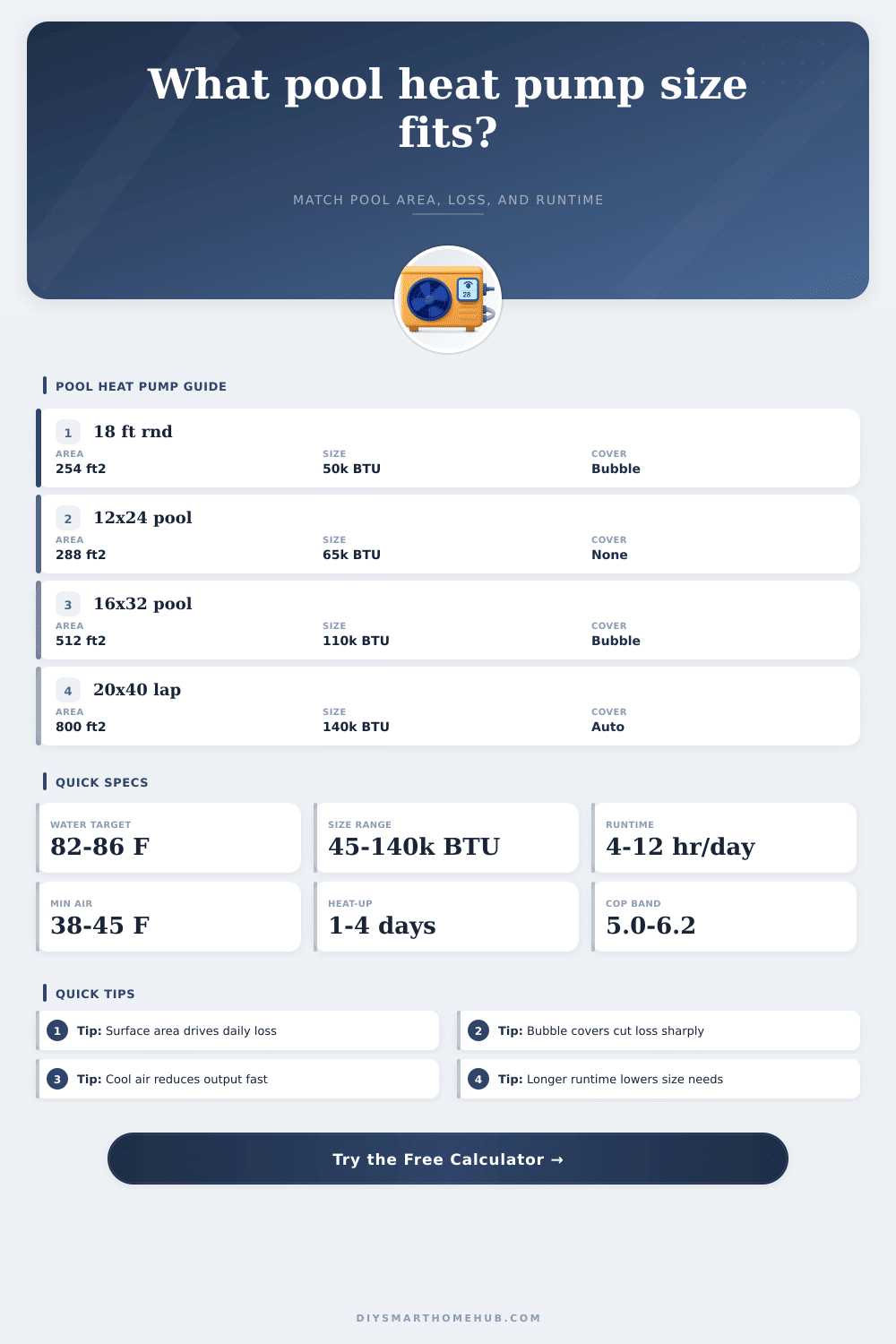
Loaded preset: 18 ft Round Above-Ground with a bubble cover, mild daytime air, and a compact 50k BTU heat pump profile.
⚙Pool and Weather Inputs
🔥Pool Heating Results
📊Heat Pump Family Snapshot
📑Reference Tables
| Family | Rated BTU/hr | Best Area | Min Air |
|---|
| Cover | Loss Cut | Solar Gain | Use Case |
|---|
🏊Pool Benchmarks
| Scenario | Area | Volume | Typical Size |
|---|
💡Sizing Notes
Surface area matters more than gallons for holding heat
Two pools with similar gallons can need very different heater sizes when one has a wider surface exposed to cool night air and wind. Covers usually beat extra BTU in daily hold efficiency.
Runtime is part of the sizing equation
A smaller unit can maintain temperature if it has enough run hours, but quick spring warm-up or short daily schedules push the answer toward a larger nominal BTU class.
A pool heat pump are common heating solution that helps to extend the swimming season. It uses electricity to circulate refrigerant through the unit and extract heat from the air. The heat pump do that by means of thermodynamics: it evaporates and re-compresses the refrigerant.
Here it likes an reversed air conditioner. About it you can think like that, that a heat pump is like a bike, during a gas heater like a strong car. A gas heater heat pool more quickly, but it costs a lot of energy.
How Pool Heat Pumps Work and How to Choose One
Rather, a heat pump give stable heat after reach the wanted temperature, with much less of cost.
Have several types, for instance single-speed and inverter pool heat pumps. The inverter technology, as in the AquaCal TropiCal, mean to the unit adjust its power for keep the ideal pool temperature, while it at least uses energy and do little of noise. Titanium pool heat pumps operate for heating and cooling.
Some models well work even in -4°F (-20°C). They answer for pools, warm baths and cold plunges. A heat pump are very energy saving, because it moves heat from the air instead of produce it. That results in lower bills for energy.
For good result size must be right. If the pump too small, it suffices in sunny day, but fail evening. Simple rule: share the pool volume in gallons by means of 2500 for find the involved kW.
For instance, a 25,000-gallon pool requires at least 10 kW heat pump. Some models raise the temperature in around 0.75 degree by means of hour. Others reach one degree each hour.
When outside air is between 65°F and 85°F, easily move heat in pool in around 82 degrees. Perfectly, if professional store installs, wires and take care the pump. In calm climates commonly the inverter model of known factory gives the best mix of efficiency, quiet and support.